
Software companies added AI features over the last two years. Many folded them into the price customers already pay. A new survey shows what happened next. Usage ran ahead of plan, and the cost landed on the seller. This is a Field Note on what two tables in that survey say when you read them together.
The short version
- KeyBanc is an investment bank that surveys private software companies every year.
- Jason Lemkin, who runs the software community SaaStr, wrote up this year's results. Almost half the companies are over their AI budget. The main reason is more usage than planned.
- In the same survey, most companies include AI in their normal price. Very few charge by usage.
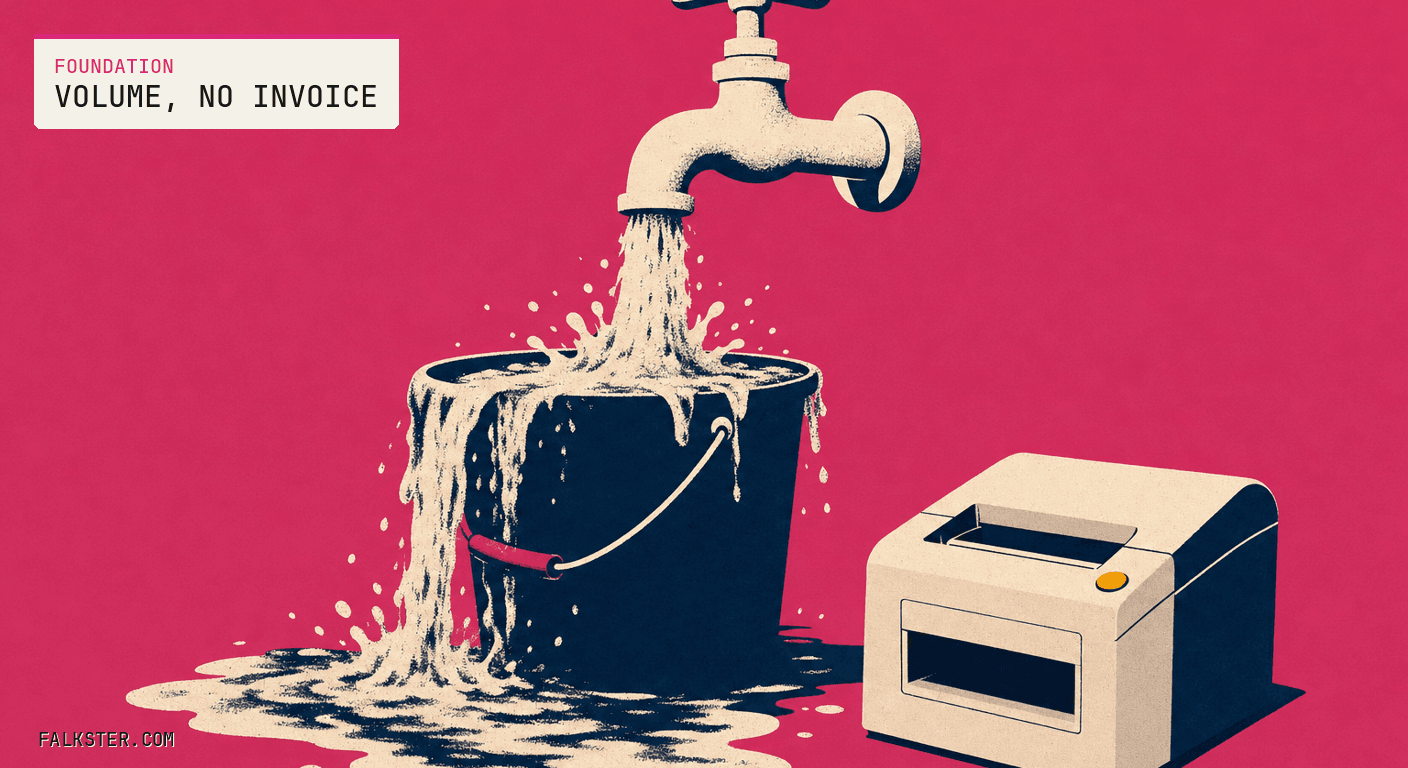
- So when customers use more AI, the seller's costs go up and its revenue stays flat. I call that volume with no invoice.
- The fix starts with one row for each AI feature: how much it was used, what it cost, and what the customer paid for it.
What the survey says
Lemkin published his write-up on November 19, 2026. I read it in full. I did not open KeyBanc's own report, so every number here is as he gives it.
The survey ran from July through September. 81 companies took part. Most are small to mid-sized, with a middle company at $22 million in yearly subscription revenue. Lemkin warns that the sample is small and some answers rest on a handful of companies.
Two of his tables matter for this note. Start with the budget. Look at how few landed under.
| AI spend this year against budget | Companies |
|---|---|
| More than 20% over | 16 |
| Up to 20% over | 14 |
| About in line | 34 |
| Under | 4 |
That is 30 of 68 over, and 4 under.
30 of 68
Of the 33 companies that explained the overrun, 25 gave the same reason: more AI usage than they expected. The price of each use was not the cause. For 47 of 67 companies, that price stayed flat.
Now the second table, on how they charge for AI. Look at the last two rows.
| How AI is priced | Companies |
|---|---|
| Included in the normal price | 31 |
| Sold as an add-on | 16 |
| A mix | 12 |
| Charged by usage | 4 |
| Charged by result | 1 |
Only 5 of 69 have a price that moves when usage moves.
Read the two tables together
Here is the simple version. A company includes AI in a flat price. Customers like it and use it more. The company's bill from its AI provider grows. The customer's bill does not.
More usage is supposed to be good news. With this setup, the seller pays for it.
One caveat, and it matters. The survey does not say that the 30 over-budget companies are the same ones that include AI in the price. I'm putting two tables next to each other. It is the first cut I would ask KeyBanc for.
A second caveat. The write-up does not split the spend between AI inside the product and AI tools the staff uses. Two things point to the product side. 16 of the 33 companies named more adoption of their own AI features. And the gap below shows up in gross margin, where tools for staff do not usually count.
There is a hint in the margins. Gross margin is the share of each sales dollar left after the direct cost of delivering the product. Companies that spend more than 5% of revenue on AI kept 66 cents of each dollar. Companies that spend under 2% kept 78. The heavy spenders also grew more slowly, at 17% against 24%.
Lemkin flags that the heavy group is only 4 to 7 companies. So read it as a hint.
Why a dip is fine and a leak is not
I have written about a pricing change from the seller's side, in Field Report: What Broke When We Killed Our Per-Seat Tier and the posts around it. That case is a blend of real ones I led or advised on, with the numbers changed. So take the shape and not the digits.
The shape was this. Margin started at 80%. It fell to around 60% as AI costs came in. Then it climbed back to 71% as more of the revenue was tied to results.
Two things made that dip safe. It was sized ahead of time, and the board saw the curve every quarter. And revenue moved with usage, so each extra unit of work brought money with it. I made the same point about a public company in ServiceNow Fell 27% on a 70.5% Gross Margin. Name the Trough and the Month..
A flat price with AI inside has neither. Nobody set the low point ahead of time. And extra usage brings no money. That is a leak, and it grows with your best customers.
What I'd do with it
Lemkin reports one more split. Companies that charge for AI grew 27% last year. Companies that don't charge separately grew 17%. He is careful to say some of that is selection: a company with AI good enough to charge for likely had a stronger product to begin with. I'd add that charging also forces you to measure.
So measure first. In Three Token Bills, One Unit I argued for one line per AI workflow. For this problem it needs three columns.
- How much the feature was used last month.
- What that usage cost you.
- What the customer paid for it.
Where the third column is zero, you have two honest choices. Keep AI in the plan and set a fair-use allowance, so heavy use has a ceiling. Or put a meter above the plan, so heavy use has a price. The survey's middle premium, about 20%, tells you buyers have not settled on what AI is worth. That makes this a good time to test.
This week
Fill in that row for your most-used AI feature. If usage went up and the third column stayed at zero, bring the row to your next budget review. This sits in SaaS to AI Business Models because it is the pricing question under most AI overruns.
Related answer: Why are software companies going over their AI budgets?
Sources: Jason Lemkin, "KeyBanc's 2026 AI x Software Survey," SaaStr, November 19, 2026, read in full. All survey figures are as he reports them from KeyBanc Capital Markets' 17th private software survey. I did not open KeyBanc's report. The 5 of 69 is my sum of his usage and result rows. The margin path of 80%, around 60%, and 71% is from my own earlier posts, which describe an anonymized composite with illustrative numbers.
Frequently asked
What did KeyBanc's 2026 survey find about AI budgets?+
As Jason Lemkin of SaaStr reports it, 30 of 68 private software companies are over their AI budget so far this year and only 4 are under. Of the 33 that explained why, 25 said token usage was higher than expected, and 16 named more adoption of their AI features. For 47 of 67, the cost of each use stayed flat.
How do those companies charge for AI?+
Out of 69 that answered, 31 include AI in the normal price. 16 sell it as an add-on and 12 use a mix. Only 4 charge by usage and 1 charges by result. Where there is a separate charge, the middle company adds about 20%.
What does 'volume has no invoice' mean?+
When AI is included in a flat price, more usage raises the vendor's bill from its AI provider and nothing else. The customer pays the same. The extra volume shows up as cost and never as revenue.
Is there proof the over-budget companies are the ones that bundle?+
No. The survey, as reported, does not cross those two answers. I am putting two of its tables side by side. It is the first cut I would ask KeyBanc for.
How big is the margin gap?+
Companies spending more than 5% of revenue on AI kept 66 cents of each sales dollar after direct costs. Those spending under 2% kept 78. Lemkin notes the heavy-spending group is only 4 to 7 companies, so it is a hint and not a finding.
What should a software company do first?+
Write one row for each AI feature: how much it was used last month, what it cost, and what the customer paid for it. Where the customer paid nothing, choose between a usage allowance inside the plan and a meter above it.

Sign in with LinkedIn to leave a comment.
Sign in with LinkedIn