
Tomasz Tunguz published his AI margin waterfall on November 11, and Jason Lemkin published his Canva cancellation the same day. This is a Field Notes entry, because put side by side they are one observation about where the application layer's margin is actually going, and the number that moved this week is a price.
The short version
- Tomasz Tunguz's November 11, 2026 waterfall traces AI gross profit from the power plant to the application in dollars per watt per year from public filings: power about $0.80, data center rent about $1.98, neoclouds at a $9 blended fleet rate from CoreWeave's Q3 2026 release ($3.661 billion of revenue, 62% adjusted EBITDA margin), inference modeled at $15 billed against $9 paid, and applications with no per-watt figure.
- His headline is that applications (40%), neoclouds (28%), and inference vendors (24%) capture 92% of the pool, at a 40% application gross margin that his footnote calls a modeled approximation. The number that moved is CoreWeave's price: new multi-year contracts at more than double the blended rate, per CEO Michael Intrator.
- The same day Jason Lemkin reported that his agents left Canva, which targeted 75 to 80% gross margins, for Gamma, which could spend nearly all of its revenue on tokens, and that Figma gave up roughly 5 points to AI and was punished for it.
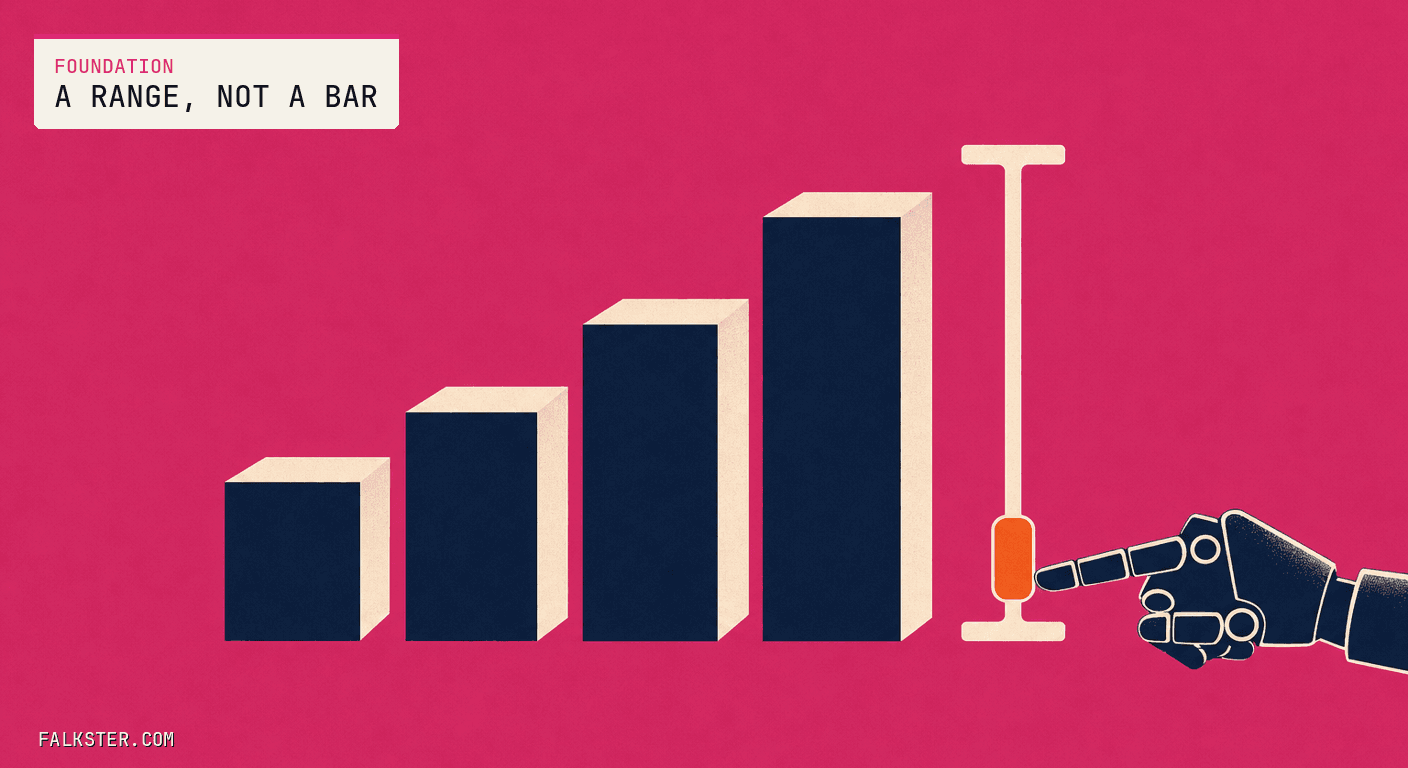
- The 40% is a scenario; the field is a range, and the agent picked the end near zero. I part ways with Tunguz on pricing power following the size of the saving.
- It follows the unit the customer can verify: $1.75 per resolved ticket held for 98% of cases, and the other 2% became more than 200 contested cases a week. Write the pass-through line before the contract.
The waterfall
Tunguz's post pieces together the AI gross profit chain from public disclosures and normalizes every layer to dollars per watt per year. Power, from Core Scientific's filings, is pass-through electricity at 6.6 to 7.1 cents per kWh, about $0.80 per watt per year. Data center rent, from Core Scientific's leases and CBRE's H1 2026 report, is about $1.98 all-in. Neoclouds bill about $9 blended, $9.15 annualized from CoreWeave's Q3 2026 earnings release, which reported $3.661 billion of revenue at a 62% adjusted EBITDA margin. Inference is modeled on an open-weight model on GB300 racks at about $15 billed against $9 paid. The application layer has no per-watt figure, because applications do not bill in watts.
98% held
Then the split. "At a 40% application gross margin, the total gross profit pool divides from left to right as" power 3%, data center 5%, neocloud 28% before GPU depreciation, inference vendor 24%, application 40%. His headline: "applications (40%), neoclouds (28%) & inference vendors (24%) capture 92% of total gross profit." His footnote 6 says the estimates rely on "modeled approximations rather than audited disclosures," and his depreciation caveat is large: GPU capex of $35 to $50 per watt over six years adds $6 to $8 per watt per year, "reducing CoreWeave's post-depreciation gross profit at today's $9/w/yr blended rate to $0 to $2/w/yr."
Three implications follow. Compute prices are rising: CoreWeave's CEO Michael Intrator says "new multi-year compute contracts price at more than double CoreWeave's $9/w/yr blended fleet today," at $20 million to $25 million per megawatt, and whether providers keep that margin "depends on whether applications can pass costs to customers." ROI-driven pricing power: "An AI that saves 30% does not command the same pricing power as one that saves 70%." And vertical integration: CoreWeave's $1.03 billion Weights & Biases acquisition, Nebius's more than $1 billion on four acquisitions in 2026.
The number that moved in the window is the price. More than double, on new contracts, from the layer that sits directly under inference. In Tunguz's own chain, every layer above power bills the next one in watts until the application, which bills a customer in something else. So the application is the layer that either passes the increase through or eats it, and the 40% is the modeled answer to a question the field was answering, differently, the same day.
The same day, the range
Lemkin's post is ten learnings from a week of his agents doing GTM work, with Ulrik Lehrskov-Schmidt on pricing. The first learning is the cancellation. He and his colleague Amelia cancelled Canva after about 12 years. Nobody decided to replace it. Their agents moved image and video work to Higgsfield and decks to Gamma and never reconsidered. "Agents pick vendors once and then stop looking."
The fourth learning is the one that belongs next to Tunguz. Canva, in Lemkin's account, "got stuck on margins": Gamma could spend nearly 100% of revenue on tokens while Canva targeted 75 to 80% or higher gross margins. "We watched Figma give up roughly 5 points of gross margin to AI, and the market punished it."
Put those on Tunguz's chart. The application bar is not 40%. It is a range that runs from Gamma, near zero, to Canva, at 75 to 80%, with Figma somewhere in between after giving up five points and being punished for it. And the buyer choosing along that range is no longer only a person comparing feature lists. It is an agent that picked once, picked the vendor spending nearly everything on tokens, and stopped looking.
That is the field note. Tunguz's 40% is a scenario about how the pool divides if the application layer holds a margin. Lemkin's week is evidence that holding the margin is now a decision with a cost on the other side, which is not being picked.
Where I part ways with Tunguz
The waterfall is careful and the caveats are honest. The sentence I disagree with is the second implication: "An AI that saves 30% does not command the same pricing power as one that saves 70%."
In my experience pricing power follows the unit the customer can verify, not the size of the saving. I moved a support product from $800 a seat to $1.75 per resolved ticket, in the redesign I wrote up in Per-Outcome Pricing: What Gets Clearer and What Gets Terrifying. The customer had been paying about $16,000 a month for what was about $450,000 of equivalent labor. The new price landed at $31,500 a month, and the customer was happier, because the number on the invoice was a number they could count.
The same unit is where the pricing power ran out. The resolved definition held for 98% of cases. The other 2% became more than 200 contested cases a week and a dispute team that grew from 4 to 14, which is the story of Kill the Finish-Line Price. A Relay Has a Definition Per Handoff.. In the per-seat sunset I ran, disputes came in at 12 times projection and margin recovered to 71% only in month 22. None of that depended on whether the saving was 30% or 70%. It depended on whether the customer and I agreed on what one unit was.
A 70% saving nobody can verify commands nothing at renewal. A 30% saving with a signed unit does. That is the SaaS to AI Business Models thesis in one contract: the price has to move to the outcome, and the margin structure moves with it, and the margin only holds where the outcome has a definition.
The line that decides where you land
So CoreWeave's price is going up, the application layer is the one that has to decide what to do about it, and the agent is now a buyer that will leave a 75% margin for a near-zero one without a meeting.
I argued in Anthropic's S-1 Has No Gross Margin Line. Your AI Product Needs One. that every AI product needs a pass-through policy written before the contract: when the vendor's price moves, who absorbs it, and whether it becomes a lower price, better quality, or margin. That post was about a price cut. This week it is a price increase, and the policy is the same line read the other way. A product with the line written lands at a chosen point in the Gamma-to-Canva range. A product without it lands wherever the next compute invoice and the next agent's vendor choice put it, and calls the result strategy.
This week
Find your application's actual point in the range: serving cost as a share of revenue, by feature, this month. Then write the pass-through line in one sentence, if the inference bill rises 20%, this is what happens to price, quality, and margin, in that order, and show it to whoever signs the next contract. If you cannot write it, you do not have a margin. You have a scenario.
Related answer: Does pricing power follow how much an AI product saves the customer?
Sources: Tomasz Tunguz, "Who Captures the Most Margin in AI?," November 11, 2026, read in full; the $0.80, $1.98, $9 and $9.15, $15, $3.661 billion, 62%, 3%, 5%, 28%, 24%, 40%, 92%, 6.6 to 7.1 cents, $20 million to $25 million, $1.03 billion, $1 billion, $35 to $50, $6 to $8, and $0 to $2 are his as he reports them from CoreWeave's Q3 2026 release, Core Scientific's filings, CBRE's H1 2026 report, and Anthropic's S-1/A, none of which were opened. Jason Lemkin with Ulrik Lehrskov-Schmidt, "Our Agents Never Picked Canva. 10 Learnings on Agent Pricing, Getting Picked, and Security From This Week's The Agents With Ulrik Lehrskov-Schmidt," SaaStr, November 11, 2026, read in full; the 12 years, 75 to 80%, nearly 100%, and 5 points are his. The $800, $1.75, $16,000, $450,000, $31,500, 98%, 2%, 200, 4 to 14, 12 times, 71%, and month 22 are my own, from the posts linked above.
Frequently asked
What does Tomasz Tunguz's AI margin waterfall say?+
In his November 11, 2026 post, Tunguz normalizes the AI gross profit chain to dollars per watt per year from public filings: power at about $0.80, data center rent at about $1.98, neoclouds at a $9 blended fleet rate from CoreWeave's Q3 2026 release ($3.661 billion of revenue, 62% adjusted EBITDA margin), inference modeled at $15 billed against $9 paid, and the application layer with no per-watt figure. His headline is that applications (40%), neoclouds (28%), and inference vendors (24%) capture 92% of total gross profit, at a 40% application gross margin, which his footnote calls a modeled approximation rather than an audited disclosure.
What number moved in the window?+
CoreWeave's price. Tunguz quotes CEO Michael Intrator that new multi-year compute contracts price at more than double CoreWeave's $9 per watt per year blended fleet rate, at $20 million to $25 million per megawatt. Every layer in the chain bills in watts except the application, so the application is where that increase is either passed to a customer or absorbed.
Why is the 40% a scenario and not a floor?+
Because Tunguz states it as the condition of his calculation and Jason Lemkin reported the actual range the same day. Lemkin cancelled Canva after 12 years when his agents moved the work to Gamma; in his account Gamma could spend nearly 100% of revenue on tokens while Canva targeted 75 to 80% or higher gross margins, and Figma gave up roughly 5 points of gross margin to AI and the market punished it. The agent, now one of the buyers, picked the end of the range near zero.
Where do you disagree with Tunguz?+
With the sentence that an AI that saves 30% does not command the pricing power of one that saves 70%. Pricing power follows the unit the customer can verify. I moved a support product from $800 a seat to $1.75 per resolved ticket against about $450,000 of equivalent labor and it landed at $31,500 a month, and the resolved definition held for 98% of cases; the other 2% became more than 200 contested cases a week and a dispute team that grew from 4 to 14. A 70% saving nobody can verify commands nothing at renewal.
What is the pass-through line?+
One sentence in the contract, written before it is signed: when the compute price moves, who absorbs it, and how. It is the policy I argued for in the S-1 margin post, and it is the only line that puts a product at a chosen point in the Gamma-to-Canva range instead of an accidental one.
Sign in with LinkedIn to leave a comment.
Sign in with LinkedIn