
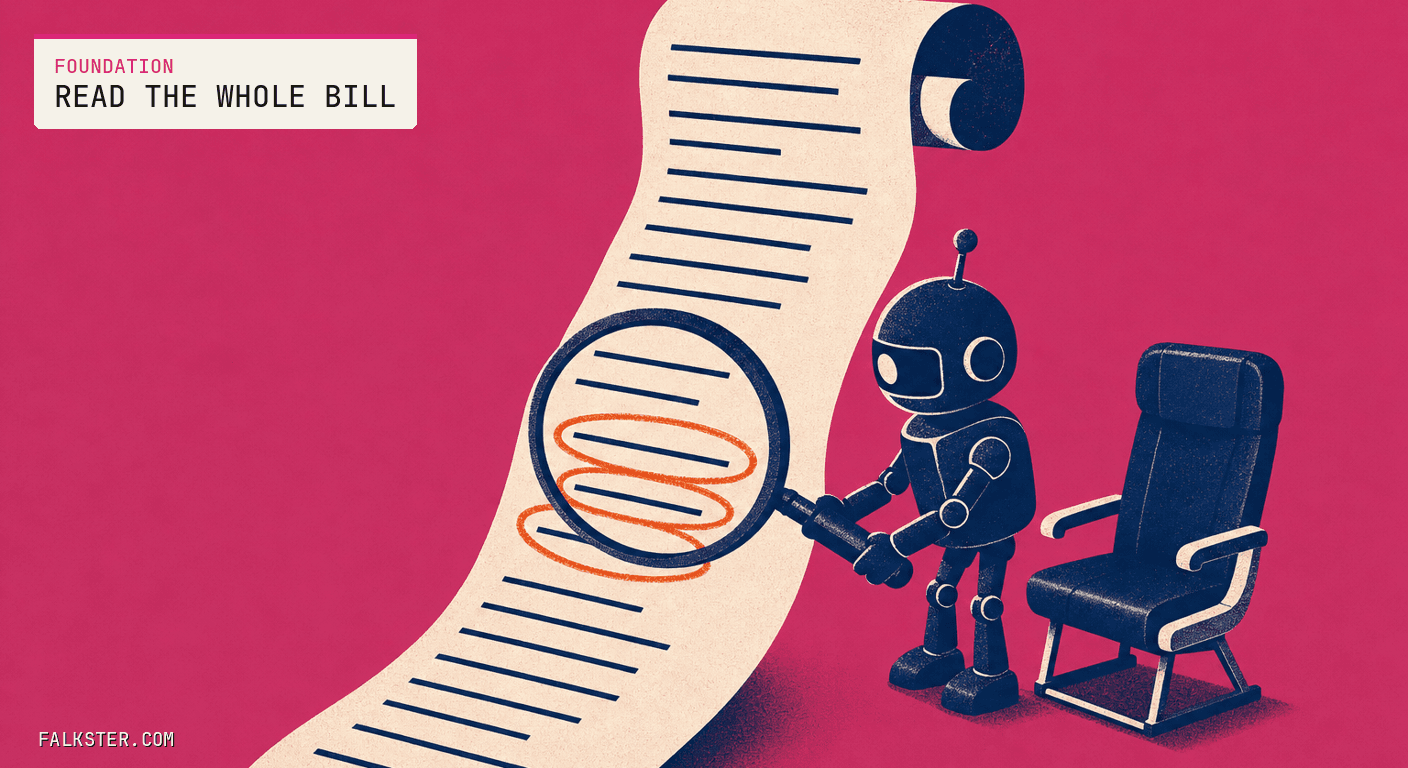
United Airlines revised its terms on November 11 to prohibit AI agents from booking tickets. Two days later Tomasz Tunguz published the arithmetic behind it, and three days after that Jason Lemkin published the B2B version without mentioning airlines at all. This is a Field Notes entry on what the two posts have in common.
The short version
- Tomasz Tunguz's November 13, 2026 post reports that monthly AI agent traffic rose 8x between August and October while United Airlines and Amazon moved to block shopping agents at checkout.
- His reason is on the income statement: United's upgrades and fees top its $4.7b of operating income, Amazon's roughly $34.3b of advertising profit equals nearly all of its $34.4b of retail operating income, and Dell's services are 127% of its operating income.
- Jason Lemkin's November 16 SaaStr post makes the same case for B2B: pricing has depended on buyers who forget, and his agents cut one vendor's calls by about 90% after a 40% bill increase.
- Both posts say the profit sat in the part of the bill nobody inspected, and an agent inspects all of it. In my own pricing migration, 12 accounts were paying committed minimums with usage below them and every dashboard said on plan.
- The repricing Lemkin recommends took my blended gross margin from 80% to a trough of 58 to 62% before it recovered to 71% by month 22. Run Tunguz's division on your own P&L, and size the trough before the board asks.
What United is protecting
Tunguz's post is short and the footnotes carry it. Bots reached 54% of web traffic in 2026, and monthly AI agent requests rose 8x from August to October, per the reports he cites. The largest storefronts answered by locking the agents out. United's revised terms prohibit any AI tool or agent from making or servicing a booking and let the airline cancel a ticket a bot bought. Amazon has blocked third-party shopping agents.
Both companies cite security. Tunguz reads the 10-Ks.
United took in $4.8b of seat and bag upgrades and $3.2b of card, loyalty, and other fees. With trip insurance commissions, those lines top its entire $4.7b of operating income. Amazon's $68.6b of advertising at roughly a 50% margin is about $34.3b, against $34.4b of operating income for everything outside AWS. Dell sells hardware at a 13.7% gross margin, and its warranties and services produce $10.4b of gross profit, 127% of operating income.
12 accounts
In each case the share is 100% or more because the base product, priced near cost, loses money by itself. The profit is what a person adds at checkout.
An agent on a mission does not add it. It skips the sponsored listing, declines Economy Plus unless told otherwise, and unchecks the warranty.
Shopify is his counterexample. It collects about 3.1% of every dollar processed whoever clicks, so in September it opened checkout to browser agents across eligible stores.
The B2B version arrived the same week
Lemkin's November 16 post is advice to companies refounding around AI, and the advice is to cut price, probably by a lot. The reasoning is the part that rhymes with Tunguz.
For 20 years, he writes, people bought B2B software, rolled it out, and partially forgot about it. Half the seats go quiet. Nobody tracks cost per action. The renewal arrives with an uplift, the buyer complains, and signs. A lot of B2B pricing depends on that: prepays, auto-renewals, seat counts that only go up.
Agents measure every call, every day. SaaStr runs on 3 humans and more than 20 agents, and those agents were hitting one core vendor about 35,000 times a day. The bill rose 40% this year. The agents cut the calls by about 90%. Nobody held a meeting about it. In his HubSpot post the day before, he describes a vendor that went down for 48 hours, an agent that routed around it, and a team that never went back.
So in one week, a consumer post and a B2B post found the same thing from two sides. The margin was in the part of the bill the buyer was not looking at.
I have that line in my own numbers
The B2B equivalent of a seat upgrade is revenue for usage that did not happen. I can point at mine.
In Field Report: What Broke When We Killed Our Per-Seat Tier I describe 12 accounts that had migrated to the new pricing on paper. They were paying their committed minimums. Their usage was below those minimums. The tracker classified them as on plan, so nobody called them. When the old tier was switched off, they found out three weeks later and we lost two.
At the time I filed that as a migration failure. Reading Tunguz, it is also a margin line. Those 12 accounts were close to pure profit for as long as nobody on their side looked. A person did not look. An agent running their support queue would have seen it in the first week.
The same line shows up in 41 Brands Price AI Five Ways. The Credit Is the New Seat.: of the three numbers a credit buyer cannot see, one is what expires unused. An agent can see it.
What repricing costs
Lemkin's arithmetic is that an 80% cut in price per action with 20x the usage is 4x the revenue. His Databricks example, a $1,000 per-user fee removed and consumption rising, is real support for it.
I ran a repricing of that kind, from seats to a price per outcome, and two things came before the good part.
The margin went down first. Blended gross margin fell from 80% to a trough of 58 to 62% in the fourth quarter of the migration, and recovered to 71% by month 22, when outcome revenue was 91% of the total. I wrote about why the trough has to be named in advance in ServiceNow Fell 27% on a 70.5% Gross Margin. Name the Trough and the Month.
And the usage did not arrive by itself. The 12 accounts above had the new price. A lower price lets an agent call you 20 times as often. It does not build the workflow that makes the calls.
So I read "make it cheaper" as correct about where this ends and silent about the 22 months in between.
The division
Tunguz's method fits on one line and works on any P&L.
Add up the gross profit from seats nobody logs into, committed minimums above actual usage, credits that expire, and renewal uplifts that came with no new value. Divide by operating income.
That share is what a buyer who inspects everything removes. United's answer is to block the buyer, which holds until a competitor welcomes it. Shopify's answer was to already be priced on what happened. For everyone in between, the answer is a repricing with a trough, and the board will want its depth and its month.
This week
Pull last quarter's invoices for your 20 largest accounts and mark every line the customer paid for and did not use. Total it. Then put that number next to operating income and show it to your CFO before a customer's agent does the same sum. The wider argument, that price moves to what the buyer can count and margin moves with it, is in SaaS to AI Business Models.
Related answer: Why are companies blocking AI shopping agents at checkout?
Sources: Tomasz Tunguz, "No Shirt, No Shoes, No Service for Bots," November 13, 2026, read in full with its footnotes. The 54%, the 8x, United's terms and its $4.8b, $3.2b, and $4.7b, Amazon's $68.6b, $34.3b, $34.4b, and $588b, Dell's 13.7%, $10.4b, and 127%, and Shopify's 3.1% are his as he reports them from the filings and reports he cites; I did not open the 10-Ks, United's terms, or the traffic reports. Jason Lemkin, "If You're Refounding Your B2B Company for AI, Make Your Product Cheaper. Probably Much Cheaper.," SaaStr, November 16, 2026, and "HubSpot Is Refounding as the 'Customer Harness Company.'," SaaStr, November 15, 2026, both read in full. The 3 humans, 20 agents, 35,000 calls, 40%, 90%, 80%, 20x, 4x, $1,000, and 48 hours are his. The 12 accounts, the two lost, 80%, 58 to 62%, 71%, month 22, and 91% are my own, from the posts linked above.
Frequently asked
Why did United Airlines ban AI agents from booking tickets?+
United cites security. Tomasz Tunguz's November 13, 2026 post points to the income statement: per United's 10-K as he reports it, $4.8b of seat and bag upgrades and $3.2b of card, loyalty, and other fees, with trip insurance commissions, together top the airline's $4.7b of operating income. An agent on a mission declines the upgrade and the insurance, so the profit line is exactly what an agent removes. United's terms, revised November 11, 2026, prohibit AI agents from booking and allow it to cancel tickets a bot bought.
What numbers does Tunguz give for Amazon, Dell, and Shopify?+
Amazon: $68.6b of advertising at roughly a 50% margin is about $34.3b, against $34.4b of non-AWS operating income on $588b of retail revenue. Dell: services gross profit of $10.4b at a 44.8% margin is 127% of its $8.1b operating income, with hardware at a 13.7% gross margin. Shopify collects about 3.1% of every dollar processed whether a person or an agent clicks buy, which is why it opened checkout to browser agents in September 2026.
What is the B2B version of this?+
Jason Lemkin's November 16, 2026 SaaStr post says B2B pricing has long depended on buyers who partially forget what they bought: annual prepays, auto-renewals, built-in uplifts, and seats that go quiet. Agents track cost per call every day. SaaStr's agents were hitting one core vendor about 35,000 times a day, the bill rose 40% in a year, and the agents cut those calls by about 90%.
What did your own pricing migration show?+
Two things. First, the inattention line existed: 12 accounts were paying committed minimums with usage below them, and the tracker classified them as on plan. Second, repricing has a cost with a shape. Blended gross margin went from 80% to a trough of 58 to 62% in the fourth quarter of the migration and recovered to 71% by month 22, when outcome revenue reached 91% of the total.
Is Lemkin right that cutting price 80% can raise revenue 4x?+
As an end state it can be, and his Databricks example supports it. Two things come first. The margin goes through a trough before volume catches up, and the usage does not arrive just because the price allows it. My 12 low-use accounts already had the new price. Someone has to build the workflow that makes the calls.
What should a product or finance leader calculate?+
Tunguz's division on your own P&L. Add up gross profit from seats nobody logs into, committed minimums above actual usage, credits that expire unused, and renewal uplifts with no added value. Divide by operating income. That share is what a buyer who inspects every line removes, and it sizes both the cost of blocking agents and the trough of repricing for them.
Sign in with LinkedIn to leave a comment.
Sign in with LinkedIn