
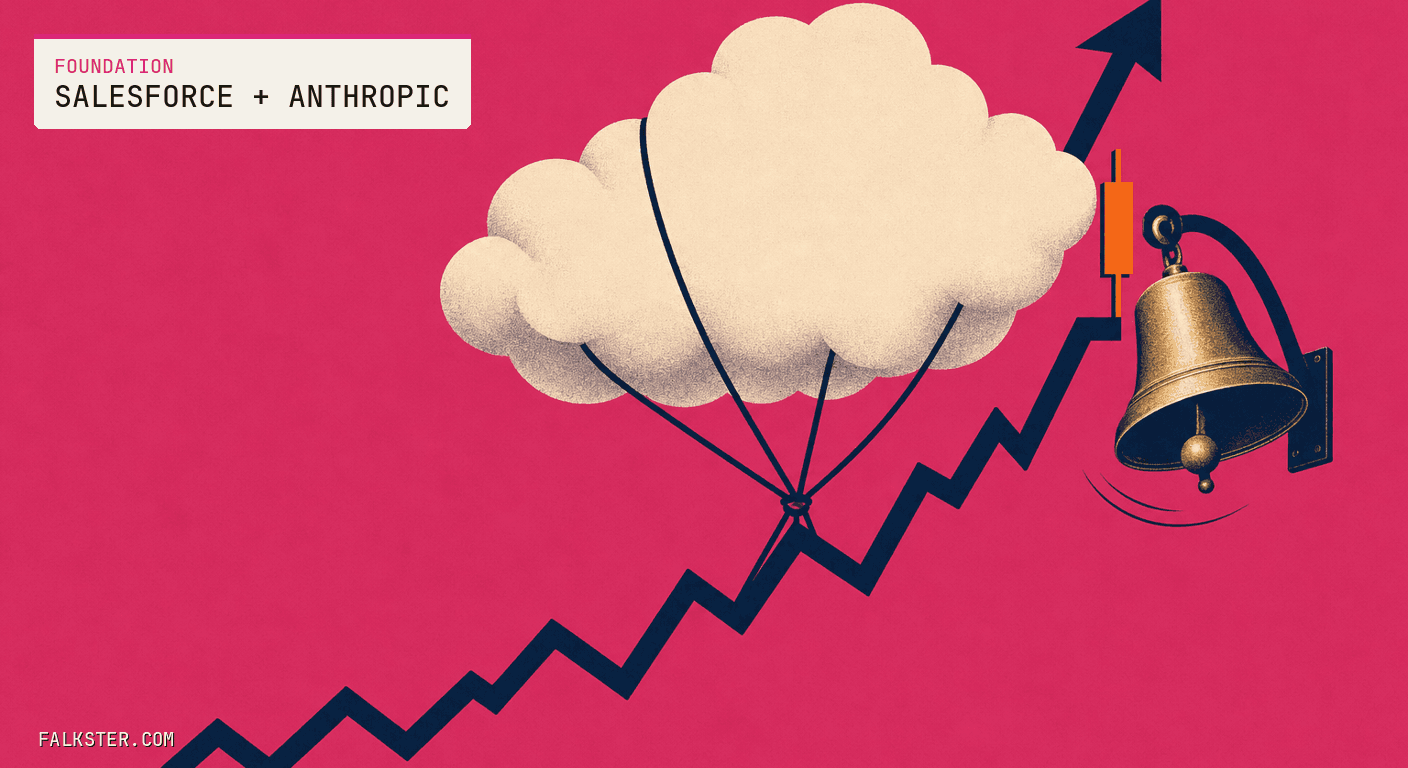
Today is the day Anthropic is finally going public. And here is why I think that carries Salesforce's stock, and its business, forward with it.
If you don't follow the stock market, here's the setup. Anthropic makes Claude, one of the leading AI assistants. Going public means its shares start trading on the stock market, where anyone can buy them. Salesforce makes the software sales and service teams use to track customers, and it owns a small piece of Anthropic.
Salesforce's stock didn't look that way this week. It went into this morning down 11.4% in two trading days, at $190.40. The big drop came on a day with no company news. An analyst at RBC Capital Markets said the AI companies will "try to destroy Salesforce entirely." Big investment funds were reportedly selling software stocks to make room for one of the biggest stock market debuts ever.
I own the stock. I'm keeping it. I ran product at Salesforce, across Marketing Cloud, Quip, and Slack. I've spent this year writing about what AI agents do to software pricing, some of it critical of Salesforce. So this is the long version of the bet, with the filings open. Technology first, then the finance, then where I could be wrong.
One line of disclosure before any of it: I own Salesforce shares, I worked there from 2012 to 2018, I'm a first-round investor in Anthropic, and Falkster.AI builds on Claude and is in Anthropic's startup program. This is my reasoning for my money. It is not advice for yours.
The short version
- Anthropic, the company behind the Claude AI assistant, starts trading on the stock market today. It sold its shares at $83 each, under the ticker ANT. Salesforce stock fell hard on the way in. It dropped 9.45% on November 17 and closed at $190.40 the next day, down more than a quarter this year.
- I'm keeping my Salesforce shares, for four reasons. First, Anthropic's IPO filing is the first audited proof that big companies pay for AI agents: $33.2 billion of revenue in nine months. The same filing names Salesforce as a way to reach those companies.
- Second, Salesforce owns a piece of Anthropic. It valued that stake at about $5.1 billion in July. At $83 a share it's worth about $7.2 billion, on an outside estimate of its size.
- Third, the two companies sell different things. Anthropic sells raw AI, priced by the chunk of text. Salesforce sells finished work, priced per action and per resolved case. Fourth, a public Anthropic needs to sell to big companies, and Salesforce already reaches them.
- The price is what clinches it. By my math, Salesforce brings in spare cash each year equal to about 9.6% of its stock market value. That price assumes growth of only about 1% to 4% a year, forever. The risks are real: slow growth without acquisitions, a still-small AI agent business, an unpriced fee on outside agents, and $25 billion of new debt.
What Anthropic sold today
The facts come from Anthropic's pricing release and the last amendment to its S-1. The S-1 is the filing a company makes with US regulators before it goes public.
Anthropic sold 980 million Class A shares at $83.00. It had marketed them at $70 to $78. The deal also started at 825 million shares. So it priced above the range, and bigger. It raised about $81.3 billion before fees. The banks running the sale, called underwriters, have an option on 147 million extra shares. If they take them all, the total is about $93.5 billion. The seven co-founders sold a small slice. Separately, a group of strategic investors is buying $26.0 billion of non-voting stock at the IPO price. The ticker is ANT, on the Nasdaq Global Select Market.
The headline valuation is about $1.5 trillion, as the AP reported it. That's fully diluted, meaning it counts every share that could exist, including employee options. Counting only the shares that exist today, from the filing and adjusted for the bigger deal, I get roughly 13.2 billion. At $83 that's about $1.1 trillion. Either way it is one of the largest companies ever to list.
The numbers underneath are the reason this matters for Salesforce. In the table, watch three things: how fast revenue is growing, how much of it is pay-as-you-go (consumption), and the size of the computing bill ahead.
| Anthropic, from the amended S-1 | Figure |
|---|---|
| Revenue, full year 2025 | $4.6 billion |
| Revenue, nine months to September 30, 2026 | $33.2 billion |
| Revenue, third quarter 2026 | $17.0 billion |
| Run-rate revenue at October 31, 2026 | about $81 billion |
| Share of revenue that is consumption-based | 79% |
| Share of revenue sold through cloud marketplaces | 44% |
| Customers above $100,000 a year | more than 11,900 |
| Net revenue retention | about 900% |
| Operating loss, nine months | $1.3 billion |
| Compute and infrastructure commitments | about $900.9 billion |
One detail about how it's presented. The income statement has no line for the cost of serving customers, so there's no gross margin, the share of revenue left after those costs. The cost of computing is lumped in with operating expenses. A footnote does break out $4.8 billion of cost of revenue for the nine months. By my arithmetic that's about an 85% gross margin. I wrote about why that presentation choice matters for every AI product in Anthropic's S-1 Has No Gross Margin Line. Your AI Product Needs One.
What Salesforce stock did on the way in
Tuesday, November 17: Salesforce fell 9.45% to $194.52. Trefis counted it as the largest one-day drop since May 30, 2024, on a day with no announcement, no filing, and no earnings. The S&P 500 index lost 1.0%. Of 62 other large app software companies, 57 fell. (Large here means worth $2 billion or more.) ServiceNow lost 6.5% and HubSpot 6.8%.
Wednesday, November 18: another 2.12%, to $190.40. BTIG, an investment bank, cut its price target from $300 to $250 but kept its Buy rating. That's 11.4% in two days.
Zoom out and it's worse. Down about 26% for the year at Tuesday's close against the S&P 500 up about 8%. About 48% below the record close of $367.87 from December 2024.
Nobody agrees on why Tuesday happened, and I'd distrust anyone who says they know. Seeking Alpha's news desk cited worry that AI agents mean companies buy fewer user licenses, called seats, and give software makers less pricing power. It also cited investors rebalancing ahead of the IPO. Other outlets pointed at an OpenAI model release the same day and a weak market (the Dow lost about 849 points). Some pointed at funds selling software stocks to raise cash for the offering. That last one is a guess from the trading. Nobody has shown the actual money moving.
There is a precedent though, and it's recent. SpaceX priced its IPO on June 11. Around that listing, an exchange-traded fund (ETF) that tracks software stocks fell about 7%, per TIKR. The Nasdaq 100 rose about 3% over the same stretch. Salesforce hit its lowest close of the past year, $150.12, on June 22. Ten weeks later, after second-quarter results, it closed at $257.54. That's up 71.6% from the low, by my arithmetic.
It may not repeat. But a giant listing pulling money out of software is a flow, and flows end. The one in front of us may not be done yet. Berenberg, an investment bank, estimates index funds will buy more than $19 billion of ANT in its first month, as TradingKey reported. That buying comes as ANT joins the big stock indexes in mid and late December. Somebody sells something to fund that.
So the stock can go lower from here on these money flows alone. I'm fine with that. The four reasons below are about the business.
Reason one: Anthropic's filing proves companies pay for AI
Since February the case against Salesforce stock, the bear case, has had one sentence in it. Agents replace software.
The trigger back then was Anthropic's own product. Claude Cowork, Anthropic's AI coworker app, shipped add-ons for sales, support, legal, and marketing work at the end of January. In a single day in early February, software stocks lost roughly $285 billion of value. Somebody at Jefferies, an investment bank, called it the SaaSpocalypse, and the name stuck.
Now we have the prospectus, and it lets you look at what the agent economy actually is.
It's $33.2 billion in nine months. And 79% of it is consumption, meaning pay-as-you-go. It grows with the work done, not with the number of users. The filing says Anthropic mainly serves big companies, and that every company in the Fortune 10 is a customer. More than 11,900 customers spend over $100,000 a year. A year earlier it was about 950.
That is the budget every enterprise software company has been arguing about. It exists. It's enormous. And it's being spent by the same companies that run on Salesforce.
Here's the part the market skipped this week. Read how the S-1 says enterprises adopt Claude. It lists systems integrators (firms that install and connect business software), consultants, and data platforms. The two data platforms it names are Salesforce and Snowflake. Elsewhere it names Salesforce as a company that has built AI products on Claude. And 44% of Anthropic's revenue arrives through cloud marketplaces, the online stores of the big cloud providers. The filing counts the full sale price of those as revenue.
Anthropic is a channel business, meaning it sells a lot through partners. A big share of the most valuable AI company in the world is sold through other people's platforms, into other people's data. The prospectus says so in its own description of the business.
Now the honest counterweight, because it's in the same document. The risk factors say Anthropic competes with some of its own customers and may do so more, and that the risk is sharpest with software-as-a-service companies. More than half of its $100,000-a-year customers now use one of Anthropic's own apps too. At the end of last year it was about 30%. So the AI lab is moving up into apps. I'll come back to that under what could go wrong.
But think about what a token is. It's the chunk of text an AI model reads and writes, and it's an input. Somebody still has to turn it into a finished result: a closed case, a corrected invoice, a renewal quote that respects the discount policy. And it has to come from something that is allowed to issue it. I've watched what happens when enterprises are handed raw capability and told to build. At Commure, several health systems bought our platform to build their own applications on it. For about two years, they didn't. We built the applications ourselves, put them in front of clinicians, and adoption took off.
Enterprises say they'll build. Mostly they buy the application.
Reason two: the stake gets a public price
This is the part everyone leads with, so let me size it properly, because the popular version is too big.
Salesforce Ventures, the company's investment arm, wrote its first Anthropic check in early 2023. By press reports it was about $50 million, in a funding round called the Series C. It says it joined every round after. Total invested is reported at more than $300 million.
Salesforce's quarterly report for the three months ended July 31, called a 10-Q, names Anthropic. It valued the investment at about $5.1 billion on its books. That's about 45% of its whole portfolio of company stakes. The portfolio is worth $11.3 billion, spread over more than 450 companies. Paper gains on Anthropic, not yet cashed in, were $2.7 billion in that quarter alone.
Salesforce doesn't disclose how many shares it holds. Moby's rough calculation puts it near 86 million. Take that estimate and run it at $83. The rows that matter are the value at $83 and what it adds up to per Salesforce share.
| The stake, on an estimated 86.5 million shares | Figure |
|---|---|
| Carrying value, July 31, 2026 | about $5.1 billion |
| Value at the $83 IPO price | about $7.2 billion |
| Uplift over carrying value | about $2.1 billion |
| Per Salesforce share (823 million shares) | about $8.70 |
| As a share of the $190.40 stock price | about 4.6% |
| Each $10 move in ANT, pre-tax | about $865 million |
| Share of Anthropic | under 1% |
All of that is my arithmetic on someone else's estimate. Treat it as a range.
At the September investor session, Marc Benioff said the stake could be worth tens of billions and that the company would probably sell it to pay off the buyback debt. On these numbers, tens of billions needs ANT above roughly $231, or a bigger holding than the estimate. I don't count on that. I count on seven.
How the stake shows up in Salesforce's profits is worth knowing, because it's about to get noisy.
While Anthropic was private, Salesforce held the stake at what it paid, adjusted only when a new funding round set a visible price. That's the measurement alternative in the accounting rules for equity securities. It's why the gain showed up in lumps after each round. From today the shares have a quoted price. Salesforce hasn't said which class of shares it owns. Assuming they're treated like the listed class, the stake gets marked to market every quarter, meaning it's revalued at the stock price. The change flows through one line, gains on strategic investments, which sits below the profit from running the business. Revenue, operating margin, and operating cash flow don't move. A lock-up is a period when early holders can't sell. Under current accounting rules it doesn't earn a discount, so the value will simply be the quoted price.
Two details most coverage gets wrong.
First, timing. Salesforce reports on December 2, but that quarter ended October 31, before the IPO. The first public mark lands in the quarter ending January 31, 2027, and it'll be struck at wherever ANT closes that day.
Second, Salesforce counts these gains in the adjusted, or non-GAAP, earnings per share (EPS) it reports. GAAP stands for generally accepted accounting principles, the standard rules. It leaves the gains out of the EPS it forecasts. Last quarter's $5.90 had $2.53 of investment gains in it, per the release. So every quarter from here will beat or miss the forecast by whatever Anthropic's stock did. Stock screens that don't strip it out will make Salesforce look cheaper or pricier than it is. Do the stripping yourself.
Then there's the lock-up. The S-1 locks up most existing shares for 180 days. Holders of more than 0.5% of the fully diluted share count can be held for up to 365 days, with staged releases along the way. The estimate puts Salesforce almost exactly on that line, so I can't tell which bucket it's in. Day 180 falls in mid-May 2027, and the first release can come sooner, after Anthropic's first-quarter results.
So what is the stake, really? It isn't a hedge. Tuesday's drop took about $17 billion off Salesforce's market value, more than twice what the whole stake is worth at $83. If agents gut the franchise, seven billion doesn't save you.
What it is: a sellable asset worth about a quarter of Salesforce's net debt (its debt minus its cash), arriving the same year the company borrowed heavily. I'll get to the debt. Hold that thought.
Reason three: they sell different things, and the gap between them is the business
Anthropic sells reasoning. The unit is the token, and 79% of its revenue is metered that way.
Salesforce sells work. Look at its price list as it stands this month, pieced together from the November 3 rate card and Steven Forth's history of Agentforce pricing. Agentforce is Salesforce's AI agent product. Compare the $0.10 action with the $2.00 resolution:
| What Salesforce sells | Unit | Price |
|---|---|---|
| Flex Credits | 100,000 credits | $500 |
| Standard agent action | 20 credits | $0.10 |
| Help Agent resolution | 400 credits | $2.00 |
| Conversation (the 2024 model, still offered) | each | $2.00 |
| Agentforce add-on for Sales or Service | user, month | $125 |
| Core, Advanced, and Max editions | user, month | $195, $395, and $550 |
| Agentic Enterprise License Agreement | fixed fee, multi-year | negotiated |
That's six ways of charging in about two years, by Forth's count, and none retired. I've been rude about that. In 41 Brands Price AI Five Ways. The Credit Is the New Seat. I argued the credit is a private currency the vendor mints and reprices. It is. It's also, on this list, the bridge between two businesses.
Because here's the structure. Salesforce buys tokens and sells actions. An action is 10 cents. A resolution is two dollars, and by Forth's reading it only bills when there were at least two exchanges, no escalation, and no negative feedback. What sits between the token and the two dollars is everything a model doesn't have.
Salesforce hasn't published that gap. There's no figure for what the AI costs per action, and no gross margin for Agentforce. The only statement on the record is from February, when CFO Robin Washington said gross margin looked fairly neutral in the near term. The company's overall gross margin last quarter was 76.7%, by my arithmetic on the reported lines. So I can't prove the spread is fat. I can show you what it's made of, and why I think it holds.
What a model doesn't have
I spent four years on the Marketing Cloud platform team, running the system that sent the emails and its connection to the CRM. Nobody demos that layer. It's the part that decides who is allowed to do what to which record, and it's the part that takes longest to get right. Agents made it the product.
Context. Data 360 is Salesforce's data platform. It can read data where it already lives, in Snowflake, Databricks, BigQuery, and the rest, without copying it. (The technical name is a lakehouse on open table formats with zero-copy federation.) Salesforce says it handled 104 trillion records last quarter. Of those, 82 trillion never moved; they were read in place. On top sits what Salesforce's engineering team calls an agent context engine. It works out who and what a request is about and what to look up. It settles conflicts between sources, applies the company's data rules, and packs the result to fit what the model can read at once. Four tiers of memory sit behind it. A leading AI model can read an enormous amount at once and still has no idea which of your fields called status is the real one.
Metadata and permissions. Salesforce's platform has more than 85,000 standard record types and over 300 million that customers defined themselves. Who can see each one is controlled by Salesforce's sharing rules. Outside AI agents connect through the Model Context Protocol (MCP), the standard way for AI assistants to reach other software. When one calls Salesforce that way, the call runs as the signed-in user. Every permission applies, down to single fields and records. That sentence is the advantage competitors can't copy, if there is one. An agent that reads a copy of the data has the data. It doesn't have the years of who-can-see-what decisions.
Predictable steps. This is the piece I find most underrated. Agent Script, available to all customers since February, is a small programming language with two kinds of instruction. Some steps run as plain code, the same way every time. Others ask a model. Salesforce's Atlas engine follows those steps like a flowchart, one box at a time. The architecture guide describes gates that remove an action from the model's tool list entirely when a condition is false. The model can't call the refund action on an account that isn't eligible, because for that turn the action doesn't exist. And every step that runs as plain code is a model call you don't pay for. Washington has pointed to that as a way to cut costs.
The trust boundary. Anthropic's and Amazon's models, served through Amazon Bedrock, are the only outside models that run fully inside Salesforce's own boundary. Salesforce says its model providers keep none of the data. Customers can also choose models from OpenAI and Google's Gemini. Claude is the default in Slackbot and the newer Agentforce products. Benioff told investors there are no exclusive deals with model partners. Salesforce is also testing a model of its own, Koa, built on a freely available model.
Evidence that the wrapper matters. Salesforce's research group put out a preprint, a paper not yet peer reviewed, in September, reported by VentureBeat. They took a small, freely available model and didn't retrain it at all. They only improved the software around it. Average task success across seven standard tests of business agent work went from 29.2% to 78.0%. Retraining the same model to imitate a stronger one got to 63.1%. It's a preprint, on benchmarks, from an interested party. It's also the cleanest number I've seen for the claim that in enterprise work, what surrounds the model moves the result more than the model does.
No screen required. The interface is leaving, and Salesforce is the one showing it out. Salesforce's word for this is headless: the software works without its own screen. Its data platform's MCP server became available to all customers in August. Slackbot, Slack's built-in assistant, connects to other software the same way. Claudeforce, in beta, puts 37 sales skills inside Claude so a seller never opens Salesforce at all. Anthropic's commercial chief told the September investor session that 1.5 million Salesforce actions ran through Claude the month before. I wrote that launch up the afternoon it landed, in Salesforce Put Its CRM Inside Claude.
Keep the roadmap honest, though. Salesforce's planned harness, the shared layer meant to run and govern all of a company's agents, doesn't start rolling out until early fiscal 2028. Koa is in pilots. Claudeforce has no price. I said in Salesforce Named the Harness. The Missing Piece Isn't on the Slide. that context is the one layer you can't bolt on later, and I still think the slide is ahead of the product.
What is shipping is enough for my purposes. The step-by-step engine, the permission checks on every call, and the context layer are all running for customers today. Those are the three things between a token and a two-dollar resolution.
And notice what a public Anthropic does to the cost side. Salesforce's main input now has a quarterly report, a disclosed margin structure, and at least two serious competitors selling the same input. Benioff has put Salesforce's own bill from Anthropic at about $300 million this year, mostly for coding. Anthropic's revenue is running at about $81 billion a year. Against that, Salesforce's bill is under half a percent. Salesforce is a small customer, and it already runs more than one model. That's the right side of that negotiation to be on.
Reason four: a public Anthropic needs Salesforce's reach
Private Anthropic could grow on product pull and patient capital. Public Anthropic has a different problem.
It has promised to pay about $900.9 billion for computing power and data centers, with $70.7 billion due in the twelve months after September. Its net revenue retention is 900%, meaning last year's customers now spend about nine times as much. That number only goes one direction from here. Third-quarter revenue grew about 47% over the second, after the second grew 144% over the first. By my arithmetic the stock is priced at 14 to 18 times its yearly revenue pace. At that price, revenue has to keep compounding, in public, every 90 days.
Where does the next $80 billion of enterprise revenue come from? Some from coding, which is where Anthropic started. A lot of it has to come from work inside the systems where enterprises keep their customers, orders, and cases. Anthropic can build those applications and compete with its customers, which its risk factors admit it sometimes does. Or it can be the default model inside the business apps that already have the data and the salespeople.
It's doing the second with Salesforce, in writing. Under Claudeforce, announced in August, Claude is the default AI model across Slack and the main Agentforce products. And Salesforce is Anthropic's preferred CRM, its software for tracking customers. The customer gets two invoices, as VentureBeat reported. One comes from Salesforce for using its software without the screen. The other comes from Anthropic for running the model. Salesforce has about 15,000 salespeople and said on the last call it was hiring 1,200 more. Every one of them is now, in effect, opening doors for Claude.
Three weeks ago I asked whether Anthropic should just buy the whole thing, in Should Anthropic Buy Salesforce? The Model Company Shouldn't Buy the System of Record. My answer was no. The parts worth owning are the parts Claude already reaches by default. And owning them would cost Anthropic its neutrality with every other software customer. Today's listing makes that argument stronger. Anthropic now has public stock it could pay with, and a prospectus that explains why it shouldn't.
The interests line up better than this week's trading suggests. Anthropic needs volume through trusted channels. Salesforce needs the best reasoning it can buy at a falling price. Both are true at once.
The finance: what a $190 share price assumes
Now the part I actually make the decision on. Two terms do most of the work here. Free cash flow is the cash left after running and investing in the business. Enterprise value is the stock market value plus net debt, the price of the whole company.
| Salesforce at the November 18 close | Figure |
|---|---|
| Share price | $190.40 |
| Shares outstanding (10-Q cover, August 20) | about 823 million |
| Market value | about $157 billion |
| Debt principal, July 31 | $39.5 billion |
| Cash and marketable securities, July 31 | $11.4 billion |
| Net debt | about $28 billion |
| Enterprise value | about $185 billion |
| Free cash flow, fiscal 2027 (CFO's estimate) | about $15 billion |
| Free cash flow yield on the equity | about 9.6% |
| Enterprise value to free cash flow | about 12.3x |
| Enterprise value to guided fiscal 2027 revenue | about 4.0x |
| Price to guided fiscal 2027 non-GAAP EPS ($16.69 midpoint) | about 11.4x |
| Same, excluding first-half investment gains | about 13.9x |
Reported inputs are from the 10-Q and the second-quarter release. The free cash flow figure is CFO Robin Washington's "about $15 billion" for this fiscal year, from the September investor session. Trefis puts the last twelve months at $15.2 billion. The ratios are mine. Net debt is as of July. About $5 billion of cash went out for two acquisitions, Fin and Contentful, in September, so today's number is higher.
For scale: TIKR, a stock research site, puts the five-year average at 27 times next year's expected earnings. Trefis has the median price since 2010 at about 40 times free cash flow. Tuesday's reading was 10.5.
Multiples like these are a shorthand. I'd rather ask what the price assumes.
What growth the price assumes
Take enterprise value of $185 billion and free cash flow of $15 billion. A simple valuation model says a company's value equals next year's cash flow divided by the discount rate minus the growth rate. The discount rate is the yearly return investors demand. Rearrange it and you can solve for the growth the price implies.
At a 9% discount rate, the implied growth is 0.8% a year. At 10%, it's 1.7%.
Forever. For a company that grew 11% last quarter, and about 6% without Informatica, a company it bought.
That's too kind to the bulls in one way, and I'll fix it. Free cash flow doesn't subtract the stock paid to employees. Salesforce expects that at 9% of revenue this year, about $4.2 billion. Treat it as the real cost it is and free cash flow drops to roughly $10.8 billion. Run the same algebra:
| Discount rate | Implied growth on reported free cash flow | Implied growth after stock compensation |
|---|---|---|
| 8% | about minus 0.1% | about 2.0% |
| 9% | about 0.8% | about 3.0% |
| 10% | about 1.7% | about 3.9% |
So the harshest fair reading says the market is paying for 3% to 4% growth, forever. Management's own target is $63 billion of revenue in fiscal 2030, which from this year's guide is about 10.9% a year. The 10-year US Treasury bond, the standard safe investment, yields about 5.1%. This is a software company with 77% gross margins, priced to earn only about four and a half points more than that bond. The price assumes it turns into a slow-growing utility.
I've argued that "we are the system of record," meaning the official database a company runs on, is a reason customers stay, dressed up as a reason the company will grow. That was Kill the System-of-Record Slide, and I haven't changed my mind. What changed is the price. At a 9.6% yield I don't need the growth claim. I need customers to stay, plus modest extra sales of credits and premium editions on top. The stock is priced as if customers start leaving.
9.6%
Could it? Yes. That's the whole debate, and it's why the technology section came first. If agents need the permissions, the metadata, and the predictable step-by-step engine, customers stay. If they can work off a copy, it doesn't.
The buyback, paid for with debt
This is the boldest thing Salesforce did all year and the least discussed this week.
In February the board approved buying back up to $50 billion of Salesforce's own stock. In March the company borrowed $25 billion, in bonds due between 2028 and 2066. It handed the money to five banks to buy back shares all at once, an accelerated repurchase. Management told investors in September it expected to retire 14% or more of the company at an average near $182.
The logic is simple: borrow cheap, and buy back something that pays more. Averaging the bond rates in the 10-Q, I get an interest rate near 5.4%. That's about $1.34 billion of interest a year, or roughly $1.0 billion after tax. Against that, the shares it retired at $182 were yielding about 10% in free cash flow. That's about $18 of free cash flow per share on today's count. Borrow at 4% after tax, retire equity yielding 10%. Diluted shares were 821 million last quarter against 962 million a year earlier. That's 14.7% fewer claims on the same cash flow, and about $240 million a year of dividends that no longer go out.
It has costs, and they're visible. Interest expense was $473 million last quarter against $67 million a year before. The company cut its forecast for free cash flow growth to about 4% or 5%. It had been about 9% or 10%. Moody's took the credit rating down a notch in March, and S&P followed on November 4. Buyers ordered only about 1.4 times the bonds on offer, thin for a company like this.
Net debt is about 1.9 times free cash flow on the July numbers, which is manageable. The cushion is spent, though, and the company kept shopping. It bought Fin for about $3.6 billion, Contentful, and Braze for $5.66 billion. By press reports, Cresta and Listen Labs too.
Here's why I can live with it. A buyback paid for with debt is a bet that the cash keeps coming. If you believe reason three, it's the correct bet, made at a price close to where the stock sits this morning. The company bought a seventh of itself at about $182. You can buy alongside it at $190.
And this is where the Anthropic stake comes back. About $7 billion of soon-to-be-sellable stock against about $28 billion of net debt, with the CEO on record that he'd probably use it to pay the debt down. The model company's IPO is, quite literally, part of how Salesforce's balance sheet gets repaired.
Two very different prices
Put the two companies next to each other this morning.
Anthropic: roughly 14 to 18 times its yearly revenue pace. Revenue is up about twelvefold in a year, and operations are near break-even, before a $900 billion computing bill.
Salesforce: about 4 times revenue and about 12 times free cash flow. It's growing 11%, with an adjusted operating margin of 34%.
I have no view on whether Anthropic is expensive, and as a first-round investor I'm the wrong person to ask. At that growth rate I can't tell you what it's worth, and neither can anyone on television today. My point is narrower. That gap is the market saying the AI model makers keep nearly all of the value, and the app makers keep a shrinking stream of income. Anthropic's own filing describes a business that reaches enterprises through platforms like Salesforce and books 44% of its revenue through someone else's marketplace. Both prices can't be fully right.
One more cut. Take the $157 billion market value and subtract the portfolio of company stakes. With Anthropic at $83, that portfolio is about $13.4 billion. The operating business is left at about $143 billion of equity, or about $171 billion of enterprise value. That's about 11.4 times free cash flow for the whole of Sales, Service, Slack, Data 360, Tableau, MuleSoft, Informatica, and the agent business.
What the business has to do
Cheap isn't a thesis. Something has to go right. Here's the short list, with the reported numbers as the baseline.
Organic growth, the growth that doesn't come from acquisitions, has to turn up. Last quarter's revenue was $11.345 billion including $456 million from Informatica. Strip that and growth was about 6.4%, by my arithmetic. Management told analysts on the earnings call that faster organic growth in the second half was close to arithmetic by then. December 2 is the test. The forecast is $11.42 billion to $11.50 billion in revenue. It also calls for about 14% growth in current remaining performance obligation, the contracted revenue due over the next year.
Agentforce has to stop being a rounding error. Its annual recurring revenue (ARR) passed $1.5 billion, up more than 240%. That's on a definition that now includes Slackbot and Headless 360. It's about 3% of revenue. Add Data 360 and it's nearly $3.9 billion. That's about 8% of revenue. The number I watch is Agentic Work Units, Salesforce's count of the work its agents do: 7.0 billion to date, 3.2 billion of them last quarter. And about half of Agentforce bookings were customers refilling credits, which is what repeat pay-as-you-go buying looks like when it's working.
The edition upgrade has to keep going. Management says only about 5% of sales and service users are on the higher editions. Those cost 60% to 80% more. Each 1% of users who move up is worth about $100 million, it says. That's the per-user license, the seat, doing what I said it does in Salesforce Put a $50 Seat Next to the Credit on Agentforce Coworker: it's the unit a finance chief can budget. Fine. Let it carry the transition.
Pilots have to become production. Salesforce said it moved 2,000 more paying customers into live use last quarter, up 70%. It needs many more quarters like that, because the outside checks are not flattering.
Where I could be wrong
I've written enough Kill List posts to know the difference between a thesis and a mood. These are the things that would break this one.
The growth is bought. S&P's view, when it cut the rating, was that Salesforce increasingly relies on acquisitions to keep growth in the low double digits. Current remaining performance obligation was $33.6 billion in April and $33.5 billion in July. Flat. If December shows organic growth still near 6%, management's arithmetic was wrong and the low price is deserved.
Agentforce is shallower than the ARR says. A survey of Salesforce partners by TD Cowen, an investment bank, reported in August, called adoption subdued. The share of partners hitting their targets fell from 43% to 33%. KeyBanc, another bank, downgraded the stock in July after customers told it their data wasn't ready. The widened ARR definition makes the trend harder to read, and that was a choice.
The meter. This is the one I'd lose sleep over, because it's self-inflicted. Salesforce has said calls from outside AI agents, through MCP and its API, will be charged in Flex Credits. The rate is still blank on the November rate card. Jason Lemkin, the founder of SaaStr, estimated it at 60 to 1,200 times the price of the same call from a regular integration. He described how that ends: agents sync the data out, read the copy, and build everything new somewhere else. I agreed with him in Kill the Per-Call Agent Meter. Everything in reason three depends on agents coming through the front door, where the permissions are. Price the door wrong and they'll use the window.
The AI labs keep climbing. Anthropic's risk factor about competing with software customers is not legal filler. OpenAI launched a sales product inside ChatGPT on Wednesday, with Salesforce and HubSpot plug-ins. Sierra, an AI customer service company founded by a former Salesforce co-CEO, said in October it had passed $400 million of ARR and added more than $150 million in a single quarter. That's a tenth of Agentforce's entire ARR, added in 90 days, outside Salesforce.
The balance sheet has no room for a bad year. $39.5 billion of debt, two downgrades, and roughly $10 billion of acquisitions still to pay for. Buying back stock with debt is wonderful until cash flow dips.
The earnings are flattered. Of last quarter's $5.90 in earnings per share, $2.53 was a paper gain on stakes. If ANT trades badly, the same line runs in reverse and the headlines will say Salesforce missed.
I'm early. Index buying in December, lock-up expiries next spring, and a market that has decided software sold per user is the funding source for every big AI listing. Salesforce fell around SpaceX and it fell around Anthropic. There will be another.
Any two of those going wrong together and I'm wrong.
What I'm watching
Dates, because a thesis without a calendar is an opinion.
- Today. ANT's first trade. It tells me nothing about Salesforce, and I'll try to remember that.
- December 2. Third-quarter results after the close. Revenue against $11.42 billion, growth without Informatica, and whether anyone says a count of seats, the user licenses, out loud.
- Mid to late December. Index entries for ANT. If software sells off again with no news, that's flow.
- January 31, 2027. The first public mark on the stake. Watch what Benioff says about selling it.
- February 2027. Fiscal 2028 starts. The harness is due to begin rolling out, and the fee on outside agents needs a price. That number is the most important product decision Salesforce makes next year.
- Mid-May 2027. Day 180 of Anthropic's lock-up, or earlier releases after its first-quarter results.
This week
If you run product at a software company, do this exercise on yourself before you do it on Salesforce. Work out what growth your own valuation assumes. Then write down what an agent needs from you that it can't get from a model and a copy of your data. If that list is short, the market is right about you. If it's long, price the door so agents use it.
That second list is why I'm holding. This sits in SaaS to AI Business Models because it's the same question every software company is facing, with one company's numbers on it.
I own Salesforce stock, I worked there from 2012 to 2018, I'm a first-round investor in Anthropic, and Falkster.AI builds on Claude and is in Anthropic's startup program. None of this is investment advice.
Related answer: Is the Anthropic IPO good for Salesforce stock?
Sources: Anthropic, "Anthropic Prices Initial Public Offering," November 18, 2026, and Amendment No. 3 to its Form S-1, filed November 17, 2026: deal terms, revenue, mix, customers, commitments, lock-up, and the passages naming Salesforce. The S-1 was read in sections through a summarizing reader, not page by page. Salesforce, Form 10-Q for the quarter ended July 31, 2026, the second-quarter fiscal 2027 release, the second-quarter call transcript, and the September 2026 investor session transcript: the stake, debt, buyback, guidance, Agentforce metrics, and Marc Benioff's and Robin Washington's remarks. Price history and the November 17 session: Trefis, Seeking Alpha, and a StockAlarm quote page for the November 18 close; sources differ by ten cents on the November 17 close and I used the one consistent with the next day's change. Rishi Jaluria's remark is from the RiskReversal podcast as TIKR reported it. The share-count estimate is Moby's. Jason Lemkin's estimate is from SaaStr, September 28, 2026. Sierra's figures are from its own post, October 30, 2026, and the OpenAI launch is as Dataconomy reported it. The S&P downgrade is as TIKR reported it. Every ratio, yield, implied growth rate, per-share figure, and percentage change labeled as my arithmetic is computed from those reported inputs; the stake values rest on a third-party share estimate that neither company has confirmed. This was written the evening before Anthropic's first trade.
Frequently asked
When does Anthropic start trading, and at what price?+
Anthropic priced its IPO on November 18, 2026 at $83.00 a share, above the $70 to $78 range, and upsized it to 980 million Class A shares for about $81.3 billion in gross proceeds, per its press release. Shares are expected to begin trading on the Nasdaq Global Select Market under the ticker ANT on Thursday, November 19, 2026.
How much of Anthropic does Salesforce own?+
Salesforce does not disclose a share count. Its 10-Q for the quarter ended July 31, 2026 carries the Anthropic investment at about $5.1 billion, roughly 45% of an $11.3 billion strategic portfolio. A third-party estimate from Moby puts the holding near 86 million shares, which would be about $7.2 billion at the $83 IPO price and under 1% of Anthropic. That last figure is arithmetic on an estimate, not a disclosure.
How will the Anthropic stake show up in Salesforce's earnings?+
While Anthropic was private, Salesforce valued the stake at what it paid, adjusted when a new funding round set a price. Now that Anthropic trades, the stake is revalued at the stock price each quarter, in a line called gains on strategic investments, below operating income. Salesforce includes those gains in the adjusted (non-GAAP) earnings per share it reports and leaves them out of its forecasts. The quarter ending January 31, 2027 will be the first with a public price. The December 2 report covers a quarter that ended before the IPO.
Why did Salesforce stock fall before the Anthropic IPO?+
It fell 9.45% to $194.52 on November 17, 2026, its largest one-day drop since May 2024, with no company announcement, and closed at $190.40 on November 18. Outlets give different reasons: fear that AI agents mean companies buy fewer user licenses, an OpenAI model release the same day, funds raising cash for the offering, and a weak market. The fund-flow explanation is an interpretation, not a measured flow.
What is Salesforce stock pricing in?+
At $190.40 and about 823 million shares, the market value is about $157 billion. Adding about $28 billion of net debt at July 31 gives an enterprise value of about $185 billion. Free cash flow, the cash left after running and investing in the business, is about $15 billion, a yield near 9.6% on the stock's market value. A simple forever-growth valuation model, with investors demanding 9% to 10% a year, implies growth of roughly 1% to 2%. If stock paid to employees counts as a cash cost, it's 3% to 4%. These are my calculations from reported figures.
What are the biggest risks to the Salesforce thesis?+
Revenue growth without acquisitions was about 6% last quarter, and the forecast leans on acquisitions. Agentforce is about 3% of revenue on a definition that widened. Salesforce plans to charge for calls from outside AI agents and has not published the rate. Anthropic's own S-1 says it competes with software customers. And the company added $25 billion of debt for a buyback, then kept acquiring, which cost it two rating downgrades.
Is this investment advice?+
No. It is my reasoning for my own money. I own Salesforce stock, I worked there from 2012 to 2018, I'm a first-round investor in Anthropic, and Falkster.AI builds on Claude and is in Anthropic's startup program.
Sign in with LinkedIn to leave a comment.
Sign in with LinkedIn