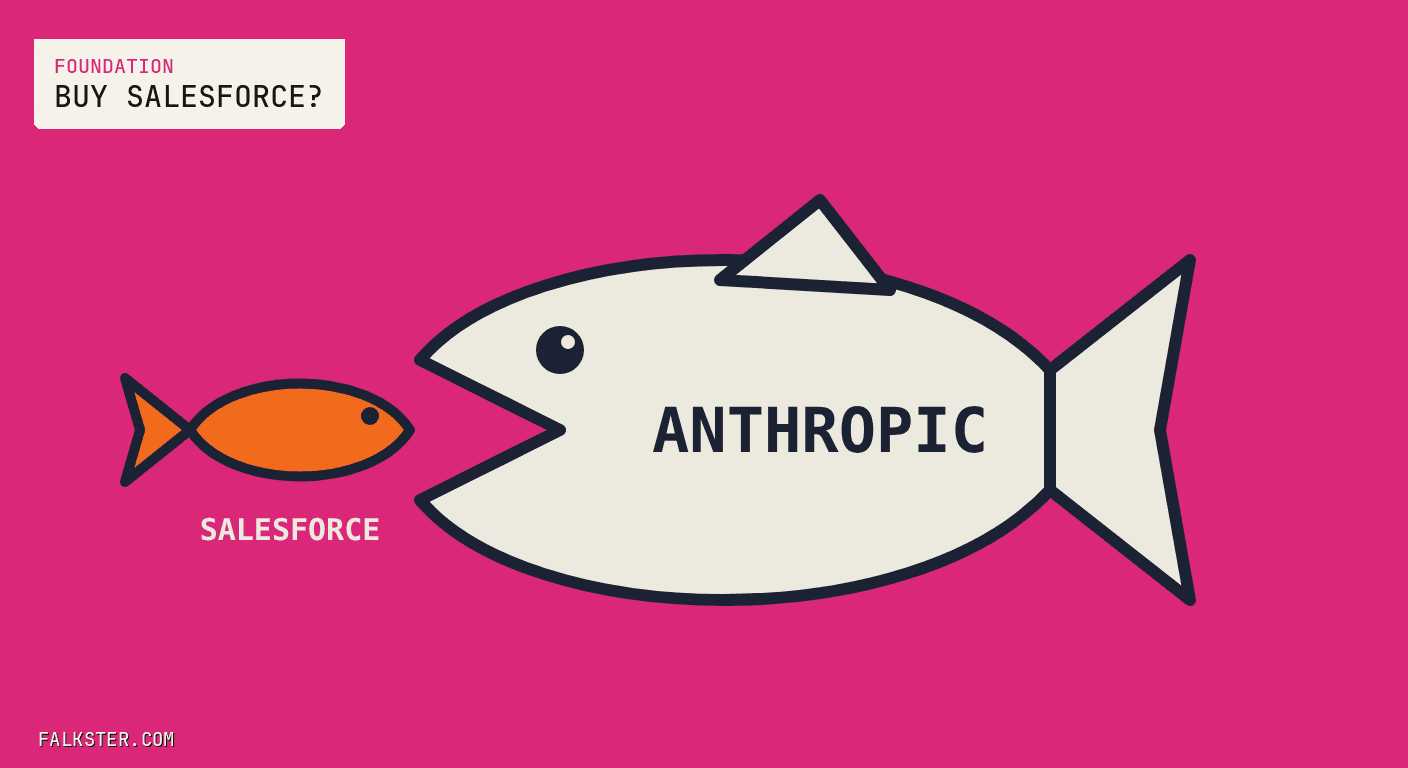
Should Anthropic buy Salesforce? What's your take?
Here's mine: no. It could probably afford to, and that's exactly why the question keeps coming up in my feed.
Most takes on this score the combined company. I went business by business instead, because Salesforce is eight or nine businesses, bought over twenty years, growing at very different speeds and facing very different amounts of AI pressure. Once you split it up, the answer gets clearer.
The short version
Anthropic should not buy Salesforce. It should keep doing what it's doing: own the reasoning layer and let Salesforce compete to be the best data and action layer underneath it. Five findings get me there.
- The price is roughly $275 billion, not $190 billion. A 30% premium on today's equity plus about $28 billion of net debt. That's close to 30% of Anthropic's last private mark.
- Nearly two-thirds of what you'd buy is seat-based application revenue growing in the single digits. Sales, Service, and Marketing and Commerce were $24.3 billion of $39.4 billion in subscription revenue last fiscal year. Agents compress exactly this kind of revenue.
- The parts worth owning are the parts Anthropic already reaches. Slack, the headless data layer, and Informatica are the strategic assets. Claudeforce already makes Claude the default in Slack and the reasoning engine in Agentforce, and Informatica now ships as a Claude plugin.
- Owning Service puts Anthropic in a knife fight with its own customers. Salesforce just bought Fin to fight Sierra. An Anthropic-owned Service Cloud would compete with every customer-service agent company buying frontier-model tokens.
- The deal is partly circular. Salesforce owns an Anthropic stake that Marc Benioff expects to be worth tens of billions, and he plans to sell it to pay down buyback debt. The cleaner trade is already in motion, and it runs the other direction.
The price tag
Salesforce closed October 28 at about $199 billion in market cap and is trading near $190 billion today. Equity is only part of the bill, though. In March, Salesforce borrowed $25 billion to fund an accelerated buyback, and total debt went from $11.8 billion to $42.4 billion in a year. An acquirer inherits that.
| Line item | Figure |
|---|---|
| Equity value, Oct 29, 2026 | ~$190B |
| Equity at a 30% premium | ~$247B |
| Net debt, July 31, 2026 | ~$28B |
| Implied enterprise value | ~$275B |
| Free cash flow, trailing 12 months | $15.2B |
| FY27 revenue guidance | $46.1B to $46.4B |
Net debt and trailing free cash flow are from an analysis of Salesforce's SEC filings; guidance is from the Q2 FY27 release.
On the other side, Anthropic raised at $965 billion post-money in May with run-rate revenue above $47 billion. So the deal is about 18 times Salesforce's cash flow and about 28% of Anthropic's mark. Big, but a stock deal after an IPO could carry it.
Then there's the twist almost nobody mentions. Salesforce is already an Anthropic shareholder. Salesforce Ventures put in hundreds of millions starting in 2023, and at Dreamforce Benioff said he expects the stake to be worth tens of billions and will probably sell it to pay off the buyback debt. Last quarter alone, gains on that position added $2.6 billion to Salesforce's profit. So an acquisition would have Anthropic paying a premium partly to buy back a slice of itself, while Salesforce's own plan is to turn that stake into cash. The money is already flowing from Anthropic's success to Salesforce's balance sheet. A merger would just make it messier.
Five businesses, five growth rates
Subscription and support revenue by line, fiscal 2026 (ended January 31, 2026), from the Q4 FY26 earnings release:
| Line | FY26 | FY25 | Growth |
|---|---|---|---|
| Service | $9.8B | $9.1B | +8% |
| Sales | $9.0B | $8.3B | +8% |
| Platform, Slack, and other | $8.9B | $7.2B | +23% (includes $388M from Informatica; about 17% without it) |
| Integration and analytics | $6.2B | $5.8B | +8% |
| Marketing and commerce | $5.4B | $5.3B | +3% |
The three application lines carry most of the revenue and the least growth. The platform line, home to Slack, Agentforce, Data 360, and now Informatica, is the only one growing at double digits.
Asset by asset
Sales Cloud: the record survives, the screen doesn't
Sales Cloud is where it all started and it's still the anchor: $9.0 billion in fiscal 2026 subscription revenue, up 8%. It's the system of record for pipeline at most large companies, and that record is valuable. Every account, every opportunity, every stage change, written down for a decade or more.
But look at what Claudeforce actually ships. Salesforce in Claude is a plugin with 37 prebuilt sales skills that let sellers prep meetings, check deal health, and update pipeline from inside Claude. The seller never opens the Salesforce UI. The data stays in Salesforce, the governance stays in Salesforce, and the work happens somewhere else. I wrote up that launch the afternoon it landed in Salesforce Put Its CRM Inside Claude.
That's the whole story of Sales Cloud in one product launch. The record keeps its value. The seat, the license that pays for a human to log in, loses it. Salesforce knows this, which is why it's pushing Agentforce One Edition and premium agent SKUs, whose bookings more than doubled last quarter.
For Anthropic, owning Sales Cloud means owning the part being disrupted (seats) to get the part it can already reach (the record). And Claude isn't exclusive here. HubSpot built the first CRM connector for Claude. Owning one CRM would make every other CRM vendor nervous about plugging in.
Verdict: partner. Read and write through the harness. Don't buy the seats.
Service Cloud and Fin: the most tempting asset, and the most dangerous
Service is Salesforce's biggest business, $9.8 billion last fiscal year, up 8%. It's also the business most exposed to agents, because customer service is where AI has the cleanest ROI story and where pricing has already flipped.
The flip is outcome pricing. Sierra charges per resolved conversation, not per seat, and it went from $100 million to $200 million in ARR in two quarters, raising at a $15.8 billion valuation in May. I wrote about why that model works in The Sierra Playbook: What They Actually Do Differently. Fin, Intercom's agent, charges $0.99 per resolution and claims a 76% average resolution rate across more than 12,000 customers.
Salesforce's answer was to buy Fin. It agreed to pay about $3.6 billion in June, and the deal completed in September. That's a smart defensive move, and also an admission. Service Cloud's revenue is mostly human-agent seats. Every resolution Fin or Sierra handles is one less reason to buy one.
Now picture Anthropic owning it. Service Cloud's case history, Fin's per-resolution motion, and Claude as the brain. That's a real Sierra competitor on day one, with a distribution advantage Sierra can't match. I understand the appeal.
Here's the problem. Sierra, Decagon, and every other customer-service agent company are exactly the kind of high-volume API buyers a model lab wants. The moment Anthropic owns a service suite, each of them has a reason to route traffic to another model. And Anthropic already sells the platform version of this play. Claude Managed Agents launched in April to let any company build and run production agents, service agents included. Being the arms dealer to every service vendor beats being one of them.
If Anthropic ever decides to own one application, customer service is the one I'd pick. But there are much cheaper ways in than $275 billion.
Verdict: partner, and stay neutral. Be the model inside Agentforce Service, Fin, and Sierra at the same time.
Slack: the one asset that actually fits
Salesforce paid $27.7 billion for Slack in 2021. It doesn't break out Slack revenue anymore, but at Dreamforce it said Slack revenue is up about 2.5 times since the acquisition. Last quarter Slack posted its fastest net new order growth since the deal, with Slackbot users up more than 150% quarter over quarter.
Slack matters for a different reason than the CRM does. The CRM is the record. Slack is the room. It's where people and agents talk to each other in the open, where a request turns into a thread, a thread into a decision, and a decision into work. That's the surface every AI company wants, and it's exactly where Anthropic is already heading. Claude Tag, Anthropic's multiplayer team agent, runs in Slack today. Under Claudeforce, Claude is the default model across Slack, powering Slackbot and the @Claude tag. Slack's MCP server passed a million active users in six weeks.
So if Anthropic were going to own one piece of Salesforce, this is it. A multiplayer surface fills the biggest gap in a product that is still mostly one person talking to one model.
Two things stop me. First, Salesforce has made Slack the front door to Agentforce. It won't sell the front door at any price Anthropic should pay. Second, Slack is the smaller player in its own market. Microsoft Teams is far larger and sold alongside Microsoft 365, and an Anthropic-owned Slack would hand Microsoft a clean story for keeping Claude out of Teams.
Verdict: the best fit, but not for sale. The default-model slot is most of the value, and Anthropic already has it.
Agentforce, Data 360, and Informatica: the headless harness
This is the fastest-growing part of Salesforce and the part most people undervalue. The platform, Slack, and other line grew 23% to $8.9 billion last fiscal year, about 17% without Informatica. In Q2, Agentforce ARR passed $1.5 billion, up more than 240%, and Data 360 ARR hit $2.4 billion, including $1.1 billion from Informatica. Data 360 ingested 104 trillion records in the quarter, and 82 trillion of them came through Zero Copy, meaning the data never moved.
The strategy shift is in Benioff's own words. He describes AIforce as an enterprise harness that makes Salesforce's data, workflows, business logic, actions, and governance available to every agent, model, and interface. Informatica, bought for about $8 billion and closed last November, now ships a plugin for Claude Code and Claude Cowork covering catalog discovery, metadata, and lineage. Salesforce is turning itself into the data and governance layer that sits under whichever model wins.
I think that's the right call for Salesforce, and I've argued before that context captured at write time is the part of the stack you can't retrofit, in Context Is King. Written Context Is Rented. This is the asset with real staying power.
It's also the asset whose value depends most on neutrality. "Available to every agent, model, and interface" is the pitch. An Anthropic-owned harness stops being neutral the day the deal closes, and every enterprise that runs GPT, Gemini, or open models next to Claude starts looking for a different governance layer.
Verdict: partner. The harness is worth more to Anthropic as a neutral pipe it plugs into than as a captive one it owns.
MuleSoft and Tableau: plumbing and semantics
Together they're the integration and analytics line, $6.2 billion last fiscal year, up 8%. Salesforce paid $15.7 billion for Tableau and about $6.5 billion for MuleSoft. Both are being repositioned for agents. MuleSoft Agent Fabric is pitched as a way to register, govern, and observe agents no matter where they were built. Tableau now talks about agentic analytics and headless delivery of insights into Slack, Teams, and Claude.
My read is that each has one durable piece and one piece under pressure.
For MuleSoft, the durable piece is the ugly enterprise integration work: old ERPs, mainframes, the systems nobody wants to touch. The pressured piece is the simple app-to-app connector, which MCP, the open protocol Anthropic introduced, is turning into something every vendor ships for free.
For Tableau, the durable piece is the semantic layer, the agreed definition of what "revenue" or "active customer" means. The pressured piece is the dashboard. When Claude can generate a live view of your pipeline on demand, and the Claudeforce onboarding does exactly that, a hand-built dashboard is a lot less special.
Neither piece is something a model company needs to own. MCP already gives Anthropic the connector layer, and semantic definitions are worth more when they're shared across every tool than locked inside one.
Verdict: pass. Useful businesses, low strategic value to a lab.
Marketing and Commerce: the slowest line, now being rebuilt by acquisition
This one's personal. I ran the Marketing Cloud platform team after Salesforce bought ExactTarget, including the send engine and the integration with the CRM. So I read the numbers here with some affection and no illusions.
Marketing and Commerce did $5.4 billion last fiscal year, up about 3%, the slowest of the five lines. Analysts covering the Braze deal noted the segment's revenue had declined for three quarters before management pointed to green shoots.
Salesforce's response is to buy its way to a new core. On October 20 it agreed to acquire Braze for about $5.66 billion, more than double the $2.5 billion it paid for ExactTarget in 2013. Braze brings a real-time, event-streaming engagement engine. Contentful, closed September 1 for about $1.5 billion, adds a headless content layer that Agentforce can assemble experiences from. Since 2010, Salesforce has spent roughly $24.6 billion on 16 marketing and customer experience deals.
The AI story in marketing is real. Agents will write the copy, pick the audience, and time the send. But the hard part of this business was never the copy. It's the infrastructure: billions of messages, consent, deliverability, and real-time triggers. That's valuable, and it's also nothing a model lab is built to run. A pending Braze close, which isn't expected until Salesforce's fiscal 2028, would also tangle any acquisition timeline.
Verdict: pass. Good business for Salesforce to fix. Wrong business for Anthropic to own.
The portfolio on one page
My own placement of the seven businesses on two axes, strategic value to Anthropic and exposure to AI disruption. Positions are a judgment, not a measurement.
| Business | Where it sits | Verdict |
|---|---|---|
| Headless harness (Data 360, Informatica, Agentforce) | Worth owning, already reachable | Partner |
| Slack | Worth owning, already reachable | Best fit, not for sale |
| Service Cloud and Fin | Tempting, but a fight with customers | Partner, stay neutral |
| Sales Cloud | Seats under pressure | Partner |
| Tableau | Seats under pressure | Pass |
| MuleSoft | Good business, wrong owner | Pass |
| Marketing and Commerce | Good business, wrong owner | Pass |
The top-left corner is where ownership would pay, and it's exactly where Claudeforce already gives Anthropic the default slot. Everything to the right is a fight with Anthropic's own customers or a seat business agents are compressing. Everything below the line is a fine business that a model lab has no reason to run.
Five ways to play it
Buy or don't buy is too blunt. Here's the real option set, roughly from most to least control.
| Scenario | Rough cost | What Anthropic gets | Main risk | My call |
|---|---|---|---|---|
| Full acquisition | ~$275B enterprise value | Everything: record, room, harness, cash flow | Neutrality gone, seat revenue shrinking, years of integration | No |
| Buy Slack only | Not for sale; Salesforce paid $27.7B in 2021 | A multiplayer surface for Claude | Salesforce won't sell its front door; Microsoft closes Teams | Only if Salesforce ever wants out |
| Buy Service and Fin | Not for sale; untangling it from the platform is hard | An instant Sierra competitor | Competes with the service vendors buying Claude tokens | No |
| Equity stake of 5% to 10% | ~$10B to $19B at today's price | Board-level alignment, roadmap influence | Signals favoritism to every other app vendor | Possible, low value |
| Deepen the partnership | Engineering time and revenue share | Default model in Slack and Agentforce, governed data access | Not exclusive; Salesforce also works with OpenAI | Yes |
That last risk is real. Salesforce also put Agentforce inside ChatGPT and runs ChatGPT in Slack. But a non-exclusive partnership is the price of neutrality on both sides, and neutrality is worth more to Anthropic than exclusivity with any single app vendor.
Score the ownership, not the combination
The typical scorecard for this deal gives strategic synergy a 9 and distribution a 10, then rates the need to actually acquire at 4. Those can't all be true. If a partnership captures most of the value, the synergy you get from owning is the gap between the two. That's the number to score.
| Dimension | Typical take | Ownership only |
|---|---|---|
| Strategic synergy | 9 | 5 |
| Distribution advantage | 10 | 5 |
| Financial feasibility | 6 | 5 |
| Organizational integration | 3 | 2 |
| Need to acquire | 4 | 2 |
Distribution is the one people get most wrong. Anthropic already sells into these enterprises. Buy Salesforce and every other application vendor (Microsoft, ServiceNow, Workday, HubSpot) suddenly has a reason to steer its customers toward someone else's model. You gain one channel and put pressure on all the others. Net distribution could easily go down.
Why the full deal still fails
Put the asset view together and three problems show up that no amount of synergy fixes.
The reinvention trap. The best argument for the deal is that Salesforce would be worth more under Anthropic if Anthropic reinvented it instead of preserving it. I agree with the test. It's also what kills the deal. Reinventing Sales, Service, and Marketing means cannibalizing seat revenue, roughly $24 billion of it. You'd pay a premium for those cash flows and then deliberately shrink them. That's the innovator's dilemma at a 30% markup.
The neutrality tax. Look at where the value sits. Slack is valuable because Claude is the default there. The harness is valuable because it serves every model. Service is valuable because it's where agent ROI is clearest, and every service vendor is a token buyer. Each of those gets worse the moment Anthropic owns it. For a model company, neutrality is the distribution strategy.
The integration bill. Salesforce has more than 80,000 employees and is mid-way through absorbing Informatica, Fin, and Contentful, with Braze still to close. After the ExactTarget deal I spent years stitching acquired products into the CRM and into each other. That was a small company folding into a big one, and it still ate leadership attention for years; Why Acquisitions Fail: The Integration Autopsy is the longer version. This would run in reverse, at many times the scale, inside a company whose real constraints are compute and research talent. Add dilution approval from shareholders like Amazon and Google, antitrust review, and a reported confidential IPO filing in June, and the timing is about as bad as it gets.
What would change my mind
I'd revisit this if three things happened together.
- Models commoditize. Prices fall toward compute cost and enterprise buyers stop caring which model is underneath. Then differentiation moves to data and distribution, and owning a system of record starts to look smart.
- Salesforce goes exclusive somewhere else. If Agentforce or Slack picked a different default model, the partnership stops being enough and control starts to matter.
- Seat erosion shows up in the numbers. If Sales and Service flip from 8% growth to decline, Salesforce gets cheap enough, and motivated enough, to sell pieces. Slack would be the first piece I'd watch.
None of those is true today. Salesforce's cRPO grew 14% last quarter, its agent business is compounding, and Claude holds the default slot. The more likely future is the one both companies are already building: Claude as the interface for enterprise work, Salesforce as the data and transaction layer underneath, and Anthropic capturing much of Salesforce's future strategic value without spending $275 billion. That is the claim under SaaS to AI Business Models in one deal: the seat was priced against labor that agents remove, and the record and the harness are what keep their value.
Your take
That's mine. Now I want yours. Should Anthropic buy Salesforce, buy just Slack, or keep partnering? If you think I'm wrong about Service, tell me how an Anthropic-owned Service Cloud keeps Sierra and Decagon buying Claude. And if you think I'm wrong about distribution, tell me which app vendor you'd expect to stay neutral after a deal like this.
One thing to try this week: the same mistake shows up in smaller build, buy, or partner calls. Pick one you're weighing and add a column to the scorecard: value from ownership minus value from the best partnership you could realistically get. Then break the target into its assets and score each one. If the column is small for everything except one piece, you've found the real deal, and it's usually not the whole company.
Related answer: Should Anthropic buy Salesforce or keep partnering?
Sources: Salesforce Q4 FY26 earnings release; Salesforce FY26 revenue disaggregation (SEC exhibit); Salesforce Form 10-K, FY26; Salesforce Form 10-Q, Q2 FY27 (Contentful and Fin agreements); Salesforce Q2 FY27 earnings release; Salesforce Q2 FY27 results, investor relations; Vantage Point: Q2 FY27 breakdown; The Strategy Story: Salesforce business model 2026; SQ Magazine: Salesforce statistics; sec-api.io: Salesforce financial analysis, August 2026; Fortune: Salesforce $25B buyback funded with debt; TIKR: Salesforce debt and the Anthropic stake; Benzinga: Benioff on the Anthropic stake; Yahoo Finance: Salesforce (CRM) quote; Bloomberg Law: Anthropic raises at $965B valuation; W.Media: Anthropic run-rate revenue; Komo: Anthropic funding and IPO status; YourStory: Claudeforce and Salesforce in Claude; The Deep View: Claude gets a Salesforce home; Constellation Research: Salesforce expands OpenAI and Anthropic partnerships; Anthropic: Claude for Small Business; The New Stack: Claude Managed Agents; Okara: Sierra revenue growth; ValueAdd VC: Sierra valuation 2026; Aissist: Intercom Fin review; Digital Commerce 360: Salesforce to acquire Braze; TechTarget: Salesforce bets $5.66B on Braze; CMSWire: Why Salesforce is buying Braze; Let's Data Science: Braze deal and Marketing Cloud revenue; FocusReactive: Salesforce bought Contentful; Info-Tech: Dreamforce 2026, Data 360, Tableau, Informatica; Carly: Slack statistics.
Frequently asked
Should Anthropic buy Salesforce?+
No. Anthropic should keep owning the reasoning layer and let Salesforce compete to be the best data and action layer underneath it. The price is roughly $275 billion in enterprise value, nearly two thirds of the revenue is seat-based application subscriptions growing in the single digits, the assets worth owning (Slack, the headless harness, Informatica) are the ones Claudeforce already gives Claude by default, owning Service Cloud would put Anthropic in competition with the customer-service agent companies that buy its tokens, and Salesforce already holds an Anthropic stake it plans to sell.
What would Salesforce actually cost Anthropic?+
About $275 billion in enterprise value: roughly $190 billion of equity at October 29, 2026 prices, a 30% premium taking that to about $247 billion, plus about $28 billion of net debt after Salesforce borrowed $25 billion in March to fund a buyback. That is about 18 times trailing free cash flow of $15.2 billion and about 28% of Anthropic's $965 billion post-money valuation from May.
Which part of Salesforce would be worth owning?+
Slack, because the CRM is the record and Slack is the room where people and agents turn requests into decisions and work, and the headless harness (Agentforce, Data 360, Informatica), the only line growing at double digits. Both are already reachable: Claude is the default model across Slack under Claudeforce, Claude Tag runs in Slack today, and Informatica ships a plugin for Claude Code and Claude Cowork. The default-model slot is most of the value, and Anthropic already has it.
Why is Service Cloud the most dangerous asset?+
Because customer service is where agent ROI is clearest and pricing has already flipped to per-resolution. Sierra went from $100 million to $200 million in ARR in two quarters, Fin charges $0.99 per resolution, and Salesforce bought Fin for about $3.6 billion to fight them. Sierra, Decagon, and every other service-agent company are the high-volume API buyers a model lab wants; the moment Anthropic owns a service suite, each has a reason to route traffic to another model.
What are the alternatives to a full acquisition?+
Five scenarios, roughly from most to least control: a full acquisition at about $275 billion (no), buying Slack alone (not for sale, and Salesforce paid $27.7 billion in 2021), buying Service and Fin (an instant Sierra competitor that fights the vendors buying Claude), a 5% to 10% equity stake at $10 billion to $19 billion (possible, low value, and it signals favoritism to every other app vendor), and deepening the partnership (yes, even though it is not exclusive and Salesforce also runs ChatGPT in Slack).
What would change Falk's mind?+
Three things together: models commoditize so differentiation moves to data and distribution, Salesforce picks a different default model for Agentforce or Slack, and seat erosion shows up in the numbers with Sales and Service flipping from 8% growth to decline. None is true today: cRPO grew 14% last quarter, the agent business is compounding, and Claude holds the default slot.
What is the scorecard mistake in most takes on this deal?+
Scoring the combination instead of the ownership. A typical scorecard gives strategic synergy a 9 and distribution a 10, then rates the need to acquire at 4, which cannot all be true. If a partnership captures most of the value, the synergy from owning is the gap between the two. Score that gap, asset by asset, for any build, buy, or partner call: value from ownership minus value from the best partnership you could realistically get.

Comments (0)
Sign in with LinkedIn to leave a comment.
Sign in with LinkedIn