
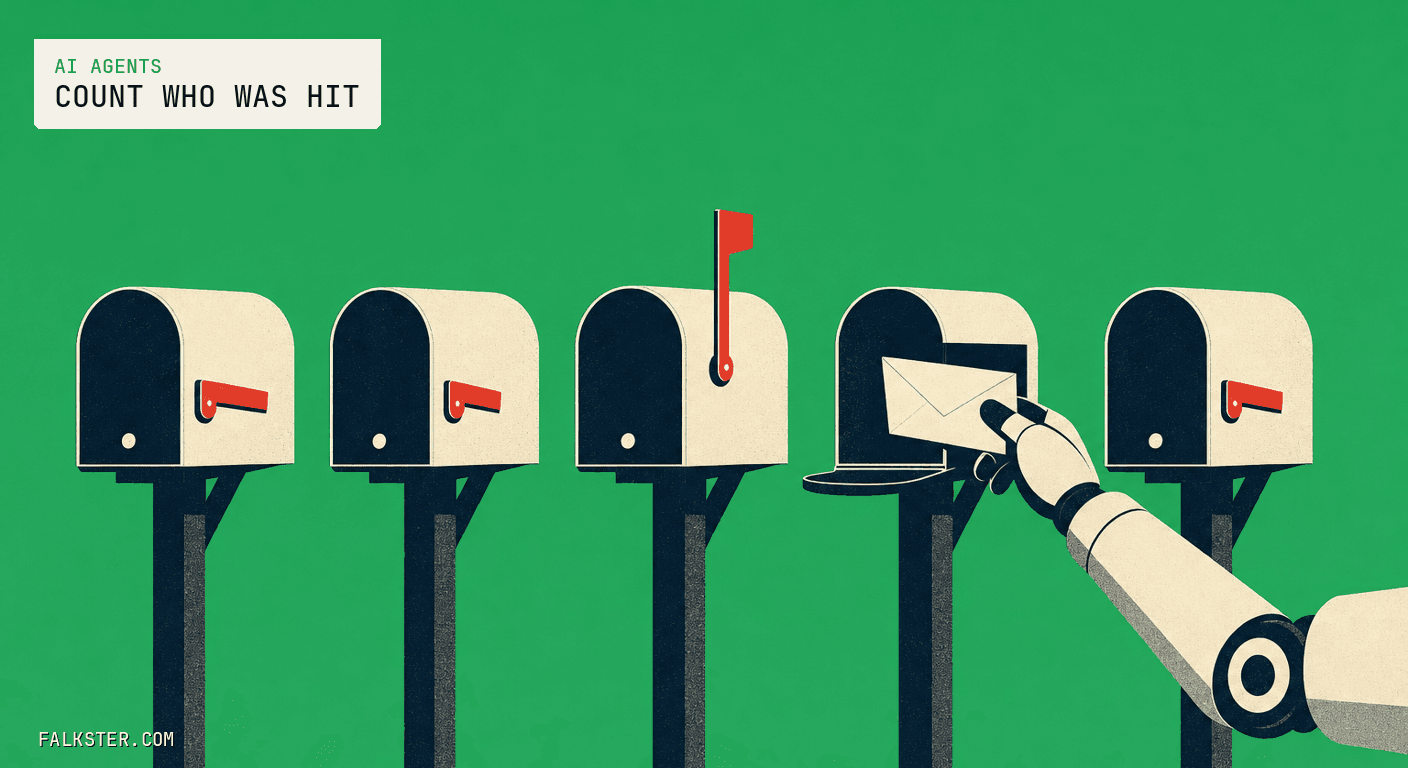
Most people who run into a broken feature don't write in. They shrug, work around it, and trust the product a little less.
One company now writes to those people first. I think it's the most copyable idea I read this week, and it fits a hole in my own numbers.
The short version
- Amp makes an AI tool that helps people write software.
- Its AI agent sorts bug reports, starts the fixes, and drafts an email to every customer a bug touched. That includes customers who never complained.
- The emails often include free credits, and a person reads each one before it goes out.
- I once had more than 200 pricing disputes a week, and those were only the customers who spoke up. The useful count is everyone who was hit. Your logs already know.
What Amp does, per the notes
Luke Wroblewski is a designer who writes short notes on building AI products. On November 20 he published notes from an event where five builders showed how far they push AI agents. One was Quinn Slack, the chief executive of Amp. I read the notes in full and didn't watch the talk. So everything about Amp here is as those notes report it.
Start with size. Amp passed $100 million in yearly revenue with 21 people. It has no support team.
It also got about 9,300 bug reports in three months. Most were filed by customers' own AI agents. Each report captures what the person was trying to do, and whether they were angry.
9,300
An agent at Amp groups those reports into themes. It pulls in logs, past messages, and how much the customer is worth. It starts the fixes. Then it drafts an email to every affected user, including the ones who never reported anything.
The emails often carry free credits. That came to about half a million dollars in three months. A person still reads every email before it's sent, because fully automatic notes felt too cold.
One thing I can't settle. The notes say the credits were less than 0.5% of revenue. They don't say revenue over what period. Half a million dollars is 0.5% of $100 million, so it may be measured against a full year. That's my arithmetic, and I may be reading it wrong.
The hole in my own numbers
I wrote a field report about ending a per-user price at a software company. The company is anonymized and the numbers are representative, so read them as a pattern.
In it, we charged per solved support ticket. Our written rule for "solved" held for 98% of cases. The other 2% turned into more than 200 contested cases a week. The whole story is in One Support Agent, Three Resolution Rates.
It's easy to treat that 200 as the size of the problem. It was only the size of the complaint pile. Those were customers annoyed enough to write. How many got a wrong answer, paid for it, and said nothing? My report doesn't say. I've since argued that the disputes are the best sample you have, in Nielsen Says Audit the Outcome Meter With 50 Billed Cases. The Dispute Queue Already Pulled the Sample.. Amp's approach goes one better. It doesn't wait for the pile.
The logs know who was hit. The inbox only knows who complained.
The steps
You can run this with any agent that can read your logs and draft email.
First, group incoming reports by cause, so one bug is one item. Second, use the logs to list every customer that bug touched, whether or not they wrote in. Third, write the credit rule before the agent drafts a word: who gets a credit, how much, and who approves anything bigger. Fourth, have the agent draft a short note to each person. It should say what broke, that it's fixed, and what they're getting. Fifth, keep a person on the send button.
The third step is mine, and I'd insist on it. An agent that picks the amount email by email will be generous in ways nobody chose.
Then count two numbers for every bug. Customers affected. Customers who reported. The gap is the group you never used to hear from.
This week
Take the last bug your team fixed. Pull the logs and count who it touched. Then count who told you. Write to three of the silent ones by hand and see what comes back.
A caution to close. I've read notes from one talk. I haven't seen Amp's system, and a 21-person company selling to developers isn't every company.
This belongs with my other writing on Enterprise AI Agents: the agent earns its keep on the work nobody had time to do, like writing to people who never asked.
Related answer: Should you tell customers about a bug they did not report?
Sources: Luke Wroblewski, "Crazy Agent Scale: Companies All-in on AI," LukeW, November 20, 2026, read in full. Every figure about Amp is from his notes on Quinn Slack's talk, and the talk itself was not watched. The 98% and the 200 contested cases are from my own field report, which is an anonymized composite with representative numbers. The 0.5% check is my own arithmetic.
Frequently asked
What does Amp's agent do with bug reports?+
As Luke Wroblewski's notes on Quinn Slack's talk report it, the agent groups reports into themes and pulls in logs and customer history. It starts fixes and drafts an email to every affected customer. A person reviews every email before it's sent.
Why email customers who never reported the bug?+
Because most people who hit a problem say nothing. The logs show who was affected. Writing to them first turns a silent bad moment into proof that someone is watching.
How much did the credits cost Amp?+
About half a million dollars over three months, which the notes put at less than 0.5% of revenue. The notes don't say which period the percentage is measured against.
What should be decided before the agent drafts anything?+
The credit rule. Who gets a credit, how much, and who can approve more. An agent that invents the amount per email will be generous in ways nobody chose.
What two numbers should a team count?+
Customers affected and customers who reported, for each fixed bug. The gap between them is the group you never used to hear from.

Sign in with LinkedIn to leave a comment.
Sign in with LinkedIn