
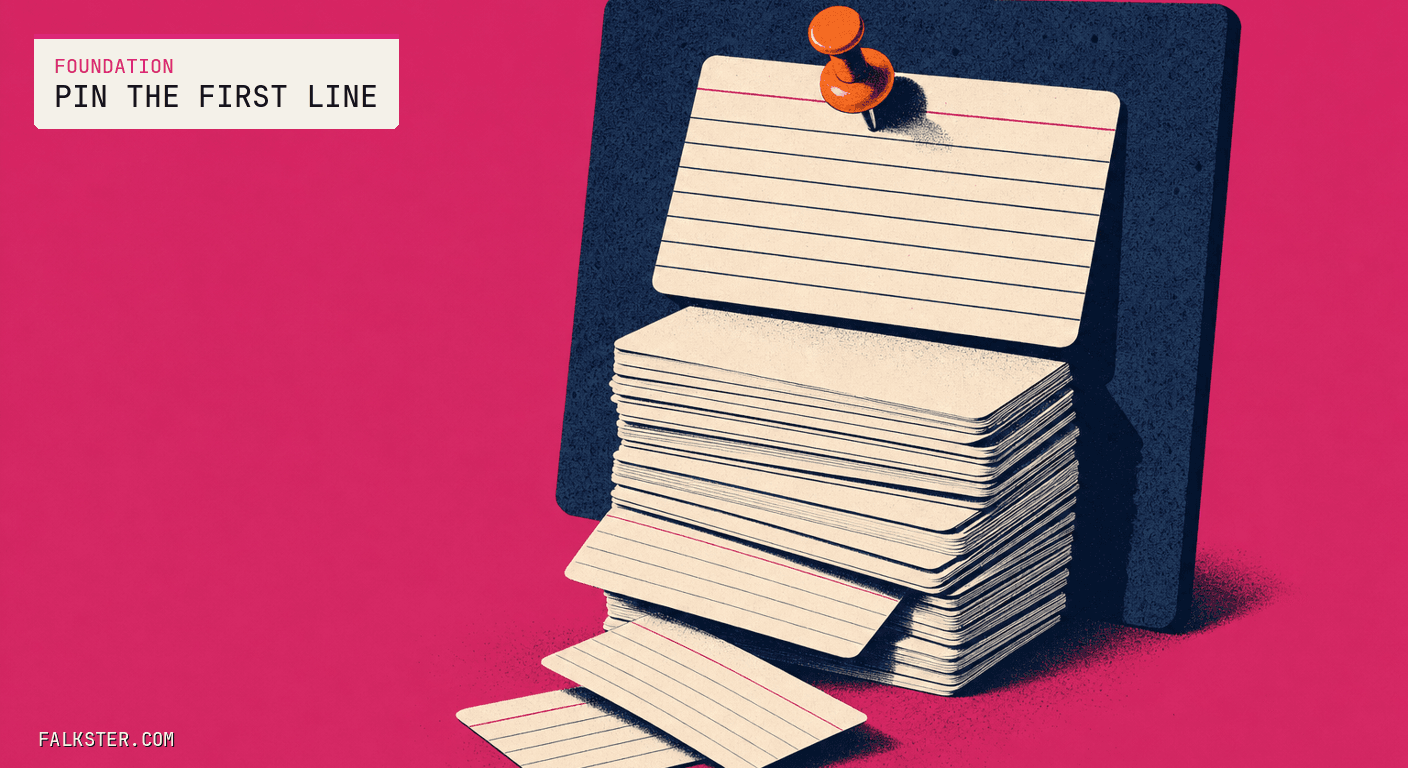
AI agents now work on jobs that last for days. No agent can keep a whole job in view. At some point it has to shrink its notes to make room. What it drops first decides whether the job stays on track.
This is an Agent Drop. It has three rules you can add to a long-running agent this week.
The short version
- An agent on a long job runs out of room and has to shrink its notes.
- A lesson in the course Becoming Forward Deployed Engineer tested two ways to do that.
- A forward deployed engineer is an engineer a software company sends to work inside a customer's systems. Both ways kept the same number of facts. The simple way shrank the oldest note first. That note was the customer's standing instruction.
- The saving was tiny, and the answers afterwards looked normal. So pin the customer's first rule so it never gets shrunk. Tag every note with where it came from.
- For anything you can look up again, keep the address and drop the body.
What the lesson tested
The lesson is number 14 in the course, published on November 21, 2026. The course doesn't name its author. I read the free part. The rest is paid, and I didn't use it.
The lesson's example is an insurance adjuster working with an agent. The adjuster starts on Monday, works for forty minutes, and comes back on Tuesday. Two things go wrong in between.
First, Monday's session gets too big for the agent's memory limit. Something has to go. Most systems drop the oldest thing. The oldest thing is what the adjuster said first, which set the rules for everything after.
Second, Tuesday's session reads what Monday wrote down. Notes the model wrote about documents now sit next to the documents. Nothing tells them apart.
The lesson then runs a test. It asks 20 questions, each with a real search. The memory limit is 900 tokens. A token is a chunk of text the model reads.
Here is what happened at each step. Look at the last two rows.
| How the notes were kept | Size in tokens | Facts kept | Customer's rule |
|---|---|---|---|
| Everything as it happened | 6,402 | 262 | kept |
| Bodies swapped for addresses | 989 | 49 | kept |
| Summary, with the rule pinned | 890 | 40 | kept |
| Summary, oldest note first | 864 | 40 | lost |
The last two rows use the same method and keep the same 40 facts. The only change is whether the first note is protected. The unprotected version is 26 tokens smaller. That is the whole saving.
The lesson makes the point that this failure makes no noise. Nothing crashes. The answers keep coming, and they read fine. They just no longer follow the rule the customer set at the start.
26 of about 890
Why this matters for customer work
An agent that works for one customer across days has a first sentence that matters more than the rest. It might be "never approve a claim without the police report." It might be "all prices are in euros."
People lose that sentence too. In 2,000 of 17,000: The FDE Shortage Is a Product Problem I listed four things a forward deployed engineer (FDE) needs on site. The fourth was a sale that sold a clear scope. That scope is the first sentence of the project. Three months in, it's the oldest thing anyone remembers. So it gets shortened first.
In Boaz Francis Looks for the Spark in an FDE. His Own Sites Say the Site Decides Who You Can Hire. I said to write those four things down before hiring. This lesson is the agent's version of the same habit. Write the first sentence down where nothing can shorten it.
Three rules for a long agent job
1. Pin the standing instruction. Write the customer's rule as its own note. Mark it so it is never shortened or dropped. In the lesson's run, that one mark is the difference between the last two rows.
2. Tag every note with where it came from. The lesson uses five labels: user, document, tool, model, and unknown. It trusts only the first two. A note the model wrote is not trusted. Neither is anything recalled from an earlier session, because a model was part of that session.
3. Keep the address and drop the body. When a tool returns a result, store the exact call that fetched it. Later, when room runs short, remove the text and keep the call. Nothing is lost, because the document is still where it was.
The order matters. Swap bodies for addresses first, and summarize second. In the lesson's run the swap alone took the notes from 6,402 tokens to 989. It missed the limit by 89, so the summary step still had to run. Later, 17 addresses were turned back into 233 facts without asking the model anything.
How I do this in one agent
I have one agent that runs on a schedule. Every week it reads what other writers published and drafts ideas from it.
Its first instruction is to read one file before it does any work. That file holds my standing rules. Seven lines in it mark a rule with my name and the date I gave it. One says to publish the posts in the same run, and it is dated September 28, 2026.
That is a pin and a source tag in plain text. The agent starts fresh each run and reads the rules again. Nobody summarizes them.
There is a limit to what I know here. I can't see how the platform shrinks the agent's notes inside one long run. That is why the rules live in a file and not in the conversation.
This week
Find the first sentence your customer said. Then run a long session with your agent and ask it to repeat that rule. If it can't, pin the rule. The whole series on this role is at The FDE Transition. This sits in AI Product Management because deciding what an agent must never forget is a product call.
Related answer: What should an AI agent keep when its memory fills up?
Sources: "Lesson 14: Multi-Agent Systems," Becoming Forward Deployed Engineer, November 21, 2026. I read the free part only. Every figure in the table and the three steps are as that part gives them. The 26 is the difference between its last two rows, and the lesson states it too. The two example instructions are mine, for illustration. The count of seven dated rules is from my own scan's instruction file.
Frequently asked
What did the lesson's test show?+
In the free part of Lesson 14 of Becoming Forward Deployed Engineer, two ways of shrinking an agent's notes both kept 40 of 262 facts. The one that shrank the oldest note first saved 26 more tokens and lost the customer's standing instruction.
What is a token?+
A chunk of text the model reads, often a word or part of a word. An agent's memory limit is counted in tokens.
What does it mean to pin an instruction?+
It means marking a note so it is never shortened or dropped when memory fills up. The customer's standing rule is the first note to pin.
Why tag notes with where they came from?+
Because a note the model wrote about a document can end up stored next to the document. They look the same later. The lesson trusts only what came from the user or from a document.
What does 'keep the address, drop the body' mean?+
If a result can be fetched again, store the exact call that fetches it and remove the text. In the lesson's run, 17 such addresses were turned back into 233 facts without asking the model.
Did you read the whole lesson?+
No. I read the free part. The rest is paid, and I did not use it. The course does not name its author.
Sign in with LinkedIn to leave a comment.
Sign in with LinkedIn