
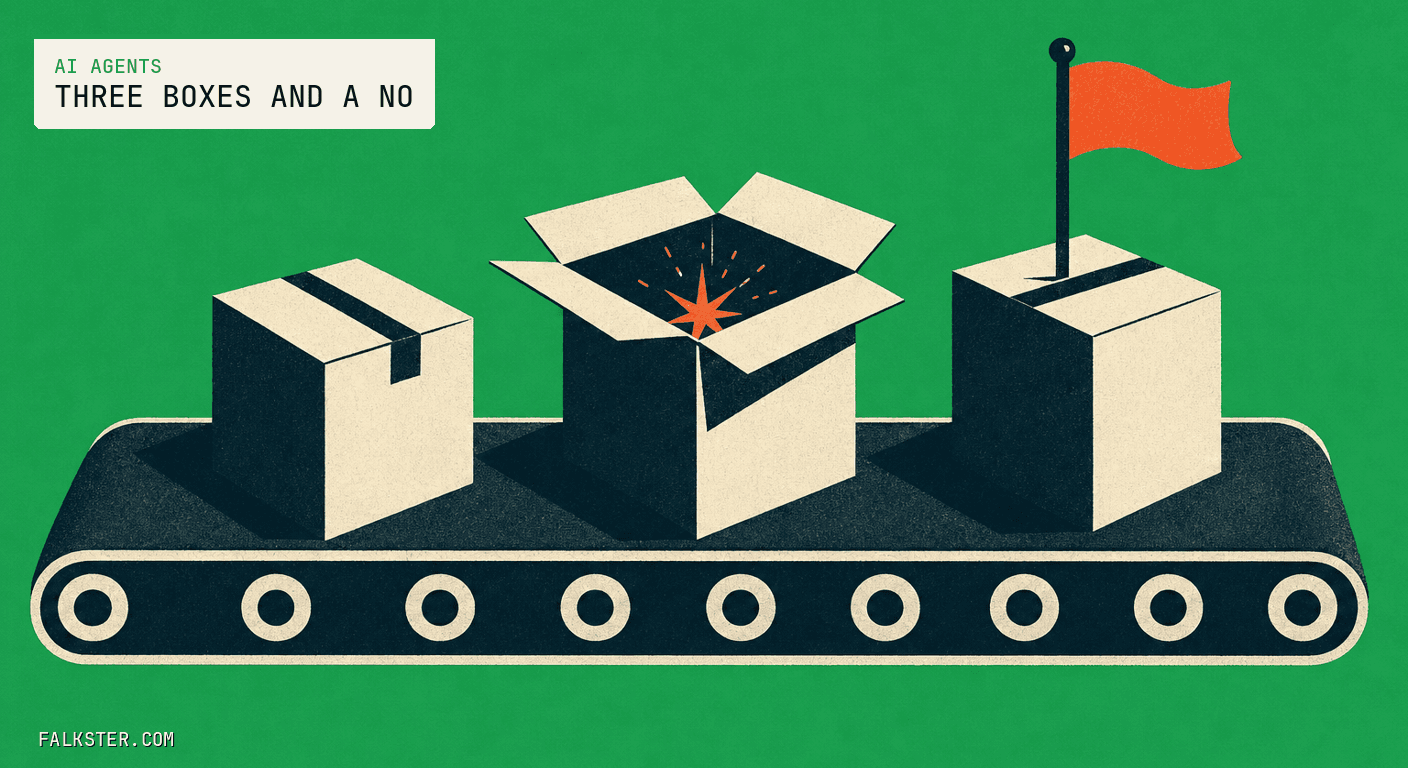
Most teams that try AI agents get stuck in the same place. The agent can do a task once, on one project, with someone watching. Doing it thousands of times with nobody watching is a different job.
A food delivery company in Brazil just showed how it does that. The pattern is small enough to copy this week, so here it is, with one addition.
The short version
- iFood is a food delivery company in Brazil.
- It keeps its software in more than 15,000 separate code projects.
- OpenAI, the maker of ChatGPT, published a write-up on how iFood runs AI agents across all of them. Each run has three parts. Fixed steps set up the work. The AI model does the task in a sealed space. Fixed steps deliver the result.
- At the end the agent fills in a form that says whether it worked. I run my own weekly agent the same way.
- I'd add one thing the write-up doesn't describe: a check the agent can't fill in itself.
What iFood built
The source is an OpenAI customer story dated November 24, 2026. It quotes Victor Coelho, a Senior Software Engineer at iFood. I read it in full. Keep in mind what it is. A vendor wrote it about a happy customer, and nobody outside has checked the numbers.
Here they are. The cost line is the one to look at.
| What the write-up reports | Number |
|---|---|
| Code projects at iFood | more than 15,000 |
| Runs the platform has completed | more than 25,000 |
| Average model cost per run | US$0.04 |
| Text the model has processed | more than 27 billion tokens |
| Security problems fixed | more than doubled |
A token is a chunk of text the model reads or writes.
The idea behind the platform is simple. Lots of teams at iFood wanted agents to do routine jobs, like fixing a risky software part or checking code against house rules. Each team was building its own way to run them. Coelho says they all hit the same wall. So one team built the runner once, and now other teams just call it.
A run goes like this. A team sends a request. The platform starts a sandbox, which is a sealed computer where the agent can't touch anything else. Fixed steps go first: copy the code, load the agent's instructions, set up a working copy. Then the model does the task. Then fixed steps again: publish the proposed change for a person to review, and save any files.
And then the form. The agent's final answer has to fit a set shape, using an OpenAI feature called Structured Outputs. Coelho says this means they always get a response from a run, "whether positive or negative."
The three boxes
Strip the product names away and you get a shape anyone can use.
The first box is everything that needs no judgment. Fetching, copying, setting up. A plain script does it the same way every time, and it costs almost nothing.
The second box is the only place the model works. Keep it sealed. Give it one job.
The third box is delivery, and it's fixed too. The model doesn't decide where its work goes.
Then the form, with a real place for "this didn't work." That's the piece I see left out most. An agent with no way to report failure will report success.
My weekly agent has the same shape
I run a research agent every week. It has these three boxes, though I never drew them until I read this.
A script goes first, with no model involved. It fetches the week's posts from the writers I follow and filters them. Today it pulled 219 posts and kept 81.
Then the model reads those and writes.
Then fixed checks run. One scores how hard each draft is to read. Others test links and page titles. Yesterday's run ended with 65 tests passed and none failed.
The instructions carry a "no" as well. If the agent can't reach my computer, it says so in one line, sends me a note, and stops. I've written before about why that matters. It's in Harrison Chase Says Sometimes Doing Nothing Is the Right Action. My Scan Has a Quota, and a Quota Cannot Choose Nothing..
The check I'd add
Look at who fills in iFood's form. The agent does.
So the form tells you what the agent says happened. At 25,000 runs that's worth a lot, because you can count the yeses and the noes without reading every run. But it's still the agent's word.
25,000+ runs
After the form, I'd run one check the agent doesn't control. For a security fix, that means scanning the code again. If the hole is still there, the "yes" was wrong, and now you know which runs to distrust.
My reading-level score works like that. A script produces it. The model can't talk its way past the number.
To be fair, iFood may already do this. The proposed change goes to a person, and the security tool it feeds probably scans again. The write-up is a short page and doesn't say. Snyk, a security software company, described its version in detail, and I covered it in Snyk Ran Its Agent Inside for a Year. Copy the Gate..
One question about the 4 cents
I did the division. More than 27 billion tokens over more than 25,000 runs is about 1 million tokens a run. That's my arithmetic, and the write-up doesn't state it.
A million tokens for 4 cents is very cheap. I can't check the price from outside, and the page doesn't say what's counted. So before you put that number in a plan, ask what's in it. The sealed computer costs money too. So does the person who reviews each proposed change. I made that second point in Kill Cost per Merged PR as the Coding Agent Number. The Count Stops at Merge..
This week
Take one task you'd hand to an agent. Draw three boxes. Move everything that needs no judgment out of the middle one. Write the form, and give it a "no." Then name one check the agent can't fill in.
This is part of the case on Enterprise AI Agents: what counts is the work an agent finishes unattended, and what each finished job costs.
Related answer: How do you run AI coding agents across thousands of code projects?
Sources: OpenAI, "How iFood scales coding agents across 15,000 repositories," November 24, 2026, with Victor Coelho of iFood quoted, read in full. Every figure about iFood is from that page. The figure of about 1 million tokens a run is my own division of two numbers on the page. The counts for my own agent are from this site's files: today's scan, and yesterday's test run.
Frequently asked
How does iFood run AI coding agents across 15,000 code projects?+
Through one internal service that any team can call. Each run has fixed setup steps, then an AI model working in a sealed computer, then fixed delivery steps. The result comes back as a proposed change for a person to review.
What does a run cost?+
OpenAI's write-up gives an average model cost of US$0.04 per run, across more than 25,000 runs. That figure is the model cost only. The page doesn't say what else is counted, so ask before you copy the number.
What is the form with a no?+
At the end of each run the agent's answer has to fit a set form. The form has room for a failed result as well as a good one. iFood's engineer says this means they always get a response, positive or negative.
What would you add to iFood's design?+
One check the agent doesn't control, run after the form. For a security fix, scan the code again. The form is the agent's own report, and a report can be wrong.
Do you run agents this way yourself?+
Yes, on a small scale. My weekly research agent starts with a plain script that fetches posts, then the model writes, then fixed checks run. Yesterday's run ended with 65 tests passed and none failed.
Sign in with LinkedIn to leave a comment.
Sign in with LinkedIn