
Luke Wroblewski published a short note this week called "Design by Playground." The sentence that stopped me: "Design tools used to be something you spent years learning. Now they can be something you make, use for an afternoon, and happily move on."
He is writing about designers who build disposable per-task tools with coding agents. Not templates. Not Figma components. Software. A data visualization tool for one presentation. An annotation layer for one user test. A component explorer for one design review. Used, then discarded.
The short version
- At Salesforce and Adobe, Figma fluency was a hiring gate.
- Messy files or slow component work meant a designer was not ready for a team at scale. That gate has moved, not disappeared.
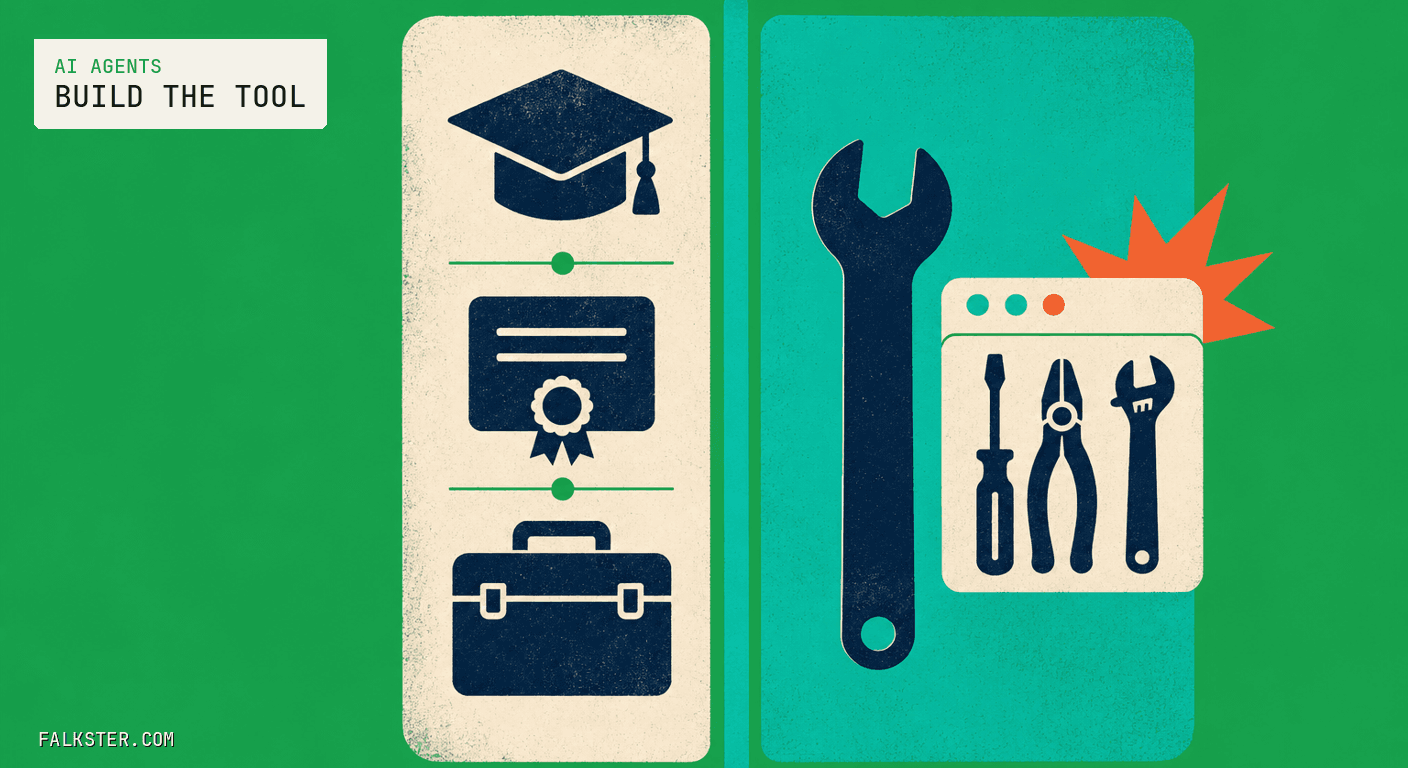
- When a designer can build a custom tool for one brief and discard it the same afternoon, the credential shifts. It is no longer mastering the shared tool.
- It is knowing which tool to build, and when to build it instead of using the one you already have.
- The Design Operating Model chapter on portfolios(coming Jan 13) argues that what a portfolio should show is judgment over screens. Building a custom tool is judgment at a higher resolution.
What tool fluency used to gate
When I ran design teams at Salesforce and Adobe, we looked at tools early in the interview process. It was not arbitrary. A designer who could not move quickly in Figma was slower in collaboration. Inconsistent component libraries meant more rework downstream. Weak file organization created friction when other designers needed to pick up work in progress.
These were real costs, and tool mastery was a reasonable proxy for someone who had paid the costs of that slowness and learned from them.
The problem with any credential is that it measures scarcity. Tool fluency was scarce in 2018. It is not scarce in 2026. Every designer can be competent in Figma with a few months of practice. The tool has also become much more accessible. Figma does more of the work. Auto layout, variables, and component logic have absorbed complexity that used to require skill.
one afternoon
What the playground changes
What Wroblewski is describing is not a new feature of Figma. It is a different category of work. The disposable tool is not a Figma prototype. It is actual software, built with a coding agent in an hour or two, that the designer needed for a specific purpose and would not use again.
This matters because it separates two skills that used to be bundled:
Knowing the shared tool (Figma, Sketch, whatever the team uses). This is still required for shared work, design systems, and anything that other designers need to pick up and continue.
Knowing which tool to build. The judgment about when the shared tool is the right choice versus when the problem needs a custom solution, and what that custom solution should look like. This is now a separable, meaningful skill, and it was not before because building a custom tool required months of engineering work.
The second skill was always present in strong designers. Luke himself has been building custom tools for years, and his notes from the last decade are full of experiments with custom interfaces and specialized utilities. What has changed is that the second skill is now accessible to every designer, not just the ones who could also code.
What the portfolio shows now
The Design Operating Model chapter on new portfolios(coming Jan 13) makes the argument that a portfolio should show judgment over screens. The best portfolios answer the question: how did this person decide what to design, before they designed anything?
Playground-built tools are a new form of that evidence. A designer who built a custom annotation layer for a user test did not reach for the shared tool. They asked what the problem actually needed and built the right thing. That is judgment at a different resolution than a designer who produced a beautiful Figma prototype of the same screen.
The gate has not disappeared. It has moved from mastery of the shared tool to knowing when to use the shared tool and when to build something better. The distinction between the two is now the interesting credential.
What this means for hiring
The practical implication for design teams: the interview question has changed. "Show me your Figma files" tests the old credential. The new question is closer to "show me something you built that you would not normally have needed to build." The playground work, the disposable custom tools, the experiments built for one meeting and thrown away.
That work does not appear in a traditional portfolio. It does not live in Figma. It lives in a coding environment and a Thursday afternoon. The design teams that figure out how to evaluate it will hire differently than the ones that do not.
Related answer: What should a designer's portfolio show in 2027?
Sources:
- Design by Playground, Luke Wroblewski, LukeW, 2026-11-19
- The New Portfolio(coming Jan 13), Design Operating Model, falkster.com
The authority cluster for this post is Enterprise AI Agents.
Frequently asked
What does 'design by playground' mean?+
Luke Wroblewski uses it to describe a shift in how designers work: instead of using a shared professional tool (Figma, Sketch) to produce work, they build a custom tool for a specific task using coding agents, use it for one project or one meeting, and throw it away. The tool is both the working environment and the proof of concept.
What changes about design hiring when designers can build their own tools?+
The traditional gate was proficiency in the shared tool. If you were slow in Figma or your component libraries were inconsistent, you were not ready for a team that shipped at scale. That gate has not disappeared, but its weight has changed. The more interesting question now is whether the designer knows which tool to build for a problem, not just how to use the one everyone shares.
What does this mean for design portfolios?+
The Design Operating Model chapter on portfolios argues for showing judgment over screens. Designers who can build custom tools are showing judgment at a different resolution: not which screen layout they chose, but which tool architecture they designed to solve the brief. That is a harder thing to fake in a portfolio review.
Does Figma fluency still matter?+
Yes, for shared work, shared components, and design systems. The credential has not disappeared; its exclusivity has. When every designer can build a Figma-like tool for the afternoon, the question shifts from 'can you use Figma' to 'do you know when Figma is the right choice versus building something disposable.'
Who is Luke Wroblewski?+
Luke Wroblewski is a product designer and technologist who has worked at Google, Alphabet, and Apple, and writes short, concrete notes on designing AI and agent interfaces. He posts at lukew.com.

Sign in with LinkedIn to leave a comment.
Sign in with LinkedIn