
AI agents that write code stop many times an hour to ask, "May I do this?" Most people click yes without reading. A well-known usability researcher wrote this week about how to fix that. His fix assumes a person is sitting there. Mine often isn't. This is a Rewrite of his three tiers into four.
The short version
- Jakob Nielsen has studied how people use software for decades. This week he covered a survey of 115 software developers.
- One in five admits to approving an AI agent's requests without reading them.
- His fix is to sort requests into three tiers: allow, ask, and block. That works when a person is watching.
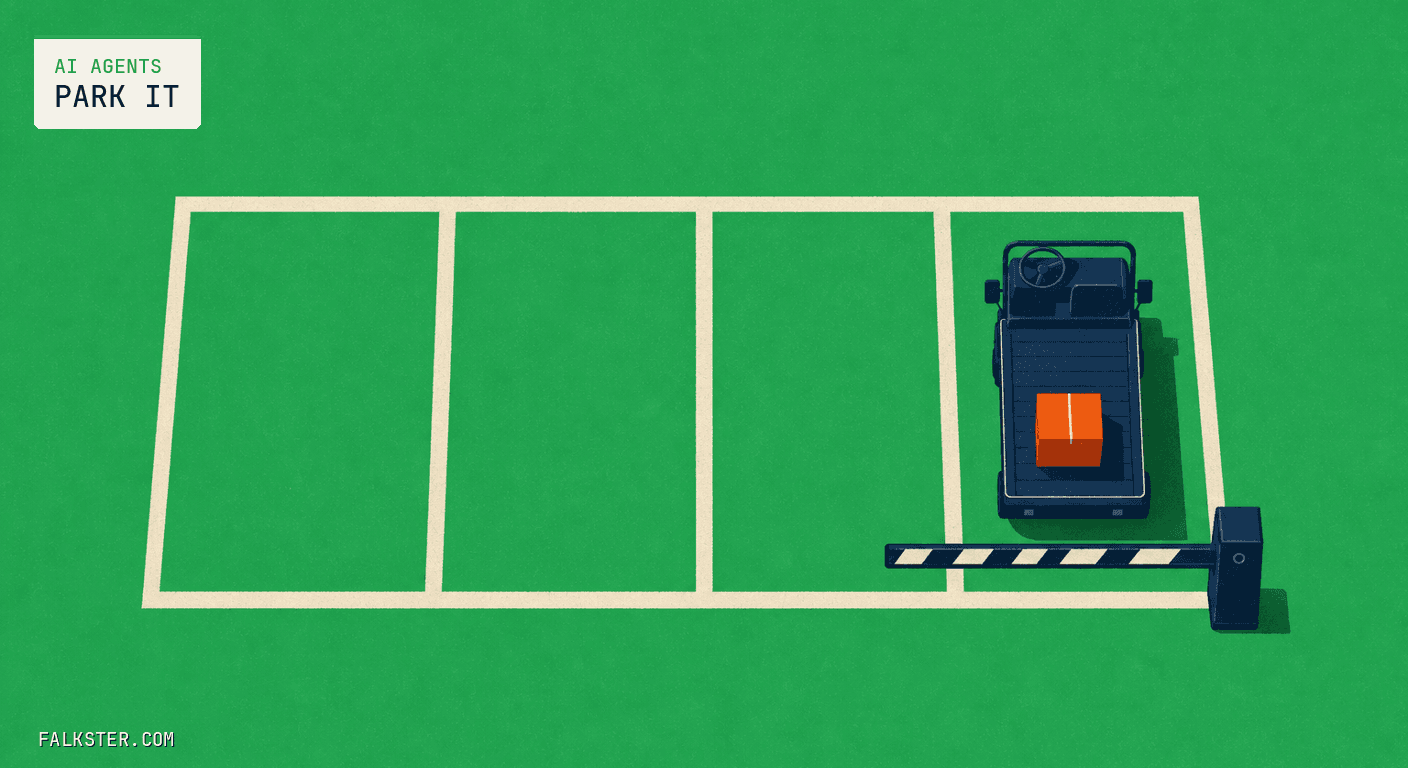
- One of my agents runs on a schedule while I'm away, so there is nobody to ask. My instructions for it grew a fourth tier. I call it park it.
- The agent finishes the work, stops before the risky step, and writes down what to do next. Parking has one problem. The pile grows, so you have to count it.
What Nielsen reported
Nielsen's roundup of November 20, 2026 has three items on this. I read all three in full.
The first is a study by Larissa Salerno and co-authors from three universities. They interviewed 18 developers who use coding agents and then surveyed 115. I did not open the paper. These are Nielsen's numbers from it.
- 21% said they approve permission requests by default.
- 48% said they read the requests carefully.
- 34% said they skim.
Nielsen thinks the 21% is a floor. People don't like to admit a careless habit. Many don't remember clicks they made without thinking.
He also cites data from Anthropic, the company that makes the coding agent Claude Code. He gives its users' approval rate as 93% in one item and 97% in another. I'm reporting both and picking neither. He adds a test Anthropic ran with 1,053 paid testers. A clearly dangerous command was planted in their sessions. Only 14% blocked it. People got worse as the session went on. Early on about 17% blocked it. After 50 or more prompts, about 5% did.
His three tiers
His answer is to ask less often, so that each ask gets read.
- Allow silently. Reading files, and any work done inside a sandbox. A sandbox is a walled-off test area where the agent can't hurt anything real.
- Ask, and show what will happen. Anything that writes or deletes, and anything off-task. Say what will change and whether it can be undone.
- Block by default. Sensitive data, and full control of the machine. He adds that a no should cover the goal, so the agent can't get there another way.
I'd use this as is for an agent I sit next to. It matches what I argued in Kill 'Human in the Loop' as a Control. Keep a Gate Ledger.: count every place a person approves, and how fast they say yes.
Where the tiers run out
One of my agents runs on a schedule. It reads about 180 writers and company blogs, picks ideas, and drafts posts for this site. Its instructions tell it to do the whole job without asking questions, because I'm not watching.
For that agent, tier two has nobody on the other end. If it asks, it sits and waits. If it guesses, it either does too much or stops too early.
So the instructions ended up with a tier Nielsen doesn't list. Two steps in that run are neither allowed nor blocked.
- Queueing the LinkedIn posts. The agent picks a free day and writes it on the post. It does not put the post in the queue. Its report says that step is waiting.
- Sending notes to people I name in a post. The agent drafts each note. It sends nothing unless I marked that person as fine to contact without me.
Both are things I want done. Both reach other people under my name. So the agent does everything up to the line and leaves the last step for me.
What a parked step needs
Four parts, taken from how those two steps are written.
- The work is finished up to the line. The day is picked. The note is drafted.
- The next action is written out. The report names the command, so finishing takes me one step.
- It says why it stopped. "Waiting for you" is different from "failed."
- It lands in one place I already read. For me that is the summary at the end of the run.
This is a cousin of what I wrote in Agents Prompt People Now, Says Arca. Put the Default on Silence in the Ask.. An ask has a clock, and it turns into a default when nobody answers. A parked step has no clock. It waits.
The catch: the pile grows
That last point is the weakness, and I have a number for it. On November 17, 70 posts were waiting with a LinkedIn date still ahead of them. I wrote about that in Harrison Chase Says Sometimes Doing Nothing Is the Right Action. My Scan Has a Quota, and a Quota Cannot Choose Nothing..
70 posts
A parked pile nobody clears is a rubber stamp that moves slower. Sooner or later I approve the pile in one go to make it go away.
So the fourth tier needs one more rule. Every report states how many items are parked and how old the oldest one is. When that count climbs, the agent is making work faster than I can release it. The fix is upstream, in what I asked for.
It helps when you are there too
Parking is useful for attended agents as well. Nielsen's own evidence says the fiftieth prompt gets less care than the first. Anything that can wait until the end of a session can be parked and shown as one list. The design handbook covers the other side of this in Undo Is a Design Primitive: what to do about actions the system took while you were away.
This week
Take one agent and list what it can do. Sort the list into four columns: allow, ask, park, and block. Then look at the park column and write where that list will show up, and who clears it. This sits in Enterprise AI Agents because most agents at work run when nobody is watching.
Related answer: How should an AI agent handle permissions when nobody is there to approve?
Sources: Jakob Nielsen, "UX Roundup: GPT-6.2, Prepare with AI, Speed, and more," Jakob Nielsen on UX, November 20, 2026. I read the item on rubber-stamping, the item on asking for permissions one at a time, and the agent section of the item on expert decisions. The survey figures, the three tiers, both approval rates, and the tester figures are as he reports them. I did not open the study by Larissa Salerno and co-authors or Anthropic's report. The fourth tier, its four parts, and the count of 70 are mine.
Frequently asked
What did Jakob Nielsen say about AI agent permission requests?+
In his November 20, 2026 roundup he reports a study by Larissa Salerno and co-authors. 115 developers were surveyed, and 21% said they approve an agent's permission requests by default. Nielsen treats that as a floor, because people under-report careless habits. His fix is to sort requests into three tiers by how much damage they can do.
What are Nielsen's three tiers?+
Allow silently, for read-only actions and work inside a walled-off test area. Ask and show the consequences, for anything that writes, deletes, or goes off-task. Block by default, for sensitive data and full control of the machine. He adds that a no should cover the goal, so the agent can't find another route.
What is the fourth tier, park it?+
It is for an agent that runs when nobody is there to answer. The agent finishes the work up to a line, does not take the step, and writes down the exact next action for a person to run later. My scheduled content agent parks two steps: queueing LinkedIn posts and sending notes to people I name.
What does a parked step need?+
Four parts. The work is finished up to the line. The next action is written out so it takes one step to run. The reason it stopped is stated. And it shows up in one place the owner already reads.
What goes wrong with parking?+
Nothing expires, so the pile grows. On November 17, 2026, I had 70 posts waiting with a LinkedIn date still ahead of them. A parked pile nobody clears is a slower rubber stamp. Report the count of parked items in every run.
Does parking help when a person is watching?+
Yes, for anything that can wait. Nielsen cites a vendor test where people blocked a dangerous command less often after 50 or more prompts. One list at the end of a session gets more attention than a prompt in the middle of it.
Sign in with LinkedIn to leave a comment.
Sign in with LinkedIn