
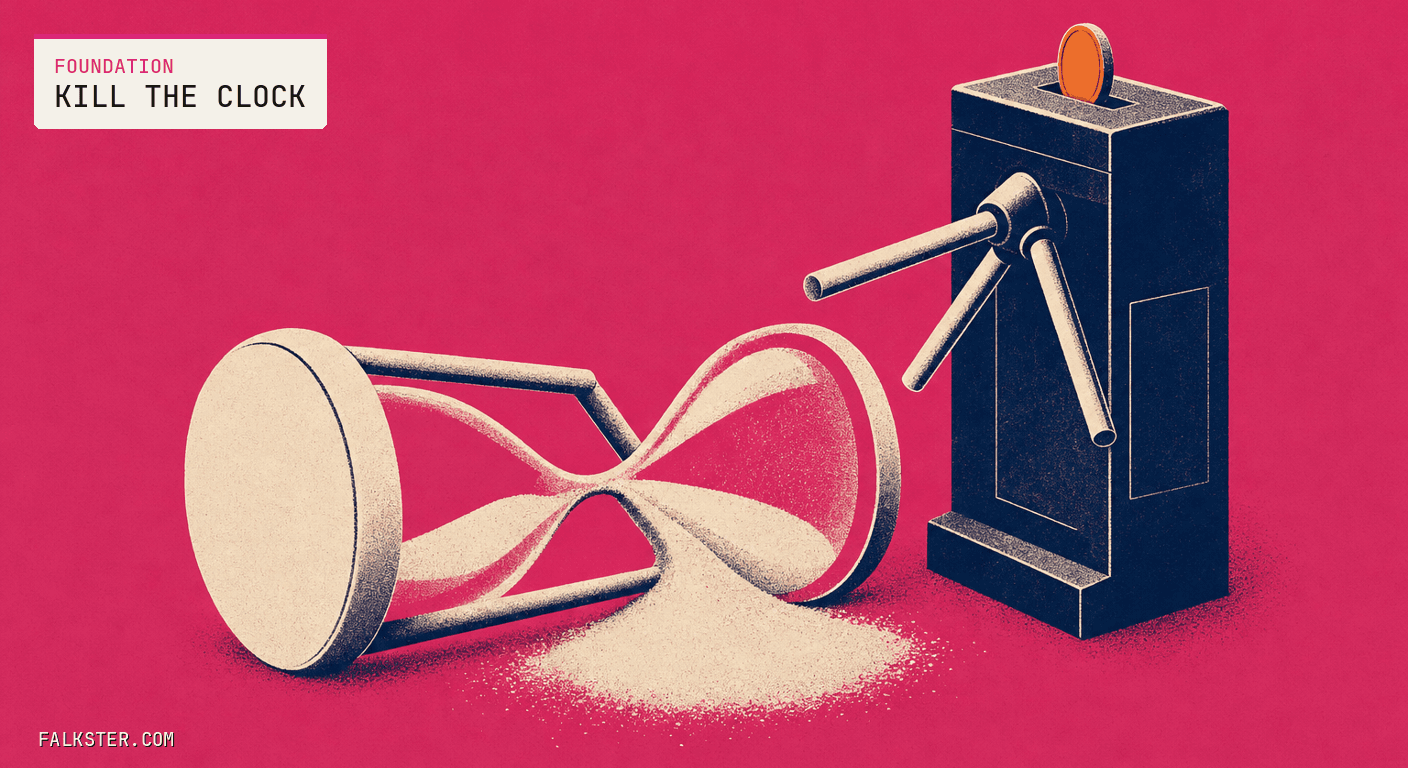
If you sell a product built on AI, every free user costs you real money. This month a founder described how strangers turned her free trial into their own free AI supply. She shut the trial down. I think the trial was not the problem. This is a Kill List entry for one small part of it.
The short version
- Claire Vo runs ChatPRD, an AI tool that helps product managers write plans.
- Over about a year, people abused her free trial and promo codes to run their own work on her AI bill. It cost her tens of thousands of dollars. Her biggest fix was to end free trials.
- I'd end something smaller: the trial that is measured in days. Days have no price. Put three numbers on the trial. A dollar cap. A cheap model picked by your own server. And a limit on how long one request can run. Her own last lesson supports this.
- She says the fraud dropped once the expensive models were out of reach.
What happened at ChatPRD
Vo told the story on her podcast, How I AI, on November 16, 2026. I read the written version in full. I did not watch the 40-minute episode. Lenny Rachitsky, who writes a widely read product newsletter, sent it to his readers the same day. Simon Willison, a developer who tracks AI tools closely, wrote about it on November 20.
She lists six kinds of abuse. These are the ones that matter here.
- Farmed trials. People made free accounts over and over, often by script. They went for the most expensive AI models.
- Resold promo codes. Codes meant for partners were stolen and sold. Lenny's summary says about half of them reached resellers.
- Relays. Some people logged in, then passed another product's requests through ChatPRD.
- A worker that never slept. ChatPRD lets a customer connect outside tools. One person used that to keep an agent running day and night.
One more number. She woke up one day to about $200,000 in attempted card payments. All of them failed. She is clear that this was attempted volume and not a loss.
Her fixes came in layers. She required a credit card. People cycled through cards. She tried paid trials. That wasn't enough either. So she turned free trials off, and she stopped issuing promo codes. She says this cost her real growth, since trials brought new users and leads from large companies. She also says the fight has felt like 80 to 90% of her job.
The claim I'd push back on
Lenny's summary puts the lesson this way: free trials may no longer work for AI products. Willison called ending them the right decision, sadly.
I'd attack the claim, and only the claim. Vo was losing money every hour and she stopped it. That was the right call for her that week.
But look at her own closing lessons. She says that if you sell AI, you are selling computing power. She says to count dollars and not requests. And she says the fraud went away quickly when the expensive models were no longer there to steal.
Read those three together. The thing being stolen was the best model, with no dollar limit, for a set number of days. The trial was only the door it walked out of.
Kill the clock on the trial
A normal software trial is measured in time. Fourteen days, thirty days. That worked because one more user cost the company almost nothing.
For an AI product, a day is not a unit of cost. One user can cost almost nothing in a day. Another can cost a great deal. So "free for two weeks" is a blank check with a date on it.
Retire that. Keep the trial, and put three numbers on it.
Three numbers
- Dollars. A hard cap on what one trial can cost you, counted in money.
- The model. A cheap one, named in your server code. The user cannot switch it. Vo recommends this kind of allowlist herself.
- Steps. A limit on how long one request can keep going before it stops.
With those three, you know the worst case. It is the cap times the number of fake accounts someone can make. And since the cheap model has little resale value, there is less reason to make them.
Why the third number matters most
Last month I wrote 1% of Users, 75% of the AI Cost. The Brake Goes on the Loop, Not the User.. A loop is one agent run that keeps calling the model until something tells it to stop. My rule there was a stop on every loop: a number of attempts, a spending limit, and a named person who hears about it.
Vo's worst cases are that rule's missing half. Account limits were beaten with more accounts. The day-and-night worker was one loop with no stop. A limit that lives on the run holds no matter who started it, or how many accounts they have.
It is also why the unit matters. In Three Token Bills, One Unit I argued for one line per AI workflow: what it cost and what it earned. A trial is a workflow that earns nothing yet. It should have the smallest budget in the product, written down.
What I don't know
I don't run her business. She may have tried a capped trial on a cheap model, and her write-up doesn't say. Her fraud classifier already moves suspected abusers to a cheaper model, which is close. She also notes that skilled abusers mixed methods to stay under each limit. A dollar cap won't stop all of that. It sets the size of the loss.
This week
If your AI product has a free trial, write its three numbers on one line: dollars, model, and steps. If any of them is "no limit," fix that one before you decide whether to keep the trial. This sits in Building a Company in Public because pricing the front door is a founder's call.
Related answer: Should an AI product still offer a free trial?
Sources: Claire Vo, "Token Fraud Is Eating AI Margins. Here's How Claire Vo Is Fighting It.," How I AI, November 16, 2026, read in full; I did not watch the episode. Lenny Rachitsky, "How I AI: Fable 5.2 Review + How I fight token fraud as a solo founder," Lenny's Newsletter, November 16, 2026, the token fraud section, for the promo code share and the line on free trials. Simon Willison, "Token fraud is here and it's BAD," November 20, 2026. The three numbers and the stop rule are mine.
Frequently asked
What is token fraud?+
It is when someone uses an AI product's free or cheap access to run their own work on the owner's bill. A token is a chunk of text the AI model reads or writes, and the owner pays for each one. Claire Vo of ChatPRD says it cost her business tens of thousands of dollars over roughly a year.
What did Claire Vo do about it?+
Her biggest step was to turn off free trials, after requiring a credit card and charging for trials both failed. She also stopped issuing promo codes, set hard limits, blocked some countries, and built a classifier that bans suspected fraud or moves it to a cheaper model. She says the defenses have felt like 80 to 90% of the job.
Do free trials still work for AI products?+
Lenny Rachitsky's summary of the episode says they may not. I think a trial measured in days is what stopped working. A trial with a dollar cap, a cheap model picked by the server, and a limit on steps has a known worst-case cost. Vo's own lesson is that the fraud dropped when the expensive models were not there to steal.
What three numbers should a trial carry?+
Dollars, the model, and steps. A hard cap on what one trial can cost. A named cheap model chosen in the server code and not by the user. And a limit on how long one request may keep running before it stops.
Why put the limit on the loop and not the account?+
Because accounts are cheap to fake. Vo describes farmed trial accounts and one connected tool that ran as a worker day and night. A limit per account is beaten by more accounts. A stop on each run holds no matter who started it.
Did Claire Vo try a capped trial on a cheap model?+
Her write-up does not say. She runs the business and I do not, so she may have. Her classifier already moves suspected fraud to a cheaper model. My point is to try pricing the trial before closing the door on new users.
Sign in with LinkedIn to leave a comment.
Sign in with LinkedIn