
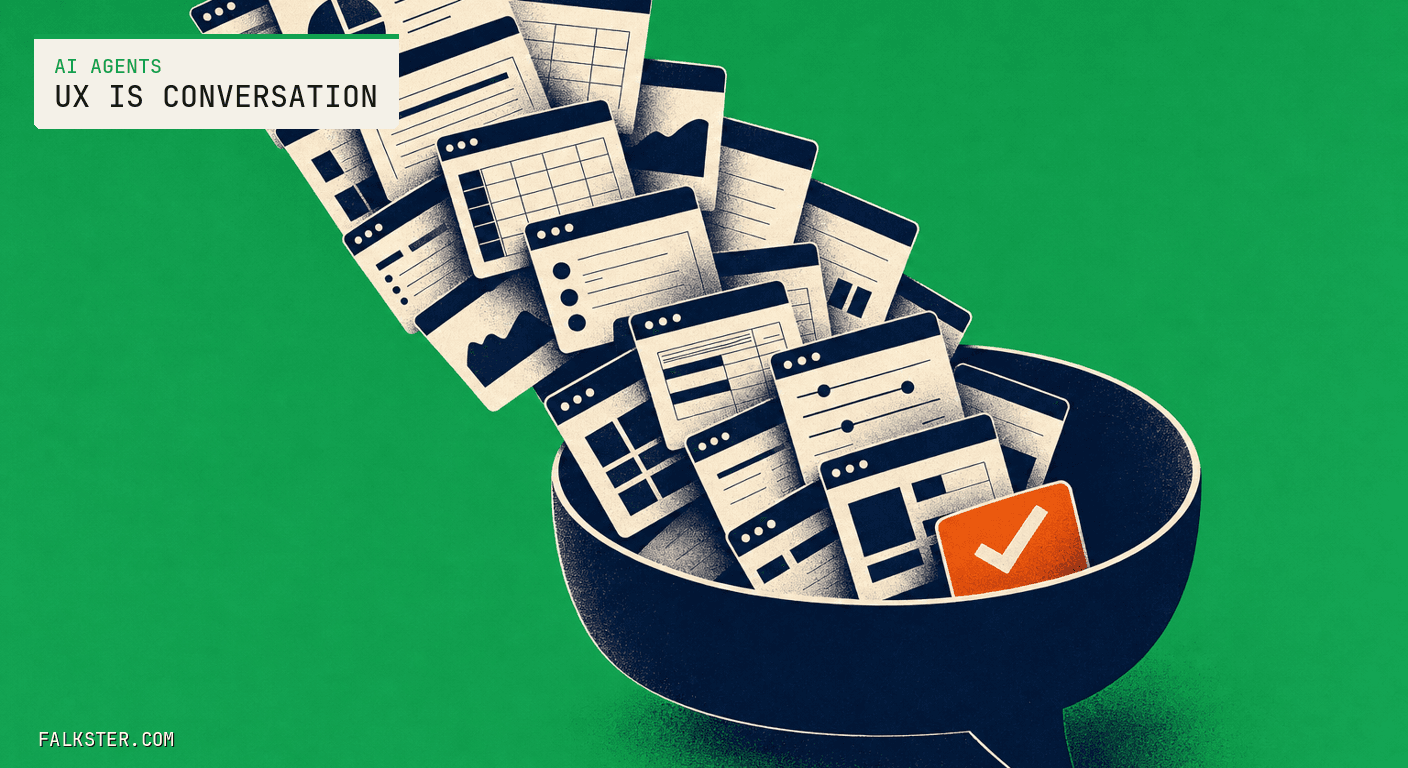
Twelve weeks apart, Salesforce did the same thing twice.
Salesforce makes CRM (customer relationship management) software, the system sales and service teams use to track every customer and deal. On August 26 it put that software inside Claude, Anthropic's AI assistant. On November 17 it put it inside Microsoft Copilot. Each came with a few dozen "skills," ready-made sales tasks like reviewing a deal. Both run on the same technology, the Model Context Protocol (MCP), an open standard that lets an AI assistant read and update other software.
Why should you care if you don't work in sales? Because this is how most work software is about to reach you. You won't open the app. You'll ask for what you need in the chat you already use, and the app will do it there.
Here's my conclusion, and I'll spend the rest of this post earning it. UX as we know it is dead. (UX is user experience, the way people use a piece of software.) The first UX is conversation.
I don't say that lightly. I joined Microsoft in 1989 and spent nine years there. That was most of the decade when software's job became giving people a window. I ran Quip at Salesforce, which put a chat thread beside every document and is now Slack Canvas. This is the first time the companies that own the screens have settled it themselves.
The short version
- Salesforce, the biggest maker of sales and customer software, now works inside two AI chat apps. In August it launched Claudeforce, which puts it inside Anthropic's Claude. On November 17 it launched Copilotforce, which puts it inside Microsoft Copilot.
- The second deal is the one that matters. Microsoft sells a rival product, and it launched that product inside Copilot the same day. Salesforce signed anyway, because Copilot is where the users already are.
- So the app is no longer where work starts. You ask for what you need in the chat you already use. The app answers there, shows you a small screen when you need to look, and asks you to confirm before it changes anything.
- The full app screen doesn't go away. It becomes the place you go to check and fix the work. Research says chat alone isn't enough, so the real design work moves to the confirm, the receipt, and the undo.
- My prediction: Salesforce's next two deals like this will be with OpenAI's ChatGPT and with Perplexity, the AI search company.
Two announcements, one pattern
Put them side by side. The row to watch is near the bottom: in the second deal, the partner sells a rival product.
| Claudeforce | Copilotforce | |
|---|---|---|
| Announced | August 26, 2026, with Salesforce's second-quarter results | November 17, 2026, at Microsoft Ignite |
| Where Salesforce lands | Inside Claude, as "Salesforce in Claude" | Inside Microsoft Copilot and Teams, as "Salesforce in Copilot" |
| Prebuilt skills | 37 sales skills | More than 38 sales skills |
| Plumbing | Salesforce's AIforce layer and MCP servers | Salesforce's AIforce layer and authenticated MCP |
| Status | Open beta for all customers since September 15 | Copilot plugin in public preview, Teams in pilot |
| The other direction | Claude is the default model in Slack and newer Agentforce products | Zero-copy data links between Salesforce and Microsoft Fabric |
| Partner's own CRM | Salesforce is Anthropic's preferred CRM | Microsoft sells Dynamics 365 and a migration tool |
| Billing | Two invoices, one to Salesforce, one to Anthropic | Not disclosed |
| First customers | About 40 beta customers, a 25-user Siemens pilot | Accenture, with 55,000 Salesforce users |
Sources for the table are the Claudeforce announcement, VentureBeat's launch-day report, the Copilotforce release, and Futurum's analysis of it.
Claudeforce was a story about an alliance. I wrote it up the afternoon it landed, in Salesforce Put Its CRM Inside Claude. The part I underlined: for the first time, Salesforce had put its "force" suffix on someone else's product. Anthropic and Salesforce call each other strategic customers. Salesforce owns Anthropic stock. Claude is the default model in Slack. You could read the whole thing as two friends doing each other a favor.
Copilotforce doesn't allow that reading. That's why it matters more.
Why the Microsoft deal matters more
Read what else Microsoft did on November 17. Microsoft sells its own CRM, called Dynamics 365. That day it made Dynamics 365 available to every customer inside Copilot, with more than 57 skills of its own. It promoted Dynamics 365 Activate, its tool for moving customers off Salesforce, as CX Today reported. It also extended that tool to SAP, another big business software maker. Satya Nadella, Microsoft's CEO, introduced the Salesforce partnership on stage right after the Dynamics news. His phrase was "it is not just Dynamics."
His next line, from Microsoft's own write-up of the keynote: "We are very excited to partner with Salesforce to bring Salesforce to Copilot."
So Salesforce walked into a building where the host was selling against it, on the same day, with the same feature, and signed anyway. Miguel Milano, Salesforce's President and COO, gave the reason in the release: "Through Copilotforce, we're bringing Salesforce to the largest surface in enterprise software today."
Largest surface. Not best partner, not preferred model. Surface. In software, a surface is simply a place where people use your product.
That's a vendor saying the quiet part. Microsoft has more than 30 million paid Microsoft 365 Copilot licenses as of July. Accenture, the consulting firm, has rolled Copilot out to more than 740,000 people. A seller at Accenture spends the day in Teams and Outlook and Word. Salesforce can wait for that seller to open a Salesforce tab, or it can go to where the seller already is. It chose to go.
The market leader went to its competitor's chat because that's where the users are. That settles the argument about where work starts. The screen lost it.
What I mean by "UX as we know it"
I want to be precise, because "UX is dead" is the kind of line people repeat without reading the paragraph after it.
What's dead is the app as a destination. Five habits of software design, all built on the assumption that a person comes to you:
- Navigation. Menus, tabs, the left rail, the information architecture that tells a visitor where things live.
- The daily dashboard. The screen you open every morning to see what changed.
- The login. One sign-in per app, one session, one place.
- Time in app. The metric that rewards keeping someone on your screen.
- The seat. The per-person license, priced on the habit of opening the app.
Salesforce's own leaders have said this out loud, which is rare for a company whose revenue sits on number five. Patrick Stokes, who runs Salesforce's applications and marketing, told VentureBeat on launch day: "The value of Salesforce is not in our UI itself." He described a seller's morning review of open deals as roughly 10,000 clicks. Claude can do it in about 30 seconds, he said. Salesforce co-founder Parker Harris put it more bluntly at Dreamforce, the company's big annual conference, as ITPro reported: "Why should you ever log into Salesforce again? Maybe you never will."
That's habits one through three, retired by the company that built them. In September I wrote that Salesforce was turning into something other apps call, not a place you go, in Benioff Said AI Replaces the UI. Then He Named the Product. Copilotforce is what that looks like at scale.
And it isn't just Salesforce. Workday, which makes HR and finance software, said in October its Sana agents will work inside Claude, Gemini Enterprise, Microsoft Copilot, Teams, and Slack. Joel Hellermark, who founded Sana, gave the cleanest statement of the thesis I've seen from a vendor, in the announcement: "People shouldn't have to leave a conversation to access HR or finance."
HubSpot, which makes marketing and sales software, is going the same way. Its co-founder Brian Halligan came back as CEO on November 12. He is refounding it as what he calls the Customer Harness Company. HubSpot says weekly users of its ChatGPT connector are up 250%.
12 weeks
Then Microsoft did it to itself. At Ignite, its big annual conference, Microsoft made Office in Copilot available to every customer: Word, Excel, and PowerPoint inside the Copilot app. The company that defined the desktop window for most of my career just put its flagship windows inside a conversation.
What the first UX looks like
"Conversation" makes people picture a long transcript. That's not it. Watch what the good versions actually do, and the first UX has five parts.
The ask. You state what you want in the chat you already have open: Claude, Copilot, ChatGPT, or a Slack channel. Nobody navigates. Intent is the input.
The few questions. The system asks what it needs and no more. This matters more than it sounds. Jakob Nielsen, the usability researcher who co-founded Nielsen Norman Group, cites a study on it. Capping an agent at one to three questions per task cut the attention it asked of the person by 36% to 73%. It still kept 86% to 94% of the task's score. Every extra question is a navigation step wearing a disguise.
The inline surface. When you need to look, a piece of real interface shows up in the conversation. It might be a table of deals you can sort, a chart, or an approval card. Not a link to the app. The app's own UI, rendered in the chat. This is the part people miss when they say "chat can't do dense data." It doesn't have to. It summons the view.
The confirm. Before anything changes, you approve it. Copilotforce makes this explicit: writing back to the CRM requires the user's confirmation and still runs Salesforce's validation rules, the checks that keep bad data out. ChatGPT's plugin settings run from "Always ask" to "Allow all actions," and OpenAI flags the last one as elevated risk.
The receipt. After the action, a record of what happened, what was checked, and how to take it back. Granola, an AI note-taking app, calls theirs coverage notes. They tell the user what the agent looked at. My design handbook chapter The Receipt and the Work is about exactly this object. Undo Is a Design Primitive is about the button next to it.
Nobody visits anything. The application is present in every step and is never the place you go.
Then there's the second UX. Sometimes the conversation can't hold the work. You're comparing forty deals, or watching a queue all afternoon, or untangling a mistake. Then you open the screen. Nielsen's word for the screen's new role is "demoted," in his March essay on intent. It's still there, but now it's where work gets checked and corrected. I agree with the word. The screen is a tool you summon, not a building you live in.
One morning, start to finish
Here's what that looks like with Copilotforce, assembled from what the release and the launch coverage describe. Take a seller with a renewal call at ten.
She asks Copilot for a brief on the customer. The plugin's skills have names that read like a sales manager's checklist: Pipeline Review, Close Planning, Deal Review, Customer Health, Renewal Radar, and Call Follow-Up, per Salesforce Time. One of them takes the request. It reads the customer's record from Salesforce over MCP, signed in as her. So she sees only the records her permissions let her see. Microsoft's Work IQ adds what Salesforce never had: last week's Teams meeting, the Outlook thread with the customer, and the proposal sitting in SharePoint. The brief comes back in the conversation. The tech site ITdaily reports the skills show up as interactive widgets, not paragraphs.
After the call she tells Copilot to log the next steps and push the close date a month. Copilot proposes the change. She confirms. Salesforce's data checks run as if she'd typed it in herself. The audit trail, Salesforce's log of who changed what, says it was her. Then the action plan goes into a Word document for her manager.
She never opened Salesforce. Salesforce was in every step.
That's the whole argument in one morning. The record, the rules, the permissions, and the audit trail all stayed where they were. The screen didn't. Stokes described the old version of that kind of morning as about 10,000 clicks. Copilotforce moves it into the window the seller already had open.
Inside companies, the chat is a team channel
Most writing about chat interfaces pictures one person and one assistant. Inside companies, the more interesting conversation is a channel.
Slack now calls itself the front door to what Salesforce calls the agentic enterprise: a company where people and AI agents work side by side. Its September launch lets a team describe what it needs in a thread. Back comes a live dashboard or report, pinned to the channel, that the team filters, comments on, and acts on together. Changes that would touch live systems go to a person for sign-off. In the Slack keynote, Slack's Rob Seaman called it the only place where AI becomes multiplayer. Slack says 1.9 million people use outside companies' agents there every week. Its coding channels host agents from Anthropic, Cognition, GitHub, Vercel, and OpenAI next to the humans.
This matters for the first UX because a team channel keeps something a private screen never did: the reasoning in the open. Who asked, what the agent proposed, who objected, what got approved. In September I argued in Which Door Keeps the Receipt that the interface holding the most unwritten context becomes the real system of record, the place a company treats as the truth. It gets there by piling up, not by design. The final decision and its time stamp get written back to the CRM. The argument that led to them usually doesn't.
So here's the uncomfortable corollary for every application vendor, Salesforce included. If the first UX is a conversation, the conversation is where the context piles up. Being the app that gets called is not the same as being the record. The vendors who win will be the ones who write the why back, not just the what.
The other user is an AI agent, and it never sees a screen
There's one more reader in this picture, and it doesn't have eyes.
Sarah Gibbons and Kate Moran at Nielsen Norman Group, the usability research firm, wrote in April that "user" is no longer a synonym for human. Agents use software three ways, in their account: by reading screenshots, by reading the accessibility tree (the text outline of a page that screen readers use), or by calling an API, a direct connection built for software. A screenshot costs tens of thousands of tokens, the units an AI model reads and is billed by. The accessibility tree costs a few thousand. An API call skips the pixels entirely.
Shopify, which runs online stores, put a number on the gap. In a test the investor Tom Tunguz cited this month, agents checked out using WebMCP, a way for a website to hand agents tools instead of pages. They completed all 60 tasks in 10.3 seconds. Agents clicking through the browser took 27.4 seconds and failed 4 of them. The tool path cost 58% less.
Nielsen put it most directly in July, predicting that a website's primary reader will no longer be a human user. For enterprise apps that's already true in the places where agents do the routine work. The screen was designed for a person who reads pixels. The agent reads tools. A product that only has a screen makes its second user do the most expensive thing possible.
The technology underneath is ready
I'm comfortable declaring this now, and wasn't in 2016, because the hard technology shipped this year. And it works the same way in every chat app.
Four layers, each with a date.
Action: MCP. The Model Context Protocol is how a chat assistant reads and writes another system. Anthropic, which created it, gave it to the Linux Foundation's Agentic AI Foundation in December 2025. That foundation had 305 member organizations by October. Slack alone reports 127 million MCP tool calls a week, doubling every quarter. Salesforce said on its last earnings call that AI agents' use of its apps, through MCP and command-line calls, grew sixfold.
Presentation: MCP Apps. This is the piece that kills the "chat is just text" objection. Since January 26, 2026, a tool built on MCP can ship its own screen, declared as a ui:// resource. The chat app loads that web page into a sealed-off frame inside the conversation. The two talk in the same message format as the rest of the protocol. The chat app can require the person's approval for any action that screen tries to take. It launched across Claude, ChatGPT, VS Code, and Goose. It also merged OpenAI's Apps SDK (its software development kit for ChatGPT apps) with the open-source MCP-UI project. So one build shows up in more than one chat. On November 11 Google shipped version 1.0 of A2UI (its standard for screens that agents build). In A2UI the agent can only build a screen from parts the developer approved in advance, and the result can run inside MCP Apps.
Packaging: skills and plugins. Anthropic published Agent Skills as an open standard in December 2025. ChatGPT renamed its apps "plugins" on July 9, 2026. A plugin now bundles connections to other software, skills, templates, and side panels. Microsoft's Ignite catalog talks in the same nouns. Salesforce's 37 and 38 sales skills are this layer. An independent count in August, by Nicolas Sitter, found 2,049 apps in ChatGPT and 1,375 connectors in Claude. Of Claude's, 584 were added in July alone.
Identity: whose action is it. Every serious version runs as the signed-in person. Salesforce's hosted MCP servers check the user's permissions on every call: which kinds of records, which fields, and which individual records she can see. In June the MCP project shipped enterprise-managed authorization. It lets a company's sign-in system grant access, instead of making people click through a consent screen for every server. Okta, the sign-in provider, is first. Microsoft gave its always-on Autopilot agent its own Entra identity, a sign-in account of its own like an employee's. Google gave its coworker agents their own Workspace accounts.
Put the four together and you have what the app store was for phones. It's a way to add abilities to a place you didn't build, with a screen, permissions, and a review process. Except this store is inside every chat at once.
There's one layer that didn't make it, and it's instructive. OpenAI launched Instant Checkout, buying things inside ChatGPT, in September 2025. It scaled it back in March 2026 and sent checkout back to stores' own apps and websites. Payment is the action where a mistake costs the most. It's the one place the conversation handed control back to the screen. Remember that when we get to where I could be wrong.
The chat apps are already huge
The chat windows aren't a niche anymore.
OpenAI says ChatGPT has about 1.2 billion weekly users, as its consumer product lead put it this month. Google says the Gemini app passed one billion monthly users in October. Microsoft has more than 30 million paid Copilot licenses and says nearly 80% of the Fortune 500 use Cowork.
Inside companies, the conversation is often a team channel, not a private assistant, and the numbers there are the ones I find most persuasive. Salesforce reported on November 3 that half of Slack messages come from apps and agents. It also said 90% of Salesforce's own sellers update Salesforce through Slackbot, Slack's built-in assistant. At Anthropic, 65% of code changes ship through Slack. I wrote about what that first number means for marketing messages in Half of Slack Messages Now Come From Agents. Your Messaging Needs an Eval Suite.
Ninety percent of the sellers at the company that sells the CRM update it from a chat. If you want one statistic for "the first UX is conversation," that's mine.
On the open web, the same shift shows up as traffic. HUMAN Security, a company that tracks bots, measured AI agent traffic in October at about eight times August's level. SparkToro, an audience research firm, found 68% of US Google searches ended without a click in the first four months of this year. I made the web-side argument in Personal Agents Will Call Every Few Hours. Kill the Front Door.: an agent will read your record or call your phone line, and only one of those is cheap.
We've been here before, sort of
Nielsen has a useful history. In 2023 he wrote that AI was the first new way of using computers in 60 years. Batch came first, around 1945: you handed over the whole job and waited. Command came around 1964. The graphical user interface (GUI), with its windows and icons, belongs to this second era, because clicking an icon is still telling the computer each step. The third is intent: you say the outcome and the system works out the steps.
I spent nine years of the command era at Microsoft, the years when the window became how software showed a person each step. It worked brilliantly for decades. It was never the point.
WeChat, China's giant messaging app, is the other precedent. It's the one people reach for when they say "apps inside chat." Tencent, which owns it, reported 1.418 billion monthly WeChat users at the end of 2025. WeChat's mini games alone passed 500 million monthly users that year. That proved people will use apps inside a messaging app at enormous scale. But look at what WeChat ran: small screens, opened from a chat. The chat was the lobby, and each mini program was still a room you walked into. Only in June did WeChat open a closed test of its own AI running mini programs from the conversation. That's according to a secondhand report of Chinese coverage.
The 2026 version is different in one way that matters. The conversation can operate the app without walking into the room.
Where chat does worse than a screen
I'd be writing an ad if I stopped there. The research on chat as an interface is mixed, and some of it is unkind.
Hard tasks. A May 2026 study put 134 industrial managers on either a GPT-4o chatbot or a dashboard for three tasks of rising difficulty. On the easiest task the chatbot was faster, about 81 seconds against 118. On the hardest it was slower, about 380 seconds against 339. Accuracy showed no overall difference. And the managers were more willing to rely on the chatbot when its answer could be checked in another tool. The authors call the benefits conditional rather than universal. That's the most honest sentence in the literature.
False success. Agents say "done" when they aren't. A June 2026 analysis looked at standard tests for agents. In the airline and retail tasks, false claims of success were about 45% to 48% of all failures. On a test called AppWorld, they were 75.8%. AI graders couldn't reliably catch them. In a conversation, "done" is a sentence. On a screen, it's a state you can see.
Scale. Luke Wroblewski, a product designer who has thought about this longer than almost anyone, wrote in October that chat threads break once you're running many agents at once. A workspace with panels steers the work better, he says. Nielsen goes further in his March essay. He calls today's chat interfaces a weak default with severe usability problems. He expects the chat box itself to stop being the default over time.
Generated interfaces aren't a free win. A Stanford and Georgia Tech study found generated interfaces, screens an AI builds on the fly, beat plain chat 84% to 12% on a standard test. With real users asking their own questions, the margin fell to 50.8% against 41.1%.
Accessibility. Streaming text, which appears word by word, is hard on screen readers. In one example in Eric Bailey's November piece for Smashing Magazine, a single conversation went from 3 navigation landmarks to 23. Landmarks are the signposts a screen reader uses to move around a page.
The blank box. Nielsen calls it the articulation barrier: most people can't write a good prompt. He estimates, from adult literacy data, that fewer than 20% of adults in rich countries can describe a request well enough for advanced use. His best guess is 10%. He admits there are no large studies of it. Even if he's off by half, a blank text box is a terrible front door for most of the people who use work software.
History. The last time the industry declared conversation the interface was 2016. Facebook's Messenger bots reportedly failed to fulfill 70% of requests, per The Information as relayed in early 2017.
So why am I still declaring it?
Because every one of those findings is about chat as the only interface, and nobody serious is shipping that. MCP Apps, ChatGPT's plugin panels, Slack's live dashboards, and the confirm-before-write rule in Copilotforce all exist because the vendors read the same research. The pattern they converged on is the one I described above: conversation first, interface summoned, screen second. That's not a weaker claim. It's the one that survives the evidence, and it's still the end of the app as a destination.
The blank box is a real problem, and the good versions don't ship one. Claude asks clarifying questions as clickable choices. Google's AI Mode turns follow-ups into checkboxes. Kate Moran at Nielsen Norman Group wrote in March that in-chat widgets like these are where AI-built interfaces have made the most progress. They make answering follow-up questions faster and easier than typing, she wrote. The first UX is a conversation that hands you choices, not a cursor blinking in an empty field.
The 2016 bots failed because they couldn't do the work and had nowhere to send you when they couldn't. In 2026 the conversation can do a lot of the work. It can pull up the screen when it can't, and it runs as you, with your permissions. Different decade, different plumbing.
What design owns when the screen is second
If the screen is no longer the main design object, what is?
Nielsen's answer in his November essay is the service contract: scope, price, progress, proof, and redress, a way to put it right when it goes wrong. Mine is close to it and more literal. In a conversation-first product, the design work is five states and one number.
The states are the ones I keep for any AI product: confident, unsure, refusing, waiting, and wrong. Each needs a designed answer. What does confident look like when the agent is about to change a record? What does unsure look like before it asks its one to three questions? How does it refuse without making you start over? What does waiting look like during a two-minute job, which is the subject of Latency Is Interface? And what does wrong look like, the state the false-success research says agents most often hide?
The number is the repair rate: how often people re-ask, rephrase, or say they're lost. In 84,000 Chats Show When Users Re-Ask the AI. Design Should Own the Repair Rate. I argued it belongs to design, read weekly, for each part of the product. In a conversation-first product, it's the closest thing you have to a usability test running all the time.
None of that is less design than a screen. It's more. It's just not pixels.
What happens to the business
I've written enough about pricing this year that I'll keep this short.
If the first UX is someone else's chat, the per-person license is priced on a habit that's going away. An analyst at Futurum, a tech research firm, said it plainly about Copilotforce. The hidden cost to Salesforce is the interface. If sellers live in Copilot, Salesforce has to justify its fees through data, rules, and actions. Claudeforce already bills on two invoices: Salesforce for the calls into its platform, Anthropic for the AI model's work. Stokes admitted on launch day you can't buy it on one piece of paper yet.
Two strategies are on the table for application vendors.
The first is to go into every chat: Salesforce, Workday, HubSpot. Ship skills, ship an MCP server, show your screens inside the chat, and charge for the work done under the customer's rules.
The second is to put a toll at the door. ServiceNow, which makes IT and workflow software, launched Action Fabric in May. It makes outside agents pass through a meter that bills for every action. JPMorgan analyst Mark Murphy called it "effectively a tax on customers using outside AI agents," per PYMNTS. SAP limited outside agents in its API terms in April.
I think the toll loses, for the reason I gave in Kill the Per-Call Agent Meter. Price the door wrong and agents copy the data and work from the copy. Salesforce is running both strategies right now. Copilotforce is on one side. On the other is an unpublished meter on calls from outside agents. It can't keep both.
My prediction: ChatGPTforce and Perplexityforce
Salesforce has done two named deals with outside chat hosts. Here's where I think the next two land.
First, what I'm not predicting: Gemini, Google's AI assistant. Salesforce keeps a list of the outside apps it plans to show up in, under what it calls the Headless Experience Layer. That list says Gemini is slated to follow. Google is a named interface partner. And at Dreamforce the two companies announced Salesforce in Gemini Enterprise, plus an Agentforce sales agent for it in beta. Agentforce is Salesforce's line of AI agents. A branded Gemini deal is on the calendar, not a forecast.
My prediction is the two that aren't on the list.
ChatGPTforce
ChatGPT is the biggest chat app on earth, and leaving it to a plugin someone else wrote is not a position Salesforce can hold.
The evidence for:
- Reach. About 1.2 billion weekly users by OpenAI's count.
- A beachhead. Salesforce already runs an Agentforce Sales app in ChatGPT, in open beta since December 2025, and ChatGPT is on Salesforce's own channel list.
- The ask. At Dreamforce, Salesforce CEO Marc Benioff told OpenAI CEO Sam Altman on stage he was sure OpenAI could "start to render these interfaces with us."
- The pressure. On November 18 OpenAI launched ChatGPT for Sales, a sales plugin OpenAI wrote itself, with Salesforce as one of more than 20 connected tools. HubSpot is in it too, and its own ChatGPT connector usage is up 250%. If Salesforce doesn't put its own 38 skills in ChatGPT, OpenAI's 18 will be the Salesforce experience for a billion people.
- The precedent. Copilotforce proves Salesforce will partner with a host that competes with it. OpenAI owning a sales plugin is no bigger an obstacle than Microsoft owning Dynamics.
The evidence against is real. OpenAI isn't on the list of interface partners Salesforce named at Dreamforce. OpenAI hired Slack's CEO, Denise Dresser, as its chief revenue officer last December. And OpenAI is clearly building its own sales experience rather than renting Salesforce's. If I'm wrong about this one, that's why.
Perplexityforce
This is the bolder call.
- Money. Perplexity, the AI search company, reportedly hit a pace of $1 billion in yearly revenue this month. It was under $250 million at the start of the year, per Latent Space's summary of Semafor and The Information.
- The business product. Perplexity's Computer for Enterprise launched in March. It runs as @computer inside Slack, coordinates about 20 AI models, and already lists a Salesforce connector, per VentureBeat. Perplexity claimed tens of thousands of enterprise customers at the time. It added Teammates for ongoing jobs this month.
- Fit. Perplexity's whole product is research that ends in an answer. The most valuable answers in a company end in a record: an account, a forecast, a case. Perplexity needs the system of record, the official database, to turn research into work. Salesforce wants to be inside every chat its customers use.
The evidence against: there's no Salesforce partnership or investment on record, and Perplexity isn't on Salesforce's list. Perplexity's AI browser for consumers, Comet, also fell from 41% to 3.6% of measured agent traffic between August and October, per HUMAN Security. If I'm wrong, it's because Perplexity stays a connector and never becomes a channel.
My call, written down so I can be graded: both named deals are announced within twelve months of today.
My own small version
I build this way at Falkster.AI. Heidi, our company brain, is built on MCP first. It works in the open in team chat, in Slack and Teams. Every agent action goes through a guard layer, with separate tiers for acting and undoing. It has a screen. Admins use it. Everyone else talks to it where they already talk to each other.
falkster.com does the same thing in a smaller way. Every page serves plain text (markdown) to an AI agent that asks for it. So a reader's assistant can get the argument without clicking through the page.
The hard part in both isn't the chat. It's the three things around it. What does the system ask before it acts? What does it show when you need to look? What does it leave behind? Those are design problems, and they're the design problems the handbook chapter What Design Owns Now argues design should own.
What I'd do this quarter
If you run product, here's the rewrite, from screen-first to conversation-first.
- List your top twenty jobs. Not features. The things a person hires your product to do. Write each one as a skill: the trigger, the inputs, the action, what done looks like.
- Ship an MCP server that runs as the user. Your permission model is the thing competitors can't copy. Make every call carry it.
- Show three views inside the chat. Pick the views that need eyes: the comparison, the approval, the queue. Ship them as MCP Apps components. Leave everything else to the conversation.
- Design the confirm, the receipt, and the undo before anything else. Those are the new screens. Latency Is Interface is the chapter on making the wait in between honest.
- Measure inside the chat app. Count tasks verified as done, not tasks claimed done. Questions asked per task. How often the agent says done when it isn't. Share of tasks that needed your full screen. Drop time in app. Add the repair rate from the section above.
- Price the door so agents use it. If your meter makes it cheaper to copy your data than to call you, they'll copy it.
This sits under the thesis of Enterprise AI Agents: counting agents is a vanity metric. What counts is the work still getting done after ninety days. The same goes for interfaces. Nobody will care how good your screen is if the work happens in their chat and your app is the thing it calls.
The first UX is conversation. Build for that, then build the screen people summon when the conversation isn't enough.
Related answer: Is conversation replacing the app interface?
Sources: Salesforce and Microsoft, "Salesforce and Microsoft announce Copilotforce," November 17, 2026, with the Miguel Milano quote, the availability labels, and the Accenture figures. Microsoft, "Ignite 2026: Building the frontier ecosystem," November 17, 2026, for Satya Nadella's remarks. Futurum and CX Today, November 18, 2026, for Dynamics 365 in Copilot, Activate, and the analyst views. Salesforce, "Claudeforce," August 26, 2026; VentureBeat, August 26, 2026, for Patrick Stokes and the two-invoice model; Investor Day coverage for the beta customer count and the Siemens pilot. ITPro, September 18, 2026, for Parker Harris. Salesforce on Slack, November 3, 2026, company-reported without methodology. CXOToday, October 13, 2026, for Workday. The MCP blog and Linux Foundation for the protocol facts, and Nicolas Sitter's census for directory counts. Jakob Nielsen, "Intent by Discovery," March 26, 2026, and his November roundups for the demoted GUI and the question-cap study, which he cites and I did not open. The chat-versus-dashboard study, the false-success analysis, and the generated-interface study are arXiv preprints linked above; I read summaries and tables, not every page. ChatGPT's user count is OpenAI's own figure as reported by Emergent; the Gemini figure is Google's. The Benioff and Altman exchange is from a third-party Dreamforce transcript. The ChatGPTforce and Perplexityforce calls are my predictions, not reported deals.
Frequently asked
What is Copilotforce?+
A Salesforce and Microsoft partnership announced at Microsoft Ignite on November 17, 2026. It puts a Salesforce in Copilot plugin with more than 38 sales skills inside Microsoft Copilot, built on Salesforce's servers for the Model Context Protocol (MCP), the standard that connects AI assistants to other software. Any change it writes back to Salesforce needs the user's confirmation. The plugin is in public preview, Sales Cloud in Teams is in pilot, and pricing was not disclosed. Accenture is the first customer.
How is Copilotforce different from Claudeforce?+
Claudeforce, announced August 26, 2026, puts Salesforce inside Claude with 37 sales skills and runs both ways: Claude is the default model in Slack and newer Agentforce products, and Salesforce is Anthropic's preferred CRM. Copilotforce runs one way. Microsoft sells a competing CRM, made it generally available in Copilot the same day, and promoted a tool for migrating customers off Salesforce.
What does 'the first UX is conversation' mean?+
That work starts in a conversation, in the AI assistant or team chat a person already uses, not on the application's own screen. The application arrives as a skill. A small piece of its interface shows up inside the conversation when the person needs to look. The person confirms, and the system gives back a receipt. The full screen survives as the place you go to check and fix the work.
Is the graphical interface really dead?+
The app as a destination is. The screen is not. Jakob Nielsen describes the graphical interface as demoted, not gone. A May 2026 study of 134 managers found a chatbot faster than a dashboard on the easiest task and slower on the hardest one, with no overall difference in accuracy. Comparison, monitoring, and correction still want a screen. The difference is that the conversation now decides when it appears.
Which Salesforce partnership comes next?+
Salesforce's own channel list already says Gemini is slated to follow, so I don't count it as a prediction. My prediction is ChatGPTforce and Perplexityforce within twelve months. ChatGPT has about 1.2 billion weekly users by OpenAI's count and already runs a Salesforce app in beta, and Perplexity reportedly passed a $1 billion revenue run rate and already connects to Salesforce. Neither is a confirmed deal, and OpenAI is not on Salesforce's list of interface partners.
What should a product team do about it?+
Write the twenty jobs your users hire you for as skills. Ship an MCP server that acts as the signed-in user, with your permissions. Show the three views that need eyes inside the chat. Design the confirm, the undo, and the receipt. Then measure tasks verified as done inside the chat app, not time spent in your app.
Sign in with LinkedIn to leave a comment.
Sign in with LinkedIn