
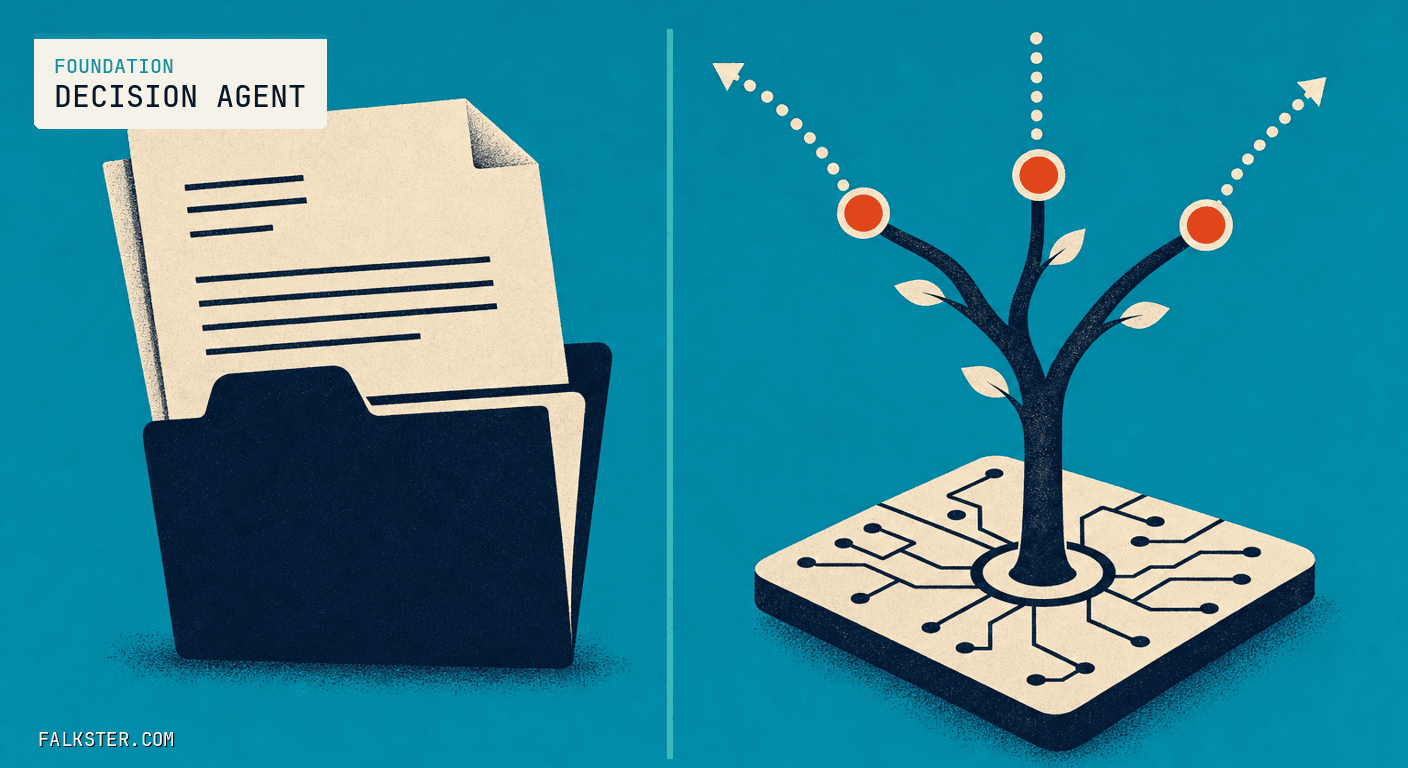
Marco Di Santo published something this week that I have not been able to stop thinking about. He built a decision agent at LivePerson before leaving his role, trained on video transcripts of himself reasoning through real decisions. The title is a sentence I wish I had written: "A Document Holds What You Knew. An Agent Holds How You Would Decide."
The short version
- Handover docs in FDE (forward deployed engineering) work capture facts, not how to decide.
- What to tell a given customer type, under which contract, at which risk level: that skill walks out with the engineer.
- Marco Di Santo built a decision agent before he left LivePerson.
- It holds five 'it depends' questions he would ask before any call.
- The next engineer at a new site does not need to guess if the last one builds the right system before leaving.
The document problem is not a document problem
The departing engineer at the customer sites I have joined in FDE work always left something. A Confluence page, a Notion doc, a long handover Slack message. These documents were not bad. They recorded what was true. The edge cases. The integration quirks. The stakeholder names.
What they did not record was how the engineer would have decided the next call that had not happened yet.
That reasoning is not writable. Not because engineers are bad at writing, but because the reasoning is not a sentence. It is a conditional. It depends on whether this customer is enterprise or mid-market. It depends on whether the contract is usage-based or flat monthly seat fee. It depends on how close they are to renewal and whether a failure here would become a churn story.
A document holds one answer. The five dimensions above produce 32 combinations. No handover document covers 32 combinations. The document gives you the answer for the specific situation that existed when it was written and trusts you to generalize.
That generalization is the week of archaeology.
What Marco built
Marco built a decision agent trained on himself. He recorded videos of himself reasoning through real decisions at LivePerson. A customer asking whether to expand usage before their data layer was ready. A renewal where the platform had underperformed. A request to skip a configuration step to meet a launch deadline.
The agent runs on five question types:
- By customer size and strategic importance
- By contract structure (usage, seat, outcome-based)
- By the customer's stated risk tolerance
- By regulatory environment (healthcare, financial services)
- By proximity to renewal
5 questions
These are not categories the agent was told to use. They are the dimensions Marco naturally reached for when he was deciding. The transcripts revealed the structure he was already using implicitly.
The result is not a chatbot that answers general product questions. It is a narrow system that reasons the way Marco reasoned, constrained to the decisions Marco actually made, in the domain he actually worked in.
Why this matters for FDE specifically
FDE work has a property that most product work does not: the engagement ends. The engineer leaves the site, the account, the customer relationship. Everything built up over months of on-site work leaves with the engineer. The trust, the institutional knowledge, the judgment about what this customer will actually use versus what they say they want.
This is not a solvable problem through documentation, because the problem is not lack of documentation. The FDE Transition series on this site covers what you need at the start of an engagement: understanding the codebase contract, knowing what the deployed agent looks like. These are arrival artifacts. The decision agent is the departure artifact, and it is not on the list anywhere.
The agency knowledge transfer gap: the person who closes the door on their last day at a customer site is carrying more than their laptop. They are carrying the conditional reasoning that made them effective. A document is a record of conclusions. The decision agent is a record of the process.
What to build before you leave
The practical shape of a decision agent for FDE handover is simpler than it sounds. Marco used video transcripts. That works because it surfaces reasoning that you would not think to write. You can also do it as a structured interview with yourself:
Five questions to record yourself answering:
- What are the three situations where you would recommend slowing down rather than moving forward with the customer?
- What is the one integration shortcut that is safe and the one that looks safe but is not?
- What does this customer say they want that is not what they actually need?
- Who at the customer should be in every significant decision conversation, and who should not be?
- What would have to be true for you to recommend pausing the engagement entirely?
The answers to these questions are not in any document. They are what week one at the next site will cost someone else if you do not capture them.
The commitment
I have not built a decision agent for my own handovers yet. This post is partly the commitment to do it next time. The shape of the artifact came from Marco's piece, not from my own practice.
If you are ending a site engagement, the best thing you can build in the last week is not a better status doc. It is a system that holds how you would have decided.
Related answer: What does an FDE leave behind at the end of a site engagement?
Sources:
- A Document Holds What You Knew. An Agent Holds How You Would Decide., Marco Di Santo, Operational AI, 2026-11-17
- The FDE Codebase Contract, falkster.com
- The Agent You Deploy at the Customer Site, falkster.com
The authority cluster for this post is AI Product Management.
Frequently asked
What is a decision agent in the context of FDE handovers?+
A decision agent is a small AI system trained on how a specific person reasons through decisions, not just what conclusions they reached. In FDE handovers, it captures the 'it depends' logic that a document cannot: which recommendation applies by customer size, by contract type, by risk tolerance. Marco Di Santo built one at LivePerson using video transcripts of his own reasoning sessions before leaving the role.
Why do handover documents fail for FDE work?+
A handover document records conclusions. It tells the next engineer what is true today. It does not tell them how to decide what to do tomorrow when the situation has changed. The reasoning that produced those conclusions leaves with the engineer. Week one on a new site becomes archaeology: reading tickets and threads trying to reconstruct not what happened but how the previous person thought.
What are the five 'it depends' question types Marco Di Santo used?+
By customer size, by contract structure, by risk tolerance, by regulatory environment, and by proximity to renewal. Each one is a dimension along which the right recommendation changes. A document records the answer for one combination; an agent can hold the full decision tree.
How is this different from writing better documentation?+
Better documentation still records outputs. The gap is not volume or format; it is that the reasoning chain is not captured at all. A decision agent is trained on the person reasoning out loud, not on the conclusions they wrote down. The video transcript method Marco describes is one way to get at that reasoning before it walks out the door.
What does this mean for the FDE Transition series on falkster.com?+
The FDE Transition series covers what an FDE engineer needs at the start of a site engagement: understanding the codebase contract, what the agent that is deployed at the customer looks like. The handover problem is the other end of the engagement. A decision agent built before leaving is the complement to the codebase contract written before arriving.

Sign in with LinkedIn to leave a comment.
Sign in with LinkedIn