
Jakob Nielsen's roundup today reports a study on what to do while an agent runs for a minute, and his advice is to use the wait to review the decisions your prompt left open. This is a Rewrite: where that decision goes after you have reviewed it once.
The short version
- Nielsen's November 9 roundup reports a paper by Kevin Pu and co-authors on micro-waits, agent runs too long to watch and too short to leave. Their prototype, Sidecar, is a read-only side chat that lists the decisions the agent made unasked.
- With 16 participants, time on other tabs fell from 35% to 13% of the wait, 6 of 16 caught an unwanted decision mid-run, and median mental demand doubled from 2.5 to 5.
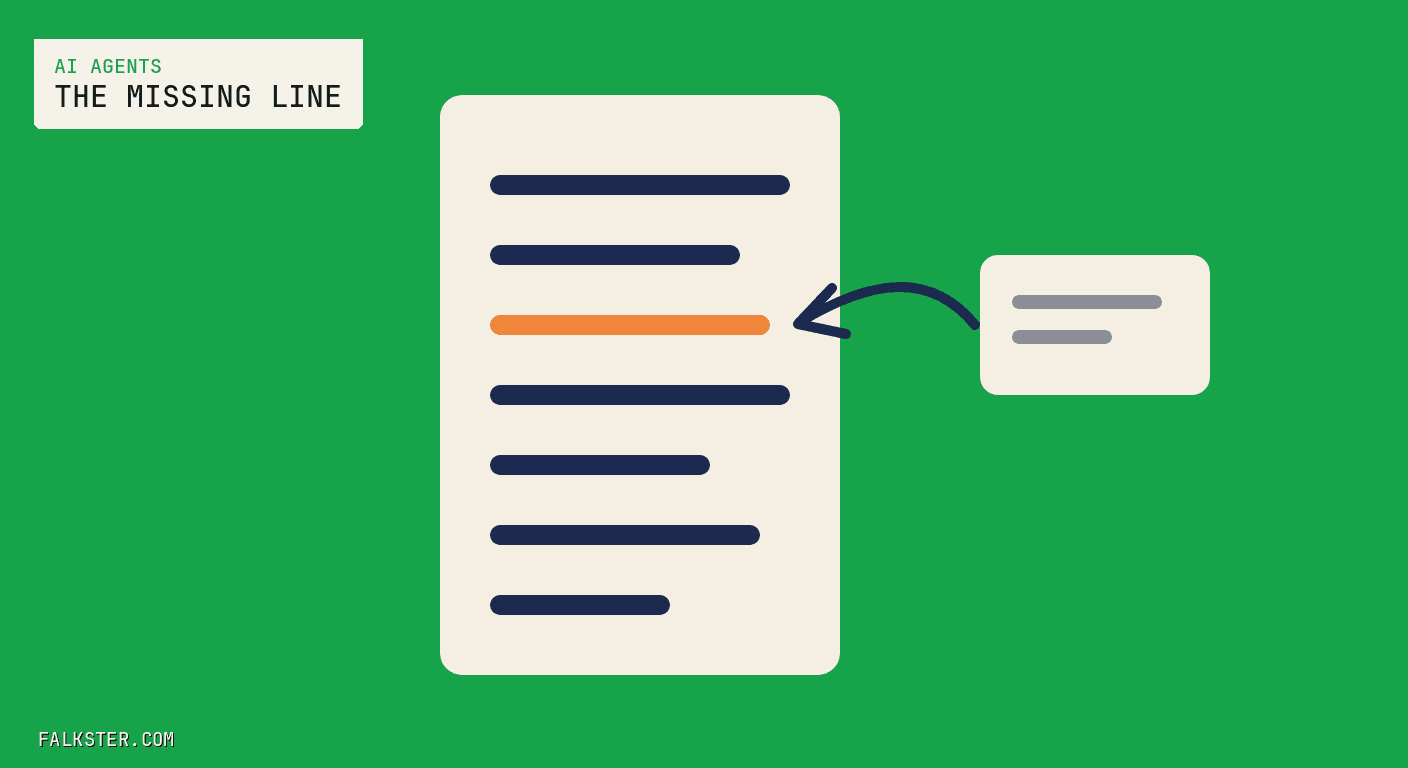
- Nielsen's advice without the tool: while the agent works, ask yourself which decisions your prompt left open. That is right for the first run and wrong for the tenth, because a decision card is a line missing from the brief.
- The two skill files that run my scheduled agents carry 30 lines stamped with my name and a date, and none of those decisions comes back as a card.
- Sort every card three ways: a rule, written once with a name and a date; a parameter, like my comment budget with six dated lines in six weeks, kept as a number with its history; or a one-off. Keep the side lane read-only on the run and add one button that writes to the brief. Then count cards per run.
What the study found
Nielsen wrote about hours-long agent runs last week. This section is about the short ones. Kevin Pu and co-authors from the University of Toronto and Google DeepMind call them micro-waits: "too long to watch, too short to leave." As Nielsen reports it, their 12 interviewees, all daily agent users, had two bad options. Stare at a reasoning trace nobody can read, or leave the tab and lose the context needed to pick the work back up.
Their prototype is Sidecar, a side chat in the agent's browser tab. It reads the whole run and cannot touch the work. It lists the agent's unrequested decisions, suggests directions, and lets you draft the next prompt while the agent keeps going.
Sixteen participants prototyped web apps or generated videos with and without it. Median waits ran 72 to 76 seconds. Time on other tabs fell from 35% to 13% of the wait. Median ratings of progress during the wait rose from 2 to 5 on a 7-point scale. Six of the 16 reported catching unwanted agent decisions during the run instead of finding them in the output, which Nielsen calls midsight. One participant said the cards showed "places where I had to make decisions that I didn't think about."
35% to 13%
And median mental demand doubled, from 2.5 to 5.
Nielsen is straight about the limits: Google researchers, Google's own agent platforms, big-tech staff, about 15 minutes per task. His advice follows from the result. Without Sidecar, do its job by hand: "While the agent works, ask yourself which decisions your prompt left open, and draft the follow-up you may need." For designers: keep the help in the agent's tab, put decisions front and center, and make the side lane read-only so a half-formed idea cannot trigger action.
The tenth run
The card is the right object. I would build it. My problem is with what happens to the card after the user reads it.
In the study every task was new. Fifteen minutes, one prototype, done. In that setting a card is news: here is a choice you did not know you had made.
Most agent work I run is not new. It is the same task tomorrow. On the tenth run the agent reaches the same fork, makes the same unrequested choice, and the side lane shows the same card. Reviewing it again costs the doubled mental demand the study measured, for a question I answered nine days ago.
A decision card is a defect report on the brief. It exists because the instructions left a choice open. The Enterprise AI Agents thesis is that an agent is worth what it still completes after ninety days, and an agent that asks the same question on day ninety that it asked on day one has not been given the answer in a place it can read.
Where my cards went
I checked my own. Two skill files run my scheduled agents, the creator scan and the LinkedIn replies. Between them they carry 30 lines stamped with my name and a date: 6 in the scan's file and 24 in the other. Each is a decision written where the agent reads it at start. None of them comes back as a card. Agents Idle 80% Waiting on Humans. Put the Date on the Decision. is the argument for the format: a name, a date, and the sentence in the person's own words.
Two of those lines taught me that not every card is the same kind of thing.
The LinkedIn comment budget has six dated lines between September 23 and November 5. Three of the sections are marked superseded. That is not one missing rule. It is a number I keep changing, and writing it as a rule six times was the wrong shape. It is a parameter: one value at the top of the file, with its history under it.
The other is a card that is still open. On October 6 I wrote an instruction that said "FTE." The agent read it as FDE, forward deployed engineering, and wrote this into the scan's skill file: "If he meant something else, this section is the one to change." That is a decision card. The agent made a call, said so, and put the note in the brief instead of a chat window that scrolls away. It has been sitting there for five weeks, which is exactly where a card should wait.
The rewrite
"Use the wait to review the decisions you never made" becomes: review it once, then give it one of three dispositions.
A rule. The answer is stable. Write it into the brief with a name and a date. The card never shows again.
A parameter. The answer keeps moving. Keep one current value where the agent reads it, and the history beside it. The card shows only when the value is missing.
A one-off. The answer matters for this run only. Answer it in the next prompt and write nothing.
That changes one thing in the Sidecar design. Pu's team made the side lane read-only so thinking out loud cannot start construction. Keep that. But the card needs a second target. Next to each decision, one control: "always." It does not touch the run. It writes the answer into the standing instructions for the next one. Read-only on the run, writable on the brief.
The design handbook's Specifying Behavior chapter says the unit of design work is a rule with a failure condition attached. A decision card is the product telling you, mid-run, which rule you have not written yet. Latency Is Interface covers the wait itself. And Figma's Agent Made Three Prototypes From 'Surprise Me.' Kill the Brief. Write the Rubric First. is the same move one step earlier: the pass-or-fail lines go in before the prompt.
Then one number. Cards per run, and repeat cards. On a recurring task both should fall. If they do not, the side lane is a daily quiz.
This week, pick one agent task you run more than once. Write down every choice it made that you did not ask for. For each, decide: rule, parameter, or one-off. Put the rules in the file with your name and today's date.
Related answer: What should you do with the decisions an agent made without asking?
Sources: Jakob Nielsen, "UX Roundup: Human 'Taste' Less Unique | World Usability Day | New Work With AI | Agent Waits | Pale Text | AI Teammates | Evidence | Proximity Compatibility Principle | Back Button," UX Tigers, November 9, 2026, the agent-waits section read in full; every figure from the Sidecar paper by Kevin Pu and co-authors is as Nielsen reports it, and the paper was not opened for this post. Falk Gottlob, "Agents Idle 80% Waiting on Humans. Put the Date on the Decision.." The 6, 24, and 30 dated lines, the six budget dates, and the FTE line are counts and quotes from the creator-scan and linkedin-replies skill files in this repository as of November 9, 2026.
Frequently asked
What is the Sidecar study Nielsen reports?+
As Jakob Nielsen reports it on November 9, 2026, Kevin Pu and co-authors at the University of Toronto and Google DeepMind studied minute-long agent runs, which they call micro-waits, too long to watch and too short to leave. Their prototype, Sidecar, is a read-only side chat in the agent's browser tab that reads the whole run, lists the agent's unrequested decisions, suggests directions, and lets the user draft the next prompt. With 16 participants and median waits of 72 to 76 seconds, time on other tabs fell from 35% to 13% of the wait, median progress ratings rose from 2 to 5 on a 7-point scale, median mental demand doubled from 2.5 to 5, and 6 of 16 caught unwanted agent decisions during the run. The paper was not opened for this post.
What is a decision card?+
A short note of a choice the agent made that the prompt never specified, shown to the user while the run is still going. One of the study's participants described the cards as showing places where they had to make decisions they had not thought about. Nielsen calls catching these mid-run midsight.
Why is a decision card a line missing from the brief?+
Because the card only exists when the prompt or the standing instructions left the choice open. On a task that runs once, reviewing the card is the right move. On a task that runs every day, the same card appears every day, and the fix is to answer it once and write the answer into the file the agent reads at start, with a name and a date, so the card stops appearing.
What are the three dispositions for a card?+
A rule: answered once and written into the brief with a name and a date. A parameter: a value that keeps changing, kept as one number at the top of the brief with its history, like the LinkedIn comment budget in my own skill file, which has six dated lines between September 23 and November 5, 2026. A one-off: answered in the run, with nothing written down.
What changes in the Sidecar design?+
One button. Pu's team made the side lane read-only so half-formed ideas cannot trigger action in the run, and that should stay. The card gets a second target: an always control that writes the user's answer into the brief for future runs, separate from steering the current one. Read-only on the run, writable on the brief.
What should a team measure?+
Decision cards per run, and repeat cards, meaning the same decision surfacing on more than one run. On a recurring task both should fall toward zero. If mental demand during the wait stays as high as the study found, 5 against 2.5, the brief is not absorbing the answers.
Sign in with LinkedIn to leave a comment.
Sign in with LinkedIn