
Nate Parrott designs Claude Design at Anthropic, and his third tip for avoiding the AI look is to tell the model about its own habits. I follow that tip on every cover this blog publishes. I also built the pipeline so that it does not matter whether the model listens. This is an Agent Drop: a way to sort your design file that you can do before lunch.
The short version
- Peter Yang's November 15, 2026 episode of Behind the Craft with Nate Parrott, the designer at Anthropic behind Claude Design and Artifacts, lists five ways to get designs out of Claude without AI slop.
- The third is to make Claude aware of its design biases by discouraging its tells in a design.md file, such as serif-only text, off-white backgrounds, and card-edge bars.
- The cover pipeline for this blog does that and does not rely on it. Its prompt bans text, letters, numbers, words, and logos in capitals, and its README still names text in the art as the case that makes a cover unusable.
- So the model decides only the picture, a script draws the badge, keyword, and wordmark on a 1408x768 canvas, and the alt text is rewritten from the rendered image on every run.
- Since October 6, 2026 the rule has also been one call per post with no rerolls. The drop: sort every line of your design.md into what the model decides, what code decides, and what a look decides.
What Parrott recommends
I read the free part of Yang's post, which carries the five tips. The episode itself and the prompt Yang built from it are for paid subscribers, and I have not seen them.
The five, as Yang summarizes them. Give Claude context upfront: screenshots, pages you like, past work. Research familiar UX patterns for hard layouts. Make Claude aware of its design biases. Start with wireframes and settle the flows before fonts and colors. Ask for five options on key screens, pick the parts you like, and have it remix them into five more.
The third is the one this post is about. Yang quotes Parrott: "The model has no idea what its own biases are." So you write them down for it. The examples given are serif-only text, off-white backgrounds, and card-edge bars.
That is good advice. A model that has been told what its defaults look like produces fewer of them.
My cover prompt already does this
Every post here gets a cover from a small pipeline in the repo. The prompt it sends carries its own list of tells, and one line of it is in capitals: absolutely no text, no letters, no numbers, no words, no logos anywhere in the image.
The README in the same folder has a short list of what makes a cover unusable enough to bring to me. The first item on it is text in the art.
Both of those are true at once. The ban is in the prompt, and the failure it bans is still the failure the README plans for. I trust the ban to lower the rate, not to take it to zero.
So the model does not get the decision
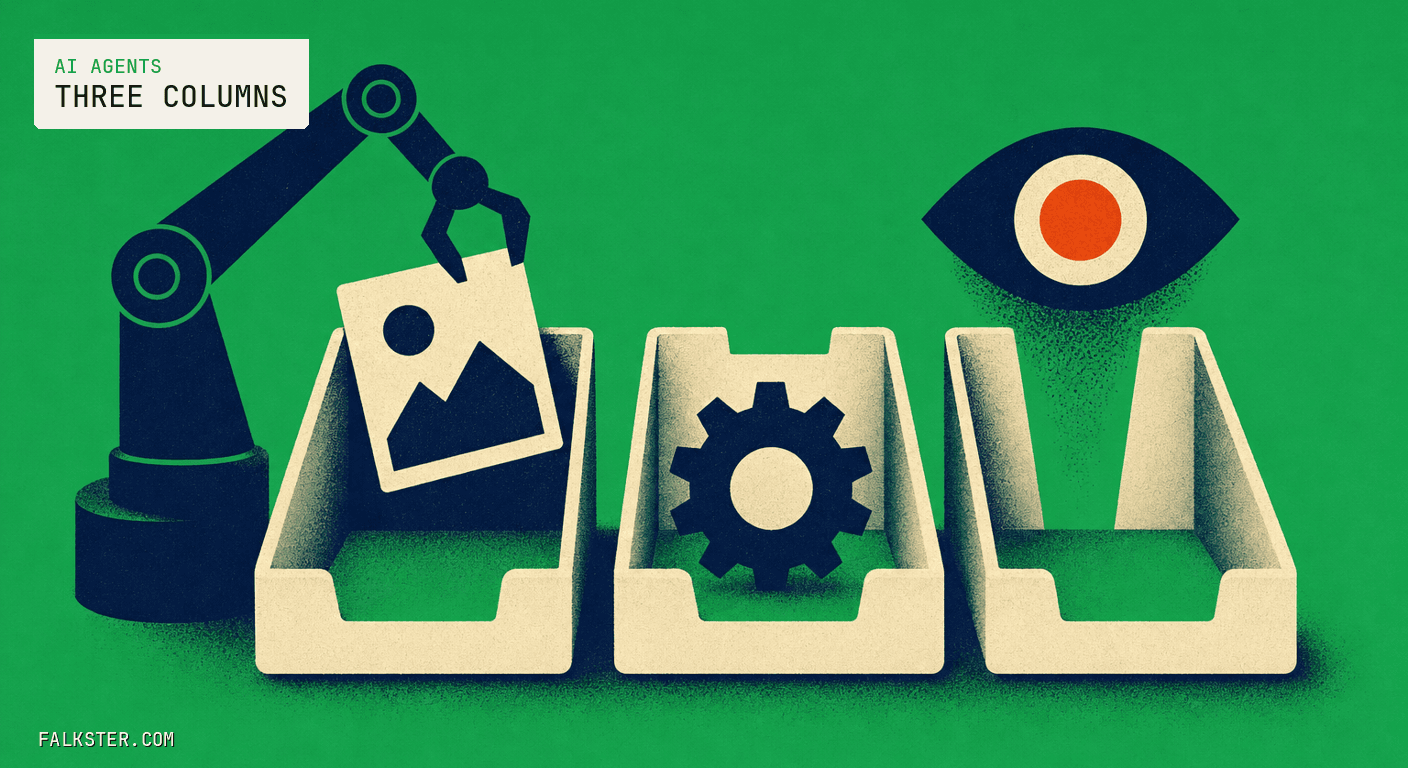
The pipeline splits a cover three ways, and I think the split is the useful part.
The model decides the picture. It gets a one-sentence concept, written with no text and no colors in it. That is the only open decision.
Code decides everything the ban is about. A second script draws the cream badge, the category label, the keyword, and the wordmark. The canvas is fixed at 1408x768. The background color comes from the post's category. The model never draws a letter, so there is nothing for it to get wrong.
A look decides what code cannot. After each render the alt text is rewritten from the actual image, because what got drawn is not always what the concept asked for. That step exists because nobody found a way to check a picture's meaning in code.
One more place I part from the list. Parrott's fifth tip is five options, then five more. My rule since October 6, 2026 is one call per post and no rerolls, because every call is billed. A weak cover ships, and the concept gets fixed for next time. That is a cost decision, and it would be the wrong one for a product screen. It does force the concept to carry the idea.
No rerolls
The drop: three columns
Open your design.md, or whatever file your design agent reads first, and sort every line into three columns.
- The model decides. Composition, the concept, anything where variety helps.
- Code decides. Type, spacing scale, color tokens, the logo, the frame. If a line starts with "never," it probably belongs here.
- A look decides. Whatever needs eyes: does it say the thing, does it look like ours.
Then apply one rule. Any line in column one that you would be embarrassed to see broken moves to column two. If it cannot be moved, it goes to column three with a name next to it.
This is the same move as the rubric work in The Rubric Is the Spec, the Design Operating Model chapter on writing down what good means, applied one step earlier. And it is the reason I argued in Fifteen Models Met 90% of the Design Brief. Kill 'Meets the Brief' as the Pass. that a check everything passes separates nothing. A tell on a ban list is a check the model usually passes. Usually is the problem.
This week
Do the sort on one file. Count the lines that start with "do not" or "never," and for each ask whether a script or a token could make it impossible instead. Move one. More on where design judgment goes when generation is cheap is in AI Product Management.
Related answer: How do you stop AI-generated designs from looking AI-made?
Sources: Peter Yang, "How to Get Claude to Design Without AI Slop in 40 Minutes | Nate Parrott," Behind the Craft, November 15, 2026, free section read; the episode and the prompt are for paid subscribers and were not opened. The five tips and the quote are as Yang reports them. The prompt line, the README, the 1408x768 canvas, and the October 6, 2026 rule are from this site's own cover pipeline.
Frequently asked
What are Nate Parrott's five tips for avoiding AI slop in Claude designs?+
As Peter Yang summarizes them in his November 15, 2026 episode: give Claude context upfront, research familiar UX patterns, make Claude aware of its design biases, start with wireframes, and ask for five options and then remix them into five more. I read the free section of the post. The episode and the prompt are for paid subscribers.
What does it mean to make Claude aware of its design biases?+
Parrott's point, as Yang quotes it, is that the model does not know what its own defaults look like. So you list them in a design.md or similar file and discourage them. The examples given are serif-only text, off-white backgrounds, and card-edge bars.
Why is a ban list in the prompt not enough?+
It lowers the rate without taking it to zero. The cover pipeline for this blog bans text, letters, numbers, words, and logos in its prompt, in capitals, and its README still names text in the art as the case that makes a cover unusable. A ban is a request. If a failure matters, take the decision away from the model.
How does your cover pipeline split the work?+
Three ways. The model decides the picture from a one-sentence concept with no text and no colors. A script draws the badge, the category label, the keyword, and the wordmark on a fixed 1408x768 canvas in the category color. And after each render the alt text is rewritten from the actual image, because the drawing does not always match the concept.
What is the three-column sort?+
Open the file your design agent reads first and sort every line into what the model decides, what code decides, and what a look decides. Any line in the first column that you would be embarrassed to see broken moves to the second. If it cannot be enforced in code, it goes to the third with a name next to it.
Do you ask for multiple options like Parrott suggests?+
Not for covers. Since October 6, 2026 the rule is one image call per post and no rerolls, because every call is billed. A weak cover ships and the concept gets fixed for next time. For a product screen I would take his advice and ask for several.
Sign in with LinkedIn to leave a comment.
Sign in with LinkedIn