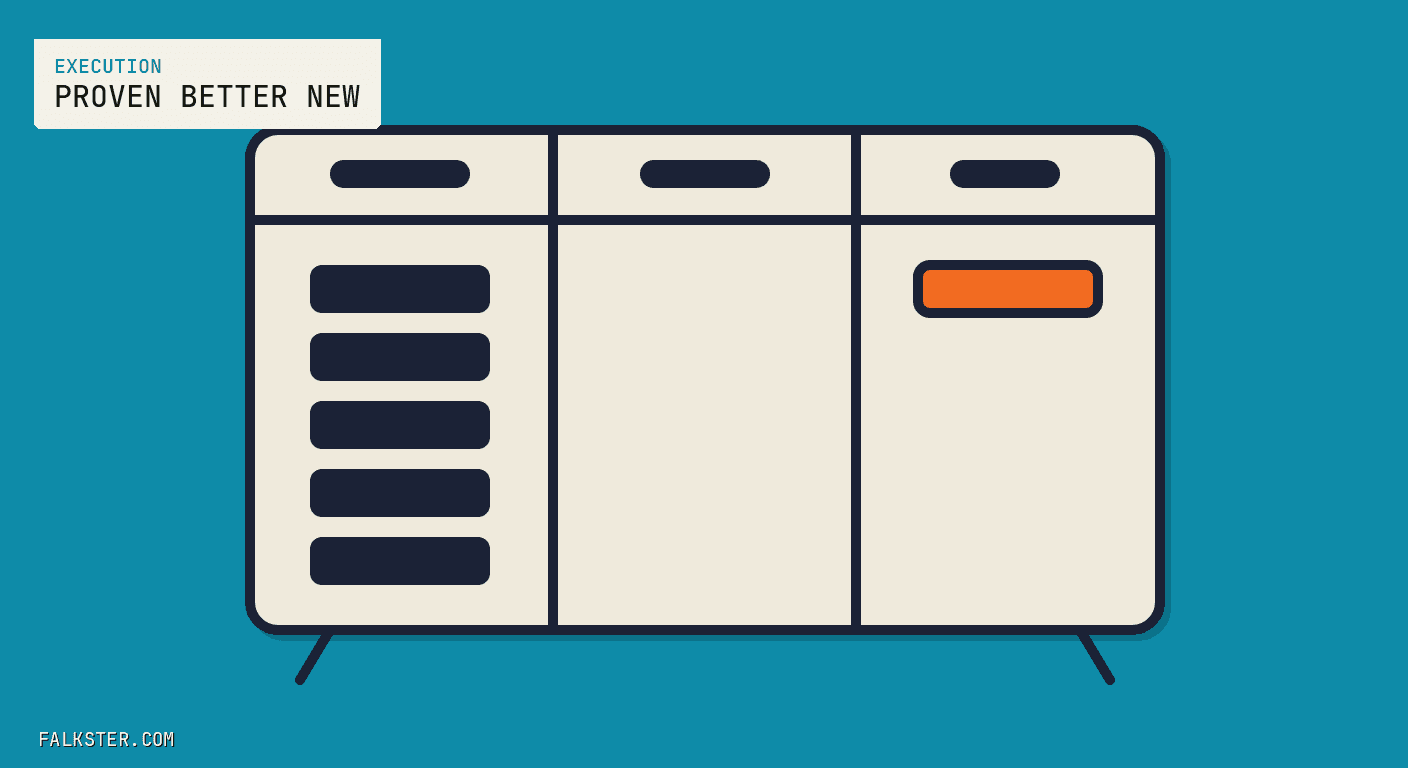
Mark Pincus drew his own product's board on Aakash Gupta's show this week and left the middle column empty. This is a ship story: Heidi's board, drawn the same way, with the empty column, the one bet, the one new that failed, and the one new that is the company.
The short version
Proven Better New, as Aakash Gupta reports Mark Pincus teaching it on October 26: Proven is anything that already works for your audience on your platform, copied click by click; Better is what 10 out of 10 users of the proven product would choose, and if only you think so it is New; New is the one idea the launch isolates and measures. Pincus's board for his own family assistant, built against Instinct, has Better empty. Heidi's board, drawn the same way from decisions already published on this site: Proven is the features, which a funded competitor can replicate and which are not the edge because models are rented. Better is empty for his reason. One removal, pooling learning across tenants, is logged as a bet rather than a better, because removing something proven is a bet like any other, and it is the weakest of my four moat answers. One new failed, the Signals layer, which held everything, displayed it cleanly, and compounded nothing. One new is the company, the tenant's earned record. Where I read him differently is the platform-cycle rule: for a company brain, less new rounds down to a rented model and a wiki import, a snapshot that ports, so the discipline is exactly one new, not less.
The framework, as taught
Gupta got Pincus to the whiteboard, and the write-up carries the board. Zynga Poker: the big online poker sites made you download before a single hand, and Pincus's number, his own and not a benchmark, is that the download loses at least 80% of the audience. So he copied the leading tables down to the chip colors, removed the download, and added one new thing, your Facebook and MySpace friends at your table.
Three columns. Proven is any part of the experience that already works for this audience on this platform, copied click by click. New is your novel idea, isolated so the launch measures it and nothing else. Better is the hard column, and his test is strict: would 10 out of 10 people who use the proven product today choose it? If they all would, call it better. If only you think so, call it new.
Then he ran it on himself. For a family assistant built against Instinct, the AI assistant that works over text, he left Better empty: no ideas today that 10 out of 10 Instinct users would call better. Putting the whole family in one thread feels like an obvious improvement to the person building it. Under the test it is new.
Two more rules from the board. Removing something proven is a bet like any other, not a better; Zynga copied FarmTown's neighbor bar, where the other player has to accept your request, and calling its removal better would, in his words, have made the product less viral. And all new fails, the Zynga mantra, so discount your own hope for your new idea and watch the market for new that is working, because that new just became proven.
Gupta's closing exercise is the one I ran: label every roadmap item proven, better, or new, and if one launch carries more than one new, that is the first cut.
Heidi's board
Everything on this board is already on the record in pieces. It has never been drawn as one board, and Building a Company is the cluster where the decisions go public before the outcome does.
Proven: the features. The Data Flywheel Has a Reverse Gear ran four moat questions on Heidi, and the answer to the first was that a well-funded competitor can replicate Heidi's features and that features are not the edge, because models are rented and get better and cheaper every quarter for everyone, including us. That is Pincus's proven column. Copy it click by click, do not spend the launch on it.
Better: empty. Same reason as his. I have no feature today that 10 out of 10 users of the proven products would call better. I'd like to write something else here, and his test is the reason I can't.
One removal, logged as a bet. Heidi is multi-tenant with strict tenant isolation, and we ruled out pooling learning across tenants because it collides with that promise. So a new customer does not make Heidi better for every other customer, and there is no classic network effect. The flywheel post called that the weakest of the four answers, by design. Pincus's rule sharpens the label: removing something proven is not a better, it is a bet. I made it on purpose, and it sits in the bet column, not the better column.
One new that failed. Kill the System-of-Record Slide told this one. Heidi shipped a Signals layer that held everything. Every source connected, every signal resolved and displayed cleanly, side by side. It demoed beautifully. It compounded nothing, because signals sitting next to each other on a screen are not correlated with each other, and a signal that never triggers an act never generates the evidence that would make the next signal smarter. By his test it was new, and it failed the way new fails.
One new that is the company. The tenant's earned record. Context Is King. Written Context Is Rented. drew the line: written context, the wiki and the imported docs, ports to whatever vendor is cheapest next quarter. What does not port is the graded record of what agents did inside your tenant, which acts a human reversed, and which rules survived contact with your outcomes. Nobody on that chart has it yet. That is the one new, and the launch exists to measure it.
Eleven lighthouse customers are the audience the 10-of-10 test runs against. The board above is the honest version of what they are buying.
Where I read the platform rule differently
Pincus's platform-cycle rule, as Gupta reports it: the earlier you are in a platform shift, the less new you should pursue. Hay Day is the proof. Supercell's game looked like FarmVille 2, 0% new in his words, and what changed was the better: it loaded faster, it had shorter crop cycles, and it had touch. AI is early, so the low-hanging fruit is there, and the discipline is to look for where you can be better because of AI.
For a consumer game on a new platform I'd take that as written. For a company brain built on rented models, "less new" has a floor, and the floor is a rented model with a wiki import. That is the whole chart in the written-context post. It is a snapshot, it ports, and every funded competitor can ship it, which is my own proven column saying so. Less new, in this category, rounds down to no company.
So the discipline is not less new. It is exactly one. Everything else copied click by click, the one new isolated, and the Signals layer is what it costs to carry a second one by accident. Pincus would, I think, call that the same rule. His board for Instinct has one new too. The difference is what the floor looks like when the proven layer belongs to someone else's model.
This week: open your roadmap and write proven, better, or new next to every item, with Pincus's test for better and nobody else's. If Better is empty, write empty. If New has more than one entry, pick the one the company is, and move the rest to the next launch.
Related answer: How do you apply Proven Better New to an AI product?
Sources: Aakash Gupta, "How to steal your way to a hit product, with Mark Pincus (founder, Zynga)," Product Growth, October 26, 2026, the newsletter text read in full; the episode itself was not watched, and every Pincus claim is as Gupta reports it. Falk Gottlob, "The Data Flywheel Has a Reverse Gear" (October 19, 2026), "Kill the System-of-Record Slide" (September 24, 2026), "Context Is King. Written Context Is Rented.," and "I'm a Company of One Because I Refused to Vibe Code" (the eleven lighthouse customers).
Also on Medium
Full archive →Frequently asked
What is Proven Better New?+
Mark Pincus's framework for sorting a product, as Aakash Gupta reports him teaching it on October 26, 2026. Proven is any part of the experience that already works for this audience on this platform, so you copy it click by click. Better is what 10 out of 10 people who use the proven product today would choose; if only you think so, it is New. New is your one novel idea, isolated so the launch measures that idea and nothing else. Zynga Poker, in his telling, copied the leading poker tables down to the chip colors, removed the download, and added one new thing: your friends at your table.
Why did Pincus leave the Better column empty for his own product?+
Because of his own test. For a family assistant built against Instinct, the AI assistant that works over text, he said he had no ideas today that 10 out of 10 Instinct users would call better. Putting the whole family in one thread feels like an improvement to the person building it, and under the test it is New. His other warning is that removing something proven is a bet like any other, not a better: Zynga kept FarmTown's neighbor bar even though it looked like friction, because removing it would have made the product less viral.
What is on Heidi's board?+
Proven: the features, which a well-funded competitor can replicate and which are not the edge because models are rented. Better: empty, for Pincus's reason. One removal logged as a bet, not a better: pooling learning across tenants, ruled out because it collides with the tenant-isolation promise, which is the weakest of the four moat answers. One new that failed: the Signals layer, which held everything, displayed it cleanly, and compounded nothing because nothing it noticed ever triggered an act. One new that is the company: the tenant's earned record of what agents did, which acts a human reversed, and which rules survived contact with outcomes.
Where does the post disagree with Pincus?+
On the platform-cycle rule as applied to a company brain. He says the earlier you are in a platform shift, the less new you should pursue, with Hay Day as the proof: 0% new, better on load time, crop cycles, and touch. For a product built on rented models, less new rounds down to a rented model and a wiki import, which is written context, a snapshot that ports to the next vendor. So the discipline is not less new. It is exactly one new, isolated, with everything else copied click by click. The Signals layer is the cost of carrying a second one by accident.
What does 'all new fails' mean for Heidi?+
It is the Zynga mantra as Pincus reports it, and the Signals layer is Heidi's instance. Every source connected, every signal resolved and shown side by side, a beautiful demo, and no loop: a signal that never triggers an act never generates the evidence that would make the next signal smarter. By his test it was new, and it failed the way new fails. The one new still on the board is the earned record, and the eleven lighthouse customers are the 10-of-10 it is tested against.

Comments (0)
Sign in with LinkedIn to leave a comment.
Sign in with LinkedIn