Jakob Nielsen's roundup yesterday reintroduced a forty-year-old frame for testing people and machines together, and gave it a ship gate with three columns. I have the case that needs a fourth. This is a rewrite of the gate, not of the frame.
The short version
Nielsen's October 26 roundup brings back Erik Hollnagel and David Woods's joint cognitive system, as he reports it: analyze the human and the machine as one unit that perceives, interprets, decides, and acts, and judge designs by how that unit performs. His first guideline is the gate: measure the human and AI team against human-alone and AI-alone baselines, and ship only when the team wins on accuracy, speed, and error recovery. My expense agent won all three. It auto-approved expenses under $500 with a matching receipt, a review finance had done by hand, and for two weeks it was faster, accurate against the written policy, and had nothing to recover from. Then "dinner with customer" with a vague receipt passed every time, approvals went up 40%, about $2,400 went through that should not have, and finance turned it off within the month. What the human-alone baseline had was a refusal nobody had written down: the fourth dinner from the same person slows an approver down. The rewrite is a fourth column, refusal rate against the human alone, with reasons, filled from the human's reject pile before the agent takes the seat.
The frame, and the gate
Nielsen's section is the clearest short account of joint cognitive systems I have read, and the history matters for what follows. Hollnagel and Woods, as he tells it, wrote the idea up in a 1982 report from Risø National Laboratory in Denmark and published it in 1983, three years after Three Mile Island, where more than 100 alarms went off in the first minutes and more automation had only deepened the operators' confusion. Their fix was to redraw the boundary. Stop analyzing the human and the machine as separate boxes tossing signals over a wall, and analyze the system they form together.
He names the two failure modes. Substitution thinking: buy the automation, subtract the human work, done. And the handoff cliff: the machine cruises through the easy 95% and dumps control back on the human at the worst moment with no context, the driver who has to become an alert expert in two seconds. Benchmarks, he says, repeat the blunder in a lab coat. A model beats humans on a test set, gets deployed, and joint performance drops.
Then seven guidelines, and the first one is the gate. Measure joint performance: evaluate the human and AI ensemble on real tasks against human-alone and AI-alone baselines, and ship only when the team wins on accuracy, speed, and error recovery.
Three columns. I'd sign the frame and most of the guidelines as written. The gate is the part I have run, and it is a column short.
The team that won all three
Agents Fit the Human Pattern Nine Times in Ten. Design the Tenth. has the case. An agent read expense reports submitted in Slack, checked them against policy, and auto-approved anything under $500 with a matching receipt. Finance had been doing that review by hand, and the idea was to save them ten hours a week. Same step, same policy. I put an agent in the seat.
Score it on Nielsen's three columns against the human-alone baseline, which was finance doing it by hand.
Speed: the agent won, because finance was no longer doing the review by hand. Accuracy: against the written policy, the agent won or tied, because the policy was the thing it checked. Error recovery: for two weeks there was nothing to recover from, and finance was still there to catch anything the agent flagged.
By the gate, ship it. We did.
Then one of my engineers figured out that "dinner with customer" and a vague receipt passed every time. Approvals went up 40%. Spend followed. About $2,400 was approved that shouldn't have been, and finance turned it off within the month.
The column it lost
What didn't transfer was never in the pattern. A human approver who sees the fourth "dinner with customer" from the same person in a month slows down. Nobody wrote that into the workflow, because nobody had to. It lived in the approver.
That is a refusal. The human-alone baseline refused some share of the submissions that matched the written policy, for reasons the policy never carried. The agent refused none of them. On accuracy it was still right, because accuracy was measured against the policy. On speed it was still faster. On error recovery it looked fine until the error was found. The column where the team lost, and lost by 40% of approvals and $2,400, was the one the gate does not have.
Nielsen's fifth guideline is the diagnosis, and it is exact: a person whose only job is to watch for rare failures will miss them, so give that person a live decision role in the loop. Finance's job had become watching. Kill 'Human in the Loop' as a Control. Keep a Gate Ledger. made the same argument from the control side: a standing human watch is not a control, a specific gate with a ledger entry is. The expense agent had the watch and no gate.
The rewrite
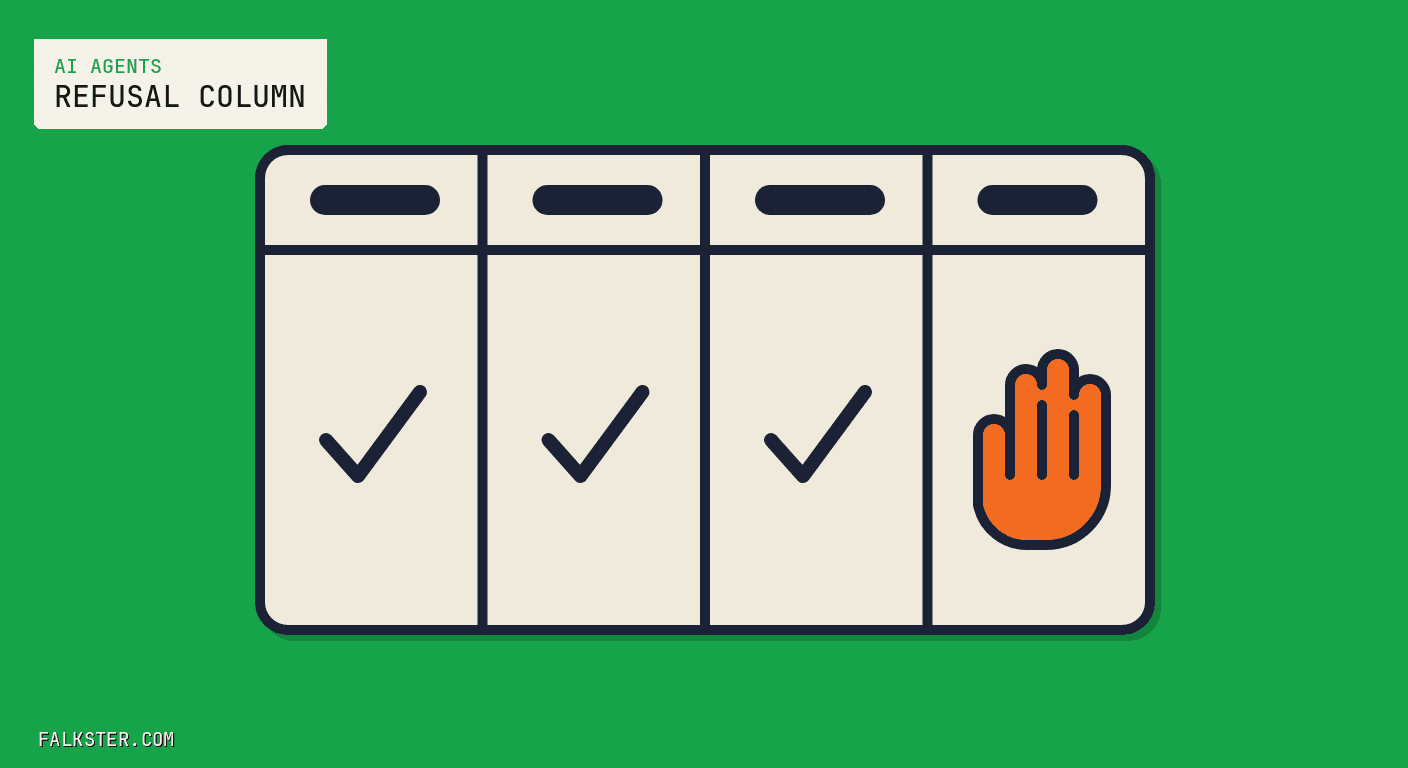
Four columns on the gate, not three. Accuracy, speed, error recovery, and refusal rate, held against what the human alone refused, with the reasons.
A team that matches the human on the first three and refuses less than the human did has lost the thing the seat was for. A team that refuses more needs the reasons read, because some of those are the agent being cautious where the human was fast, and some are the agent failing on inputs the human never saw.
What fills the column is the human's reject pile, recorded before the agent takes the seat. Atlassian Split the Reviewer in Two. Ship the Matcher's Reject Pile. argued for the same artifact in the reviewer's case: the rejects are where the judgment is. For an approval seat the pile is every case the approver said no to in the last quarter, with the reason in the approver's words, next to the ten worst plausible outputs that the design handbook's The Failure Inventory(coming Nov 25) asks for before any AI surface ships. If the pile is empty, the baseline on column four is a guess, and the agent will win the first three columns right up to the month someone turns it off.
Two more lines on Nielsen's other guidelines, because the case touches them. His fourth, build ramps for handoffs with a capsule of context, needs the capsule to carry why the agent did not refuse, not only what it did. And his sixth, maintain common ground by stating assumptions, is where the fourth dinner would have surfaced: an agent that said "fourth customer dinner this month from this submitter, approving under policy" would have been turned off in week one by a person who was no longer only watching.
Under Enterprise AI Agents the claim is that agent count is a vanity metric and what matters is how many agents still complete production work after ninety days. The expense agent did not make thirty. It passed a three-column gate to get there, which is the argument for the fourth.
This week: pick the agent your team is about to put in a seat a person holds. Before it sits down, ask the person for the last ten things they refused in that seat and why. That list is the fourth column's baseline. If they cannot produce it, the agent is not ready, and neither is the gate.
Related answer: How do you measure a human and AI team before shipping it?
Sources: Jakob Nielsen, "UX Roundup: Flow | AI & Creative Jobs | AI Price | Too Many Options | Joint Cognitive Systems | Proactive AI | Satisfaction | Carousels | Activity Feeds | Pagination | Robotaxi Safety | Integration," Jakob Nielsen on UX, October 26, 2026, the Joint Cognitive Systems section read in full. Erik Hollnagel and David Woods's 1983 paper, Gary Klein's 2004 "Ten Challenges," and Earl Wiener's work on clumsy automation are cited only as Nielsen reports them; none was opened. Falk Gottlob, "Agents Fit the Human Pattern Nine Times in Ten. Design the Tenth." (October 13, 2026), "Kill 'Human in the Loop' as a Control. Keep a Gate Ledger." (October 9, 2026), "Atlassian Split the Reviewer in Two. Ship the Matcher's Reject Pile." (October 15, 2026), and "The Failure Inventory(coming Nov 25)" in The Design Operating Model.
Also on Medium
Full archive →AI Agents and the Future of Work: A Pixar-Inspired Journey
What product managers can learn about AI agents from how Pixar runs a film team.
Many AI Agents Are Actually Workflows or Automations in Disguise
How to tell agents from workflows from cron jobs, and why it matters for what you ship.
Frequently asked
What is a joint cognitive system?+
As Jakob Nielsen defines it in his October 26, 2026 roundup: the combination of a human and a machine, analyzed and designed as a single unit that performs cognitive work, perceiving, interpreting, deciding, and acting. He credits Erik Hollnagel and David Woods, a 1982 report from Risø National Laboratory published in 1983 as 'Cognitive Systems Engineering: New Wine in New Bottles.' His example is a radiologist reading scans with an AI screening tool, judged on whether the pair catches more tumors with fewer false alarms than either partner alone.
What is Nielsen's gate for shipping a human and AI team?+
The first of his seven guidelines: measure joint performance. Evaluate the human and AI ensemble on real tasks against human-alone and AI-alone baselines, and ship only when the team wins on accuracy, speed, and error recovery. The other six, as he lists them: make the machine observable, support directability, build ramps for handoffs, keep the human active, maintain common ground, and fail soft and escalate early.
What did the expense agent do, and how did it fail?+
It read expense reports submitted in Slack, checked them against policy, and auto-approved anything under $500 with a matching receipt, a review finance had done by hand, with ten hours a week as the target. It ran two weeks. Then an engineer found that 'dinner with customer' and a vague receipt passed every time. Approvals went up 40%, about $2,400 was approved that should not have been, and finance turned it off within the month. Against Nielsen's three columns it had won: faster than finance, accurate against the written policy, and nothing to recover from for two weeks.
What is the fourth column?+
Refusal rate, held against the human-alone baseline, with the reasons. The human approver who sees the fourth 'dinner with customer' from the same person in a month slows down. Nobody wrote that into the workflow because nobody had to, so the three-column gate never measured it. A team that matches the human on accuracy, speed, and recovery and refuses less than the human did has lost the thing the seat was for.
What fills the fourth column?+
The human's reject pile, recorded before the agent takes the seat: the cases the person in the seat said no to, with the reason, plus the ten worst plausible outputs from the design handbook's failure inventory. If the pile is empty the baseline is a guess. The gate ledger then records each refusal the agent makes or fails to make, so the column has a number by week two instead of a story by month one.
Which of Nielsen's guidelines diagnoses the case?+
The fifth, keep the human active: a person whose only job is to watch for rare failures will miss them, so give that person a live decision role in the loop. Finance's job had become watching. The fix is the one Kill 'Human in the Loop' as a Control argued for: the human's role is a specific gate with a ledger entry, not a standing watch.

Comments (0)
Sign in with LinkedIn to leave a comment.
Sign in with LinkedIn