
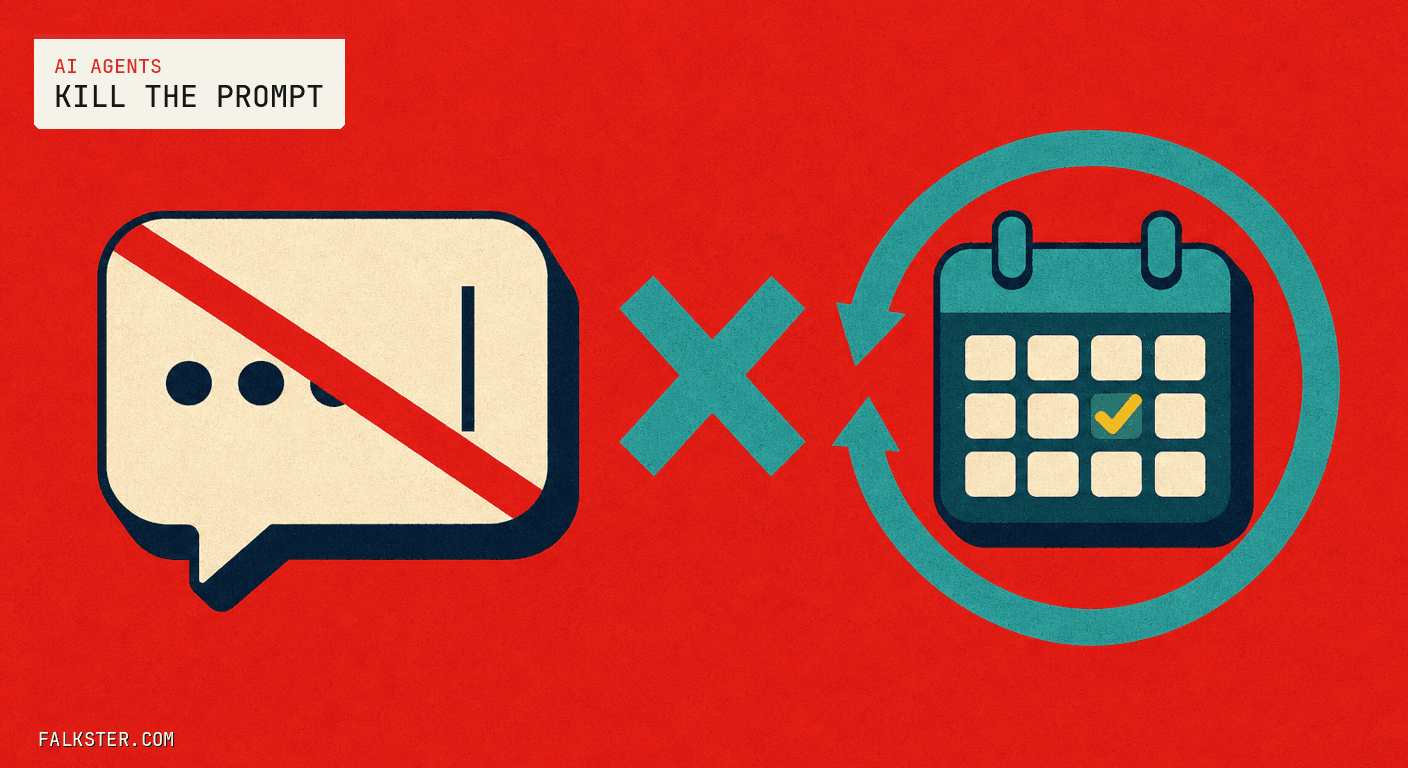
When three independent sources converge on the same idea in one week, the signal is not that they are all correct. It is that a convention is hardening, and the week to write the contrarian version is now.
Harrison Chase, the chief executive of LangChain, published two pieces in the same week. Alex Wang published one that reached the same conclusion from a different angle. The idea: the agent that waits for a command is already the legacy version.
The short version
- The task-execution pattern is scaffolding. You prompt an agent and check if it worked.
- It was the first form of agent interaction, built for systems too brittle to run without close supervision at every step. Three sources converged on its replacement in one week.
- Goal-driven agents hold an objective, run on a schedule, persist state between runs, and deliver a result you read. This creator scan is an example. The kill list entry is not the task agent itself.
- It is the assumption that every agent interaction should feel like a conversation.
- When an agent can hold a goal over days, the right interface is a report, not a chat.
Three independent sources in one week
Harrison Chase, "From tasks to goals" (LangChain, 2026-11-17): The LangChain chief executive argues that the next generation of agents does not receive a command and execute it. It holds a goal, works toward that goal in the background, and surfaces to the human when it needs input or has a result. The goal persists across runs. The agent decides when to continue and when to check in.
Harrison Chase, "What We've Learned Building Proactive Agents" (LangChain, 2026-11-17): The same week, Chase covers the patterns behind proactive agents. The two key components are ambient scheduling and persistent memory. Ambient scheduling means the agent runs on a timer or an event, not a human prompt. Persistent memory means state survives between runs, so a resumed agent picks up where it left off. He also names the third pattern: do not just trust "Done." Evaluate the result before surfacing it. An agent that reports completion without verification is worse than no agent because it creates false confidence.
Alex Wang, "We Know Multi-Agent Systems. But What Are Long-Running Agents?" (Learn AI Together, 2026-11-12): Wang separates two problems the industry has conflated. Multi-agent systems are about how multiple specialized agents coordinate and hand off work. Long-running agents are about how a single agent persists reliably over hours or days while holding a goal. The first problem is largely solved. The second is not. He names three engineering patterns. Event-driven execution: the agent sleeps and wakes on external signals instead of polling. Persistent state and checkpointing: a resumed agent picks up where it left off. Outcome verification: evaluate the result, do not trust "Done".
The convergence is notable because Chase and Wang are coming from different angles. Chase is building the platform. Wang is analyzing the landscape. They named the same gap.
What the pattern actually is
The task-execution agent is not wrong. It is narrow. It was designed for agents that were brittle, that needed tight supervision at every step because they might go off in an expensive direction with any ambiguity. The pattern is: prompt, run, check. It is appropriate for one-off tasks, for agents exploring unfamiliar territory, for any situation where the human needs to steer in real time.
The mistake is treating it as the final form.
The task-execution pattern is scaffolding. It is the first form of agent interaction that proved agents could do useful work. The goal-driven ambient pattern is what comes after agents are reliable enough to be trusted with a persistent objective.
This creator scan is an example of the second pattern. The goal is not "scan the RSS (content feed) sources." The goal is "maintain the content pipeline." The agent runs weekly. It holds state from the previous run (the existing posts, the recent ideas, the roster). It delivers a digest and four published posts. I read the summary. When it fails, I read the failure message rather than debug a conversation. The model and the conversation are implementation details.
The kill list entry
Kill: command-line agent UX. The pattern where every agent interaction is a prompt-run-check cycle. This is the prototype for a goal-driven agent, not the finished form. It trains users to expect failure at every step and to treat agents as expensive calculators rather than autonomous systems.
The replacement is not a different conversation pattern. It is the absence of a conversation. A goal-driven agent should deliver a report. The exception, surfacing to the human, should be notable rather than routine.
The AI agents pillar hub has the full framework for evaluating when an agent is ready to hold a goal versus when it still needs task-level supervision.
What this means if you are building
If you are building an AI product and your users primarily interact with it through prompts, ask whether the core jobs on your platform require that. The scheduler, the researcher, the monitor: these are goal-shaped jobs. The editor, the explainer, the advisor: these are task-shaped jobs. The first group should not look like the second.
The goal-driven ambient pattern has three requirements Chase and Wang both name. The agent schedules itself: ambient runs, not human-triggered. It persists state across runs: checkpointing, not stateless sessions. It verifies its own output: evaluation, not trust. When all three are present, the right product interface is a notification and a report, not a chat window.
Related answer: What is the difference between a task agent and a goal-driven agent?
Sources:
- From tasks to goals, Harrison Chase, LangChain, 2026-11-17
- What We've Learned Building Proactive Agents, LangChain, 2026-11-17
- We Know Multi-Agent Systems. But What Are Long-Running Agents?, Alex Wang, Learn AI Together, 2026-11-12
3 sources
The authority cluster for this post is Enterprise AI Agents.
Frequently asked
What is the task-execution agent pattern?+
The task-execution pattern is the interaction model where you give an agent a specific command, it runs until it completes or fails, and you check the result. The pattern was necessary when agents were brittle and needed tight human supervision for every step. It is becoming the scaffolding pattern: the first version that proved the concept, before the ambient goal-driven version replaces it.
What is a goal-driven agent and how is it different?+
A goal-driven agent holds an objective rather than a task. You give it a goal (maintain the creator scan, keep the content pipeline running), and it schedules its own runs, persists state between them, decides when to surface to you versus keep going, and delivers a result you read rather than a session you watch. Harrison Chase describes this as the agent working toward goals in the background and checking in when it needs you.
What is the difference between a multi-agent system and a long-running agent?+
Alex Wang's framing: multi-agent systems are about how multiple specialized agents coordinate and hand off work to each other. Long-running agents are about how a single agent persists reliably over hours or days. The industry has largely solved multi-agent routing. The unsolved problem is persistence: event-driven execution instead of polling, checkpointing state across runs, and verification that the agent actually finished rather than just said it did.
What does Falkster.AI run on this pattern?+
The weekly creator scan is a goal-driven ambient agent. The goal is a digest and four published posts. The agent runs on a schedule, reads 182 RSS sources, scores them against the five authority clusters, writes the digest, and publishes the posts. I read the summary. When it fails, I read the failure message rather than debug a conversation. The model and the conversation are implementation details; the result is the product.
What should still be a task-execution agent?+
Anything that requires real-time human judgment at each step: an agent helping you draft a specific reply to a specific message, an agent exploring an unfamiliar codebase on first read, an agent running a one-off data analysis where you need to steer the query. Task-execution is not wrong, it is narrow. The mistake is treating it as the final form rather than the starting form.
Sign in with LinkedIn to leave a comment.
Sign in with LinkedIn