
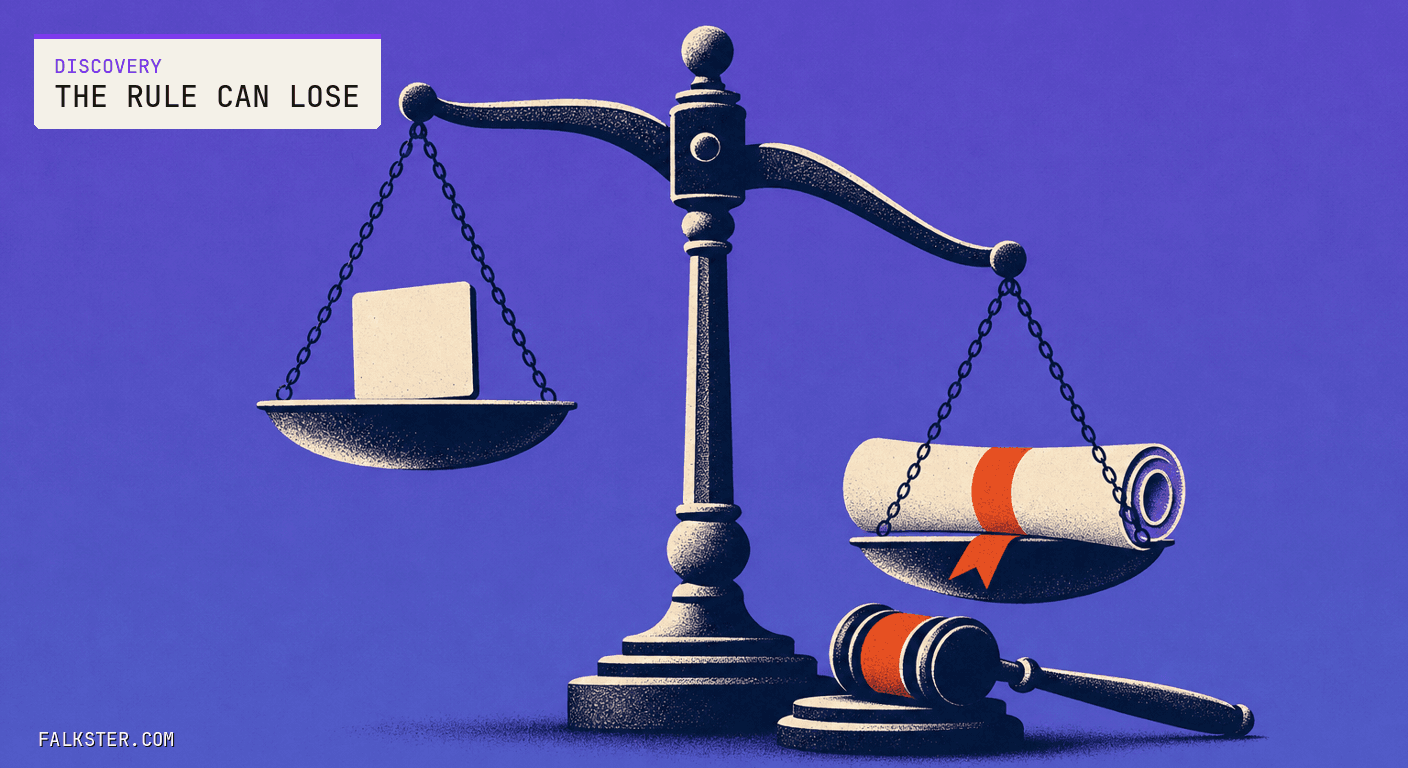
When a test fails, there are two things that could be wrong. The work, or the test.
Design teams mostly ask about the work. I think the second question is about to matter a lot more, because software now runs the checks, and it runs them all day.
The short version
- One team has every piece of its screens sign a written promise about how it behaves.
- A program watches the live product and reports broken promises.
- Then a judge decides which one is wrong, the piece or the promise. Most design reviews never ask that second question. I'd add a third verdict, which is that the rule is vague. And I'd keep a log.
- Each time a rule loses, write down which rule, what caused it, and who signed.
- My own site excuses 917 old files from a writing check, and the list can't grow.
What the notes describe
Luke Wroblewski is a designer who writes short notes on building AI products. On November 20 he published notes from an event where five builders showed how far they push AI agents. I read the notes in full. I didn't watch the talks, so everything here is as he reports it.
One of the five was John Hayes, whose team builds a product called Motif. It turns the work of a marketing department into code. AI agents write that code and fix it on the live product. Marketers don't read code, so nobody checks it by hand.
So how do they check the softer things, like whether a screen feels steady?
Each piece of the screen fills out a contract. The contract covers things like whether the layout stays still and whether the cursor stays where it was. A program watches the pieces while the product runs and writes up what it finds.
Then comes the step I care about. The findings go to a judge. The judge decides whether the piece is wrong or the contract is.
It wasn't smooth. At around 130 pieces the system got stuck for 48 hours trying to keep track of its own findings.
Why the second verdict matters
A design review usually has one outcome. The screen fails, so the screen gets fixed.
But rules are written by people, on some earlier day, for some earlier product. Sometimes the screen is right and the rule is stale. If nobody is allowed to say so, one of two things happens. People bend good work to fit a bad rule. Or they stop trusting the rules at all.
Brad Frost wrote the book Atomic Design and teaches design systems. The same day, he wrote that more than 20 of his websites are now built only from his own design system. He calls the checks that AI-written code must pass a steel curtain. I like the curtain. It still needs someone who can say it hangs in the wrong place.
The third verdict
I've written about this from the design side. My handbook chapter The Rubric Is the Spec is about turning taste into a scoring sheet. When two people score the same work and disagree, I count three causes.
The rule is vague, and both readings are fair. Or the rule measures the wrong thing. Or the two people really disagree about quality.
Hayes's judge has two verdicts. I'd add the first of mine as a third. A vague rule isn't wrong. It needs clearer words, and the bar stays where it was.
Keep a log of the losses
Every time a rule loses, write one line. Which rule. Which screen caused it. What changed. Who signed.
Why a name? Because a rule that can lose quietly will lose on the Friday before a launch. (Most of us have watched it happen.) My chapter says a scoring sheet should change when the product changes. A score being awkward is no reason.
My own site has half of this. A script checks every new post for plain language. When the check started, on November 19, 2026, 917 older files didn't pass. They're on a list that excuses them. The list carries a note: "Never add to this list; fix the writing instead."
917
So that rule can't lose in secret. Good. But I don't have the other half. The script has limits in it, like how long a sentence can be. Nothing records who would change them or why. That's the log I'm telling you to keep, and I haven't kept it yet.
I made a related point in Agents Read the Design System. Read Is Not Checked.. That post counts how many lines of a design system have a checker. This one is about the day the checker is the thing that's wrong.
This week
Find the last time a check on your team was loosened, skipped, or rewritten. Write down who decided and what caused it. If nobody knows, you've found the gap.
One caution. I've read notes from a talk. I haven't seen Hayes's system, and I can't say how often its judge sides with the contract.
This sits with my other writing on AI Product Management: once software runs your quality checks, somebody has to own the checks themselves.
Related answer: What do you do when a design check is wrong?
Sources: Luke Wroblewski, "Crazy Agent Scale: Companies All-in on AI," LukeW, November 20, 2026, read in full. Everything about John Hayes, Motif, the contracts, the judge, the 130 pieces, and the 48 hours is from those notes, and the talk itself was not watched. Brad Frost, "Putting AI & Design Systems to work," bradfrost.com, November 20, 2026, read in full; his course videos were not watched. The 917 files and the note are from this site's own check, in tests/readability-baseline.json.
Frequently asked
What is a component contract?+
A written promise that one piece of a screen makes about how it behaves. In Luke Wroblewski's notes on John Hayes's talk, the promises cover things like the layout staying still and the cursor staying put. A program watches the live product and reports when a promise breaks.
Who decides whether the screen is wrong or the rule is wrong?+
On Hayes's team, a judge does, as the notes describe it. On a design team it should be a named person. The point is that somebody is allowed to say the rule lost, and that it gets written down.
What is the third verdict?+
The rule is vague. Two people can read it two ways and both be right. That calls for a rewrite of the rule's words. The standard itself stays where it is.
What goes in the log?+
One line each time a rule is changed or excused. Which rule, which screen or output caused it, what changed, and who signed. A date helps too.
Why does the name matter?+
A rule that can be loosened without a name gets loosened under deadline pressure. A signed line makes the change a decision somebody owns.
Sign in with LinkedIn to leave a comment.
Sign in with LinkedIn