
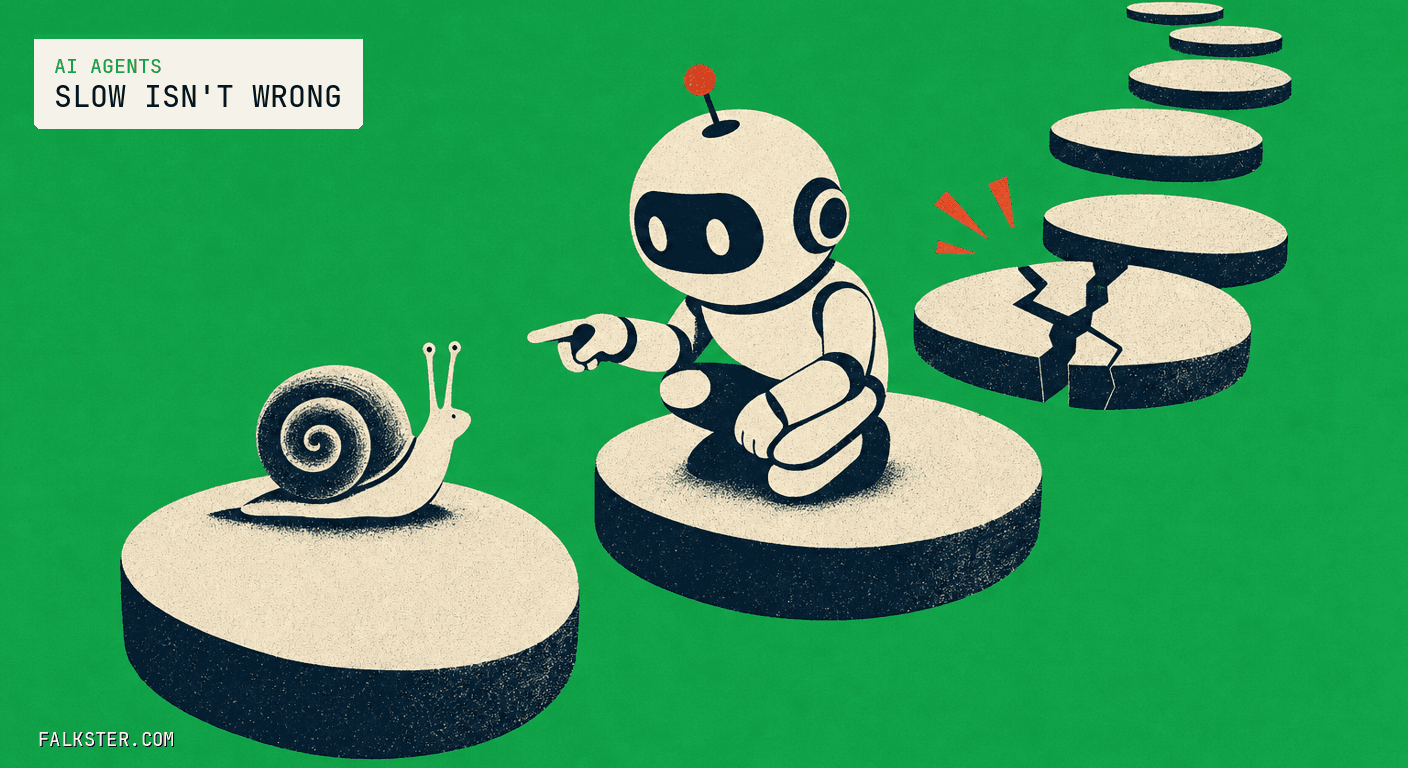
When an AI agent gets something wrong, somebody has to read its work log and find the mistake. The hope is that another agent can do the reading. This week a vendor said it can. One of its customers said it can't yet.
If you're planning next year's team around that hope, check it first. The check takes an afternoon.
The short version
- LangChain sells tools for watching AI agents.
- It says its product can read agents' work logs, find repeat failures, and propose fixes.
- Clay sells software for sales teams and is a LangChain customer.
- Clay's head of AI says models still can't find the mistake in a long log. They blame the slow step. So Clay writes fixes by hand.
- I'd keep "the agent reads the logs" off the plan until it passes a test. Give it ten failures you already solved. Count how many it gets right.
What LangChain says
Sam Crowder of LangChain published "The Agent Lake" on November 24, 2026. I read it in full. A work log, which engineers call a trace, records every step an agent took. LangChain's product for storing and reading them is called LangSmith.
The post says LangSmith takes in logs from billions of agent runs a month. It names Clay as a customer that sends hundreds of millions of events a day. Nobody can read that by hand. So LangChain built agents to do the reading.
One of them is called Engine. As the post describes it, Engine scans logs on a schedule and groups repeat failures. It finds the root cause and proposes a fix. Since its second version, it tests the fix before a person sees it. The post says Engine has analyzed more than 60 million logs.
What Clay's head of AI says
Two days later, Latent Space published an interview with Jeff Barg, Clay's head of AI. Latent Space is a publication for AI engineers. The host was Basil Chatha. I read the written summary in full and the part of the transcript on debugging. I didn't watch the video.
Chatha asked what Barg wants from the next models. His answer was a model that can look at a long log and say where the agent went wrong.
He says that doesn't work today. The model has the wrong instinct. It points at a step and says it took a long time. But a slow step is often fine, and the real mistake is somewhere else. He says feeding bad logs to an agent and asking it to improve things "just doesn't work." Clay still writes a lot of its agents' instructions by hand.
Now, to be fair. Barg didn't name Engine. He may be describing his own experiments with general models. LangChain's tool may do better. I haven't tested it, and neither post settles it.
But that's my point. Nobody should take either side on faith.
Kill the line, keep the test
The line I'd kill is on a lot of plans right now. It says the agent will read the logs for us. It's usually next to a smaller headcount number.
Take it off until it passes this.
Pick ten failures your team already solved by hand. You know the real cause of each one. Hand the logs to the auto-debugger with no hints. Then count two things. How many causes did it get right? How many times did it blame the slowest step?
That second count is Barg's warning turned into a number. If the tool blames the slow step seven times in ten, you've learned what it's really measuring.
Ten is small. It won't give you a tidy percent. It'll tell you whether to trust the tool with the next thousand.
What mine run on
My own agents run on three instruction files. The count on November 27 was 68. That many lines in those files quote a correction from me, with the date I made it. Things like "always post the blogs right away." Each one exists because a person read what the agent did and didn't like it.
68
No agent came up with those corrections. I'd love one to. I wrote about where instructions should come from in Uber's Agents Made 6x the Errors Without One Skill. Kill the Starter Library. Keep the Replay. The answer there was to start from your corrections. This post is about who finds the correction in the first place. For now, on my site, a person does.
There's one idea in LangChain's post I'd take today, test or no test. Store the result next to the log. Was the code merged? Did the customer accept the answer? A log shows what the agent did. The result shows whether it mattered. Even a perfect reader needs that to know which runs were bad. I made a related case in The Receipt Gate, where every check has to leave proof that it ran.
This week
Write down ten solved failures and the real cause of each, on one page. That page is your test. Run it on whatever tool promises to read logs for you.
This belongs with my other writing on Enterprise AI Agents: an agent is only as good as the loop that corrects it, and somebody has to prove who is doing the correcting.
Related answer: Can AI agents debug other AI agents?
Sources: "How Clay Builds GTM Agents: Jeff Barg, Head of AI," Latent Space, hosted by Basil Chatha, November 26, 2026. The written summary was read in full and the transcript's debugging section was read. The video was not watched. Sam Crowder, "The Agent Lake," LangChain, November 24, 2026, read in full. Every figure about LangSmith and Clay is as those two pieces report it. The 68 lines are a count of this site's own instruction files on November 27, 2026.
Frequently asked
Can AI agents debug other AI agents yet?+
Not reliably, by one builder's account. Jeff Barg, head of AI at Clay, says models reading a long work log tend to blame the step that took the longest, even when the mistake was elsewhere.
What does LangChain claim?+
That its LangSmith product can scan work logs on a schedule, group repeat failures, find the root cause, and propose a fix that is tested first. Its post says the tool has analyzed more than 60 million logs.
How do I test an auto-debugger?+
Take ten failures you already solved by hand. Give it the logs. Count how many causes it gets right, and how many times it blames the slowest step.
What should I do if it fails the test?+
Keep a person reading the failures and writing the corrections. Date each correction. Run the test again when the tool or the model changes.
What is worth copying from LangChain's post?+
Storing the result next to the log: whether the work was used, merged, or rejected. A reader, human or machine, needs that to know which runs were bad.
Sign in with LinkedIn to leave a comment.
Sign in with LinkedIn