
Unused research is wasted research, Jakob Nielsen wrote on November 13, and the rule he attaches is three committed fixes per readout. This is a Rewrite of one clause in that item, the one that treats every artifact besides the fix as filing.
The short version
- Jakob Nielsen's November 13, 2026 UX Roundup says unused research is wasted research: users give no credit for a research repository, tagged insights, or a 40-page findings deck, so leave every study readout with 3 committed fixes, each with an owner and a deadline, and schedule the retest before the meeting ends. The three fixes are right. The rewrite is what sits under them.
- The same roundup says findings about people keep for decades while findings about agents spoil within months, and reports a field study of 11 developers by Yi-Hung Chou and co-authors in which documentation gained a second reader, the agent.
- So the claim under each fix has a shelf life and the drawer has a reader.
- Add one row per fix: the claim, its strength, a source someone can re-open, and the date it gets re-checked.
- My creator scan has run this way for 42 reports since September 19, with a three-run expiry, and the rows that went stale were all claims about what a tool can reach.
What the item says
It is three paragraphs in a long roundup, and it is the bluntest thing in it. Users have one requirement, that the product works. They do not reward the team for a research repository, for carefully tagged insights, or for a 40-page findings deck sitting in a shared drive. Research earns its cost only when a finding turns into a shipped fix.
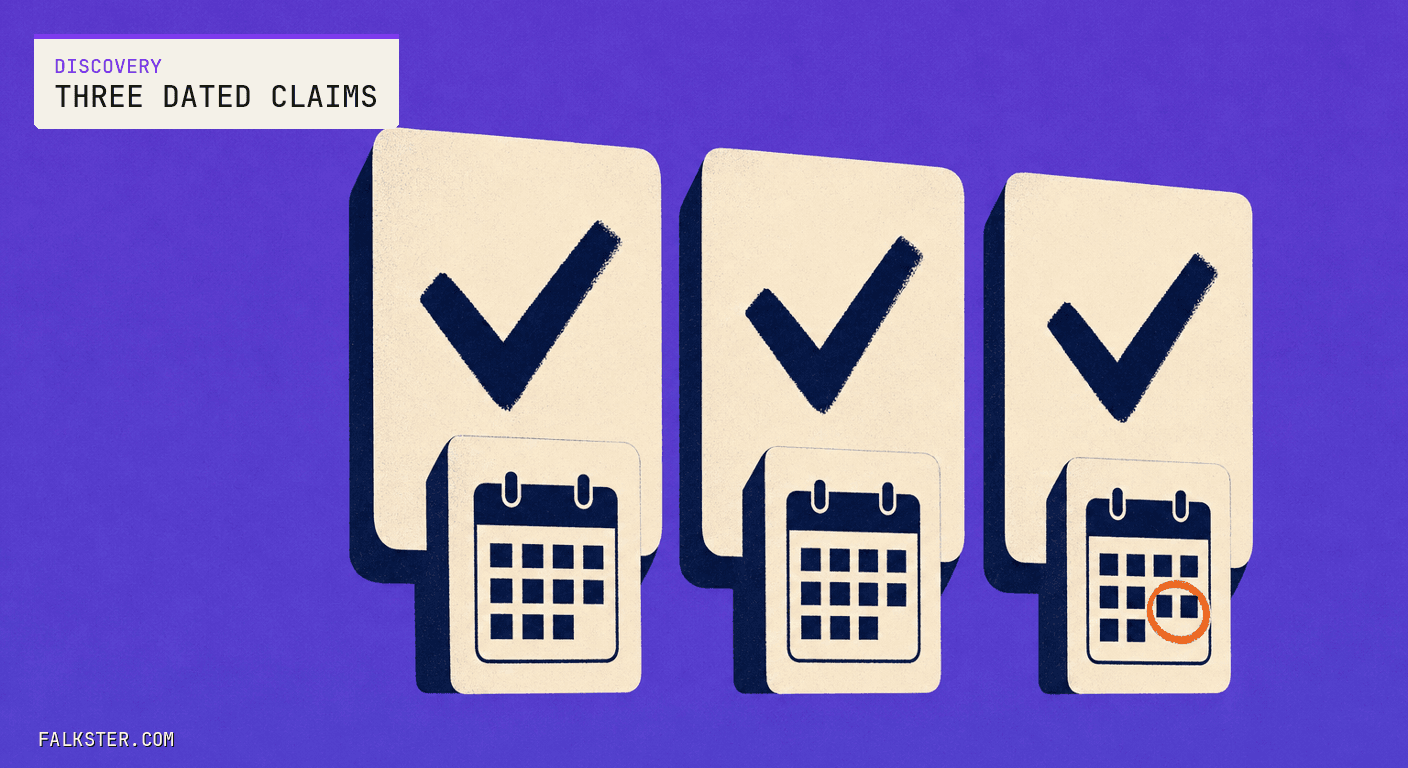
Then the rule. Leave every study readout with 3 committed fixes. Each has an owner and a deadline. The retest goes on the calendar before the meeting ends. Anything else, in his phrase, is "expensive filing."
3 fixes, 3 rows
I have sat in the readout he is describing. Forty slides, general agreement, no owner. The three-fix rule would have saved most of them. I argued a neighboring point in The Three-Call Theme Was the Renewal. Count What Landed, Not Fixes: shipping is the half the team controls, and whether the complaint stops arriving is the half it has to go back and check.
The clause to rewrite
A fix ships and stays shipped. The claim it rested on does not stay true.
Nielsen makes that case himself, earlier in the same roundup. In his advice on testing for agents he tells teams to keep testing with 5 human users and to add 5 frontier AI agents every quarter, and he gives the reason: findings about people keep for decades because human nature does not change, and findings about agents spoil within months.
So the three fixes from this quarter's readout rest on three claims, and at least some of those claims have an expiry. If the claim is about how an agent reads your checkout, the fix you shipped in November is resting on something that may be false by spring. Nobody will know, because the finding went into the drawer he told you not to maintain.
The second reason is in his report of a field study. Yi-Hung Chou and co-authors, from UC Irvine, the University of Southampton, and SAP Labs, shadowed 11 professional developers for about 90 minutes each and labeled 4,481 activity segments. One of the things they saw is that documentation now serves two readers: the people who need to understand the system and the agents that need context to work on it.
A drawer nobody opens is filing. A drawer the agent reads before it drafts the next brief is context. The cost of the row did not change. The reader did.
Three fixes and three rows
The rewrite is one line long. Under each committed fix, write the row it rests on:
Fix: owner, deadline, retest date
Claim: one falsifiable sentence
Strength: one or two instances | repeated pattern | survived a test
Source: sessions, dates, sample, link
Re-check by: date
The strength field is where honesty is hardest. Most readouts present a thing two participants did as a thing users do. The source has a bar too: "from the study" is not a source, and "six sessions, November, mid-market admins, recordings linked" is.
This is the register I describe in the design handbook chapter Evidence as an Asset(coming Dec 9), cut down to what fits on a readout slide. The date is the field that does the work. Claims about the job a person is trying to do last for years. Claims about what a model or a tool can do go stale fastest, and they are the ones teams write down once and treat as a permanent limit.
The rows that spoiled
I do not run a research team right now. I run a scan that reads the people I learn from and writes a report every morning, and it has the same problem in miniature. It has written 42 reports since September 19. Each one opens its ideas with an evidence state: what was read in full, what was read only in its public section, what was never opened. Anything left on file expires after three runs, used or not. I described the report format in Nielsen Says a Map Beats a Babysitter. Write the Map for the Next Run.
Here is what went stale in that register. None of it was about people.
A list of company blogs said three of them had no feed. A re-check on October 6 found working feeds on all three. A LinkedIn handle sat on file for one writer until someone opened it and got a 404. One profile was recorded as unreadable for weeks, behind a login wall, and this morning's run read it, because the browser the run uses had changed and the row had not.
Each of those was a claim about what a tool could reach, written down once, and believed for longer than it was true. With no date on the row, the only way any of them got corrected was by accident.
That is the argument for the row in one small system. The fixes were never the problem. I shipped those. The claims under them quietly went false, and the next run built on them anyway.
This week
Take your last readout. For each fix that came out of it, write the claim underneath in one sentence and put a re-check date on it. If the claim is about people, give it a year. If it is about a model, an agent, or an integration, give it a quarter. Then put the rows where the next brief gets written, which is increasingly where an agent will read them first.
This sits under AI Product Management: discovery did not get less valuable when building got cheap, it got easier to lose.
Related answer: Is a research repository worth keeping if nobody reads it?
Sources: Jakob Nielsen, "UX Roundup: No More Web, Social Knowledge Work, Auto-Logout, Agents in the Field, Agentic Training Video, Unused Research, Synthetic Users, Onboarding, AI Restraint," November 13, 2026, read in full. The 3 fixes, the 40-page deck, the 5 human users and 5 agents per quarter, and the 11 developers, 90 minutes, and 4,481 segments are his, the last three as he reports the study by Yi-Hung Chou and co-authors, which I did not open. The 42 reports, the three-run expiry, the three feeds found on October 6, the 404, and the profile that loaded on November 13 are from my own scan's records.
Frequently asked
What does Jakob Nielsen say about unused research?+
In his November 13, 2026 UX Roundup, Nielsen argues that research pays off only when a finding becomes a shipped fix. Users give no credit for a research repository, tagged insights, or a 40-page findings deck in a shared drive. His rule is to leave every study readout with 3 committed fixes, each with an owner and a deadline, and to schedule the retest before the meeting ends.
Where do you disagree with him?+
Only with the idea that everything besides the shipped fix is expensive filing. A fix stays shipped, but the claim it rested on has a shelf life. Nielsen's own roundup says findings about people keep for decades while findings about agents spoil within months, and it reports a field study in which documentation gained a second reader, the agent. A claim with a date and a reader is not filing. It is the input to the next brief.
What goes in the row under each fix?+
Four things: the claim in one falsifiable sentence, its strength (one or two instances, a repeated pattern, or something that survived a deliberate test), a source specific enough for a stranger to re-open, and the date it gets re-checked. Claims about people get a long date. Claims about what a model or a tool can do get a short one.
What is your own evidence that claims spoil?+
The creator scan behind this blog has written 42 reports since September 19, 2026. Each one states what was read in full, read in part, or not opened, and items left on file expire after three runs. The rows that went stale were claims about tools: three company blogs recorded as having no feed were found on October 6 to have working feeds, a LinkedIn handle on file returned a 404, and a profile recorded as unreadable for weeks loaded on November 13 after the browser changed.
Does this replace the retest Nielsen asks for?+
No. The retest checks the fix. The date on the row checks the claim. They can be the same meeting. The difference is that the retest ends when the fix passes, and the row stays open for the next team that wants to build on the same belief.

Sign in with LinkedIn to leave a comment.
Sign in with LinkedIn