
Leonard Jung at Sierra published the making of Mossy on November 9, and it is the clearest account I have read this year of a designer shipping an agent interface alone, in code, in two weeks. This is a Rewrite: the method is right, and one of its five learnings needs a sentence added.
The short version
- Jung designed Mossy, the visual for Sierra's voice agents shown at Sierra Summit, in about two weeks, with AI coding agents, in code from beginning to end, where a decade ago his studio put a team of 12 on projects of one to six months.
- He tried around 50 materials, built a tool with nine sliders, pushed each to its limit, and tuned by eye.
- His feedback list had three reactions that were taste and one that was a behavior: "I can't tell when I'm talking and when the agent is talking." The sliders fixed the taste.
- The behavior needed two new states, speaking and listening, which is the only line in the post that specifies behavior and the only one that can be tested, and the post does not say it was. The rewrite: build the tool, tune by eye, then write the rows the eye cannot grade.
- I keep five states for any AI surface, confident, unsure, refusing, waiting, and wrong; a voice visual adds speaking and listening, and the rubric row is that a person who did not build it can say which state the agent is in, within a second, by eye, graded pass or fail on 20 real exchanges with people who were not in the room, with the repair rate under it.
What Jung built, and how
Mossy is "a living ball of grass that breathes, grows, and reacts as you speak." Sierra wanted a voice visual that looked like Sierra, and Jung's starting observation is one every design lead will recognize: "Most voice interfaces are a glowing orb or a pulsing waveform," and a brand is hard to tell from the next one through an orb. Sierra's identity is nature. The logo is a pinecone seen from above. So the visual became a plant.
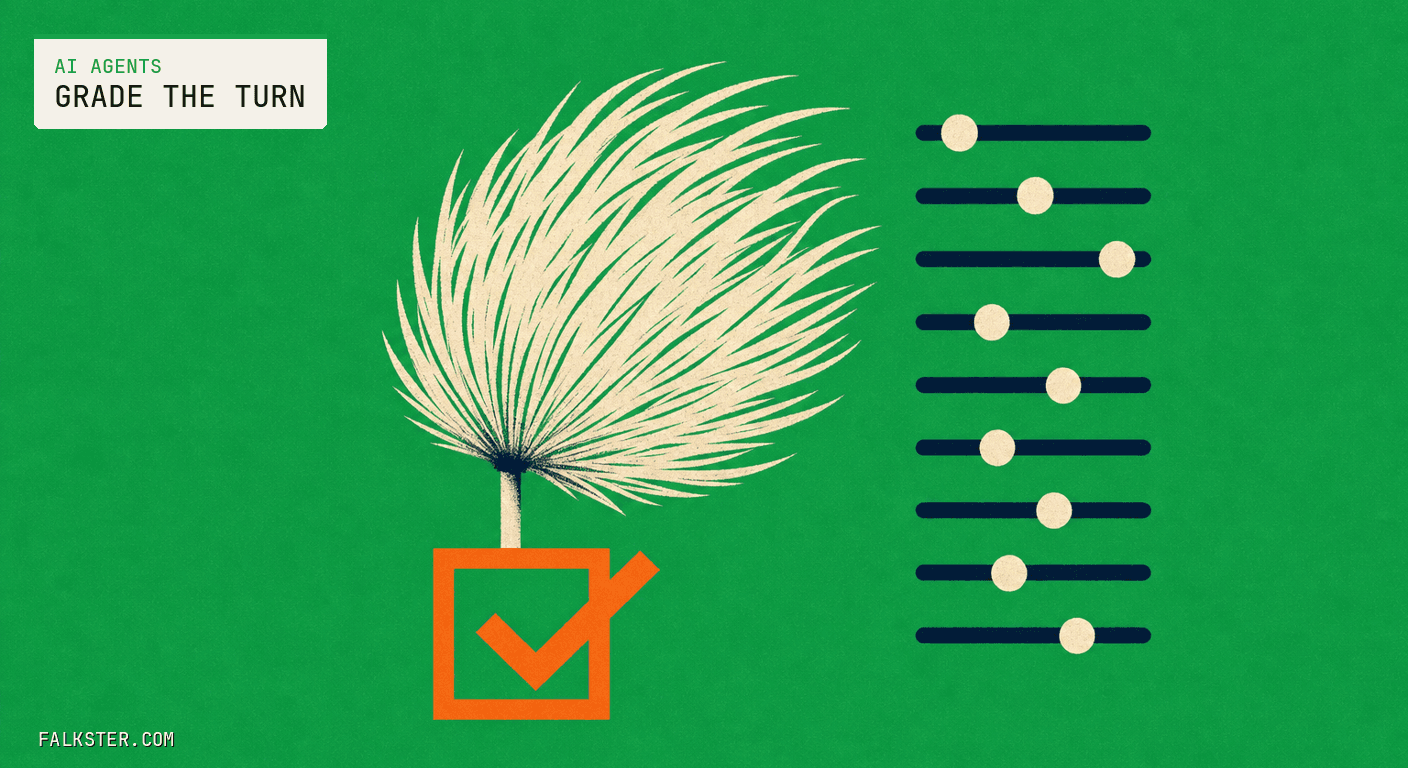
The process is the part I would hand to a design team. He tried around 50 materials: velvet, fleece, moss, grass. Moss was too dense to move visibly. Grass could bend and sway with sound. Then he built a real-time tool with nine sliders, grass length, density, color, contrast, highlights, rotation, inertia, responsiveness to sound, and how far the movement overshoots before it settles, and he pushed every one of them from bald to overgrown to find the range. Tune by eye, at speed, with the extremes visible.
He worked "in code from beginning to end," so the design went to production without a translation step from design files. Years earlier, at a design studio, the same kind of project had a team of 12 and ran one to six months. This one took two weeks alongside his other work, and his closing line on AI is the honest one: more options did not make the decisions easier, "it made judgment critical."
That is the Design Operating Model's spine, design moving from producing artifacts to specifying behavior, happening at a company falkster.com already covers for its pricing and its growth. I have no argument with the method.
The feedback list
Read the four reactions Jung quotes.
"It's okay." "Obsessed." "Why does it look like a virus?" And: "I can't tell when I'm talking and when the agent is talking."
The first three are taste. They are useful, and the tool he built is the right instrument for them: the virus comment sent him back to the sliders, he softened the grass and added small flowers, and Mossy read as a plant again.
The fourth is not taste. It is a failure with a cost. A person on a voice call who does not know whose turn it is talks over the agent, or waits when they should speak, or hangs up. No slider fixes that, and Jung did not reach for one. He added behavior. When Mossy is speaking it rotates slightly and its grass moves in different directions. When it is listening it pulls back and gently pulses, leaving room for the person.
That is the design. It is the line in the post that an engineer can implement from, that a reviewer can check, and that a user depends on. It is also the only one of the four that specifies behavior, and the post says nothing about how it was tested, with whom, or against what.
The rewrite
Jung's second learning is "build the tool, then tune by eye." His third is "look for the feedback you can act on." Both are right as far as they go. The sentence to add is this: tune by eye, then write the rows the eye cannot grade.
In 84,000 Chats Show When Users Re-Ask the AI. Design Should Own the Repair Rate. I argued that when the output cannot be predicted, the design is the states around the answer, and I keep five: confident, unsure, refusing, waiting, and wrong. A voice visual has at least two more, because nothing else about it matters until the person knows whose turn it is. Speaking. Listening.
The rubric row for the pair is one sentence. A person who did not build it can say which state the agent is in, within a second, by eye alone. Pass or fail, on 20 real exchanges, with people who were not in the room when the sliders were set. That is the same page I use instead of a PRD, described in Lenny Counts 3.8 Open PM Roles per Designer. Kill the Ratio. Count the Surfaces With a Rubric.: three to five criteria, at least 20 test cases, graded pass or fail per dimension, and the design handbook's The Rubric Is the Spec says why the pass or fail matters, because a five-point scale lets two reviewers write 3 for different reasons and believe they agreed.
Under the row goes the number: the repair rate for voice, how often the person talks over the agent, asks it to repeat, or restarts. Read weekly, by surface, owned by design.
The reason this matters more than it sounds is in Jung's own account. The turn-taking fix came from one comment. One person in his feedback loop said it, and he was good enough to hear it as a behavior rather than a taste. The next designer, on the next voice surface, may not get that comment, because the people in the room already know whose turn it is. The row is how the fix survives the designer who made it, which is what Specifying Behavior calls a constraint: what is always true of the product, the observable moment it failed, and who catches it.
The Enterprise AI Agents thesis is that agent count is a vanity metric and what matters is how many still complete production work after ninety days. A voice agent whose user cannot tell when to speak does not complete the work, however good it looks, and the interface is where that failure shows up first.
This week
If your team ships a voice or chat surface: write the speaking and listening row, grade 20 real exchanges with five people who have never seen it, and put the pass rate next to the design. If it fails, you have found what Jung's one commenter found, before launch instead of after. Then go back to the sliders.
Related answer: How do you test turn-taking in a voice agent interface?
Sources: Leonard Jung, "Meet Mossy: designing a voice you can see," Sierra blog, November 9, 2026, read in full; every statement about Mossy, the 12-person studio, the two weeks, the 50 materials, the nine sliders, and the four quoted reactions is as Jung wrote it. The five states, the repair rate, the 20 test cases, and the pass-or-fail rule are my own, from the posts and chapters linked above.
9 sliders
Frequently asked
What is Mossy, and how did Sierra build it?+
Mossy is the visual for Sierra's voice agents, shown at Sierra Summit in November 2026: a ball of grass that breathes, grows, and moves as you speak, chosen because most voice interfaces are a glowing orb or a pulsing waveform. Leonard Jung designed it in about two weeks alongside other projects, working with AI coding agents in code from beginning to end, so it shipped without being translated from design files. He tried around 50 materials and built a real-time tool with nine sliders to tune it by eye.
What was the one piece of feedback that changed the behavior?+
Someone said they could not tell when they were talking and when the agent was talking. The other quoted reactions ('It's okay,' 'Obsessed,' 'Why does it look like a virus?') were taste and the sliders handled them. This one needed new behavior: when speaking, Mossy rotates slightly and its grass moves in different directions; when listening, it pulls back and gently pulses. It is the only line in the post that specifies behavior and the only one that can be tested.
What is the rewrite of 'build the tool, then tune by eye'?+
Build the tool, tune by eye, then write the rows the eye cannot grade. Tuning by eye finds the look. The states a person depends on, speaking and listening, need a rubric row with a pass or fail: a person who did not build it can say which state the agent is in, within a second, by eye alone, graded on 20 real exchanges with people who were not in the room.
What are the five states, and why does a voice visual get two more?+
For any AI surface I keep five: confident, unsure, refusing, waiting, and wrong, because the design is the states around an answer that cannot be predicted. A voice visual adds speaking and listening, because the person has to know whose turn it is before anything else about the interface matters. Mossy's fix is those two states; the rubric row is what makes them a spec.
What is the repair rate for a voice interface?+
The share of exchanges where the person talks over the agent, asks it to repeat, or restarts. In chat, the repair rate is how often users re-ask or rephrase, read weekly by surface and owned by design. In voice, the turn-taking states are the first thing it measures.
Does this disagree with Jung's post?+
With one of its five learnings, 'look for the feedback you can act on.' The feedback he acted on was right. The disagreement is that the turn-taking fix deserves more than one comment's worth of evidence: a written row, a pass or fail, and real people who were not in the room. The rest of the post, the tool, the extremes, shipping in code, is the Design Operating Model's spine happening at a company I already write about.
Sign in with LinkedIn to leave a comment.
Sign in with LinkedIn