
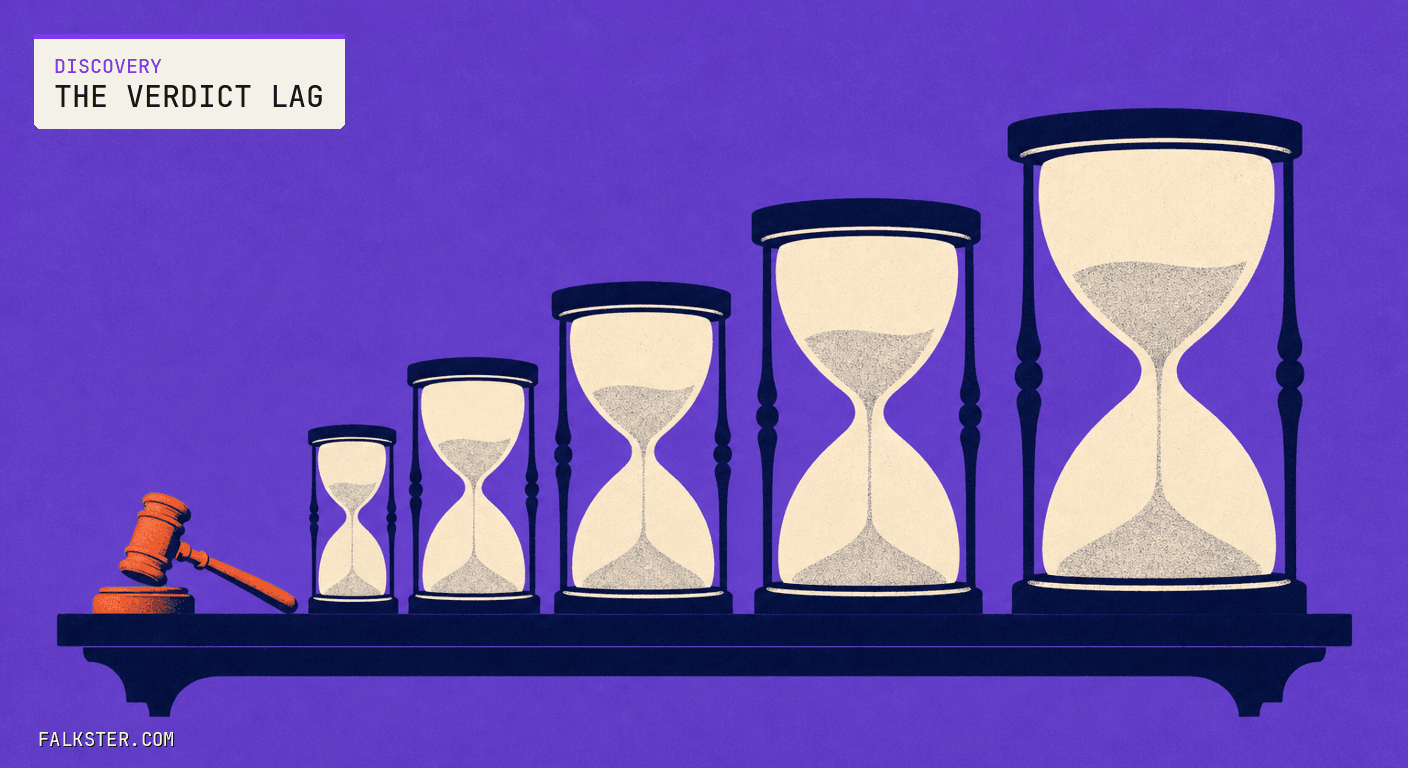
AI tools can now write working code for hours without help. They are much weaker at design work. That gap shapes how design and product teams plan the next year.
This is a Rewrite of one estimate about that gap. The estimate treats the gap as a date to wait for. I think it's a list a team can work on now.
The short version
- AI is better at coding than at design. A new analysis says the reason is checking. A machine can test code in seconds. Only people using a design can judge it, and that is slow.
- Jakob Nielsen, a well-known usability researcher, estimates that design is about a year behind coding. I'd rewrite that.
- The year is the time it takes to learn if a design choice was right.
- That time is different for each choice, and a team can shorten it. List your design decisions. Write how long each one takes to check.
- Then shorten the slow ones with a scoring sheet that design writes.
What Nielsen wrote
Nielsen made the estimate in his roundup of November 23, 2026. I read that item in full. He builds on a report from Model Evaluation and Threat Research (METR), a group that measures what AI models can do. I didn't open METR's report, so the figures here are as he gives them.
METR tracks how long a task an AI model can finish alone. It counts the task in hours of expert human work. The model has to succeed half the time. Nielsen reports that this length doubles about every 3.6 months.
The new part is a split. METR sorted tasks by how costly they are to check. On the hard-to-check tasks, AI handles tasks about a third as long. Nielsen works that out to about 5 months behind. Both groups improve at about the same pace.
about 5 months
Then he adds a step of his own. Design work, he says, is harder to check than even METR's hard tasks. He guesses it costs one more doubling. He is open that nobody has measured this. That adds about 4.6 months. He rounds the total up to about a year.
His advice has three parts. Study your developers, since their work today is your work next year. Make design quality easier to check. And don't wait out the year.
Where I'd rewrite it
"Design is coding plus a year" is one number for a whole field. Nielsen's own reasoning points somewhere more useful. The delay comes from the cost of checking. That cost isn't the same across design work.
He gives the examples himself. A quick study with 5 users takes days. Sales data tells you which problems matter weeks later. The market grades a roadmap a year later.
So here is the same idea as a table. Look at how far apart the last column runs.
| Design decision | Who gives the verdict | How long it takes |
|---|---|---|
| Text contrast, spacing, and component rules | A machine | Seconds |
| Does this prototype meet the scoring sheet? | A sheet with test cases | Minutes |
| Is this checkout flow better? | Five users | Days |
| Which usability problems matter most? | Sales data | Weeks |
| Was the roadmap right? | The market | A year |
Four of those rows come from Nielsen's examples. The second row is mine.
Read that way, there is no single lag. Each design decision is coding plus the length of its own verdict. The top rows are already where developers are. The bottom row may not get there for years.
How a team shortens a verdict
The second row is the one a team can add. It needs a scoring sheet, which designers often call a rubric.
I wrote about the sizes in Figma's Trial Closed 70% of the PM Gap. The Gate Is the Rubric, Not the Designer.. The sheet is one page. It has three to five things to score and at least twenty test cases. The prototype it scores takes four to six hours to build.
Design writes the sheet. The design handbook chapter The Rubric Is the Spec explains why. Taste that lives in one person's review meeting can only cover what that person has time to look at. A sheet lets the same taste run without them in the room.
That turns a wait for a designer, which can take days, into a score that takes minutes. It also gives an AI tool something to be checked against, which is the thing Nielsen says it lacks.
A sheet doesn't replace users. It's a guess about what users want, and the guess needs testing. But some of that testing got faster too. In 3,470 Ancestry Shoppers Wrote Back to an AI. Discovery Is a Daily Signal Now. I wrote about software that asks every customer who leaves why they left. Those answers come back the same week.
Some verdicts won't shorten. Nobody can speed up the market's view of a roadmap. That's fine. The point of the list is to know which rows are which.
What to do with the list
Nielsen puts "make design easier to check" second of his three tips. I'd put it first, and I'd do it one decision at a time.
Hand AI the rows with short verdicts first. Keep your people on the rows with long ones. Then move one row up the table each quarter.
Watching the engineers tells you what is coming. The length of your verdicts decides when it reaches you.
This week
Pick one design decision your team made last month. Write down how long it took to learn if it was right. If the answer is "we never found out," start there. This sits in AI Product Management because the checking is shared work between design and product.
Related answer: Why is AI worse at design than at coding?
Sources: Jakob Nielsen, "UX Roundup: What's UX? | UX Trails Developers in AI," Jakob Nielsen on UX, November 23, 2026. I read the item on design trailing coding in full. The 3.6 months, the 5 months, the 4.6 months, and the year are as he gives them. He credits the underlying data to METR's capability update, which I did not open. "About a third as long" is my rounding of his 2.9 times shorter. The sheet sizes are from my own earlier post.
Frequently asked
Why is AI better at coding than at design?+
As Jakob Nielsen reports data from the research group METR, AI improves fastest where a machine can check the work. Code has tests that pass or fail in seconds. Design is judged by people using it, which is slower and costs more.
How far behind is design?+
Nielsen reports that AI is about 5 months behind on hard-to-check tasks. He then guesses that design is harder still to check and rounds up to about a year. He says nobody has measured that last step.
What do you mean by the length of the verdict?+
The time it takes to learn whether a design choice was right. A rule about text contrast gets a verdict in seconds. A five-user study takes days. A roadmap takes a year.
How does a team shorten a verdict?+
By writing down what good looks like in a form that can be scored. I use a one-page scoring sheet with three to five criteria and at least twenty test cases. Design writes it.
Does a scoring sheet replace testing with users?+
No. The sheet is a guess about what users want. It still has to be checked against real users. It moves the everyday calls from days to minutes.
Sign in with LinkedIn to leave a comment.
Sign in with LinkedIn