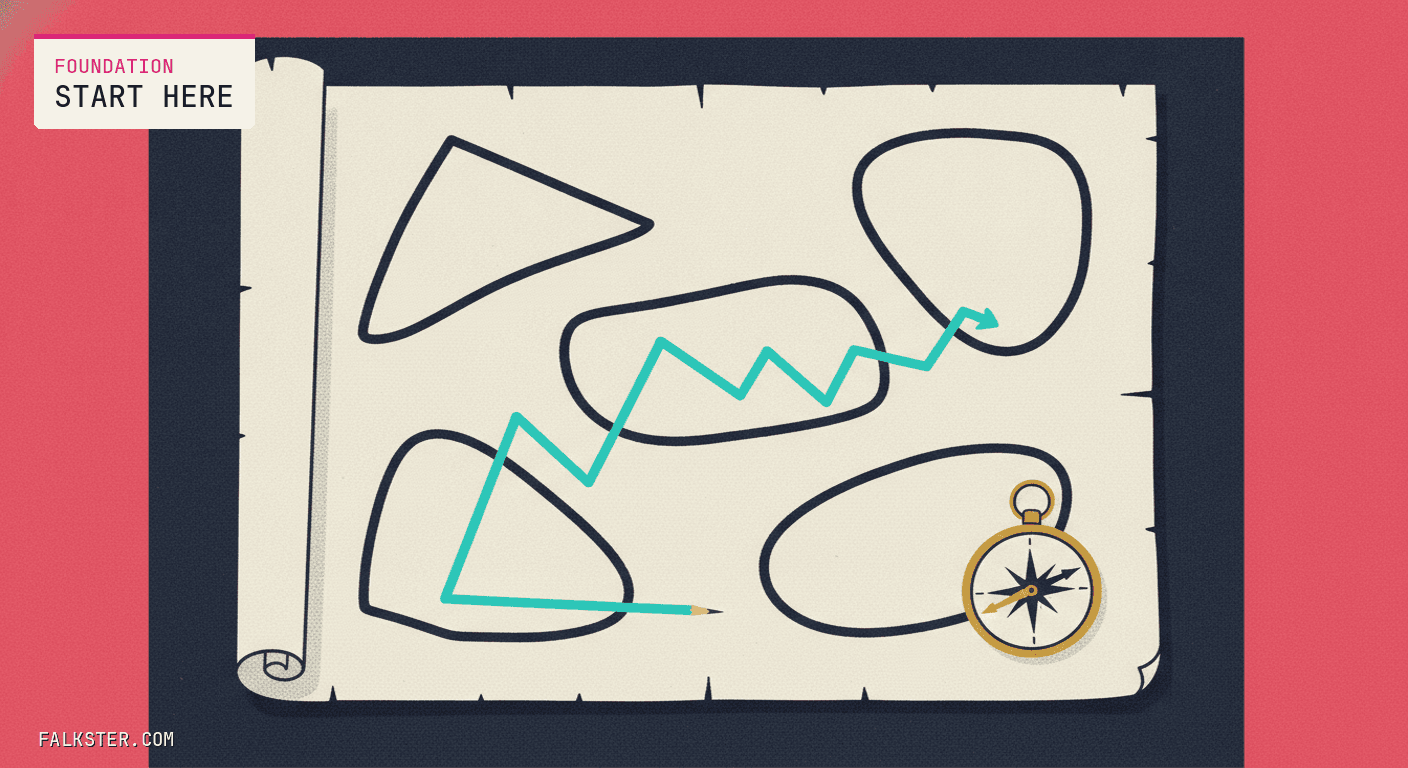
Someone asked me last week where to start on this site. I gave them three links and realized afterward that I had never written the map. Two hundred and sixty-seven posts, a handbook, a couple hundred answers, a toolkit, a corpus, and no page that says what any of it is for.
So this is that page. It's written for a reader arriving cold, and for a reader who has been here a while and only ever saw one corner. It is also, I'll admit, the most self-referential thing I've published, so I'll keep the claims to what's countable and let the links do the persuading.
The short version
Everything on falkster.com was written from one seat: a product leader building an AI company, writing down what changes while it changes. The Field Log holds 267 posts in a handful of categories, each aimed at a different reader. Leadership is the operating model for the people running product orgs through this. The agent blueprints are working programs that do slices of PM work. Foundation is what the platforms and the big companies are actually doing. Execution is the craft of evals and prototypes. Discovery is research when your users are behind agents. Templates are things you fill in. Above the posts sits the Product Builder OS handbook in six waves, the Design Operating Model, 203 one-question answers in five pillars, 115 templates, and the Corpus, the whole practice as one file for your own AI. The thread through all of it is AI as a cause, not a topic: building got cheap, and judgment, landing, and reading did not. Every category is an answer to some version of that.
Why there is a category system at all
The site started as a blog and grew like one, which is to say by accretion. Somewhere past a hundred posts the newest-first list stopped being a way to find anything. The categories, the collections, the handbook, and the answers all exist because a pile is not a body of work until someone draws lines through it.
The lines are by reader, not by subject. That's the one design decision worth explaining. A post about evals could be filed under AI, or Execution, or Leadership, depending on who I imagined reading it. I file it by who it's for. So the same argument shows up in the Leadership category as "here's how to run the org" and in Execution as "here's how to build the eval," and that's intentional. Nobody reads a whole site. People read their corner and occasionally wander.
The Field Log, category by category
Leadership, 91 posts. The largest category and the spine of the site. This is the operating model: what replaces the PM ladder when the deliverables are gone, why outcome accountability is a luxury good at agent velocity and what to measure instead, why nobody is reading anything in an org that made generation free, why Cagan's definition is right and the weights are wrong. Written for CPOs, VPs, and heads of product who have to run a team through this rather than admire the tools. The AI angle is never the model; it's what the model did to the economics of the org. If you lead product and read one category, read this one.
Agent blueprints, 44 posts, plus the AI Agents category, 14. The opposite end of the abstraction ladder. Each blueprint is a small program that does one slice of PM work on its own: the KPI watchdog, the auto bugfix agent that turns a Zendesk ticket into a reviewable pull request, the launch comms agent, the direction dashboard. Prompt, wiring, failure modes, what it cost. The AI Agents category around them is the honest layer: 39 agents deployed, what stuck, what died, ten I built that failed, and the performance review where three got fired. For PMs and engineers who want to build rather than read about building. These are the posts most likely to be forked, and the collection page puts them in build order because every agent in the fleet is some shape of the same loop.
Foundation, 30 posts. Where I read the industry. Salesforce put its CRM inside Claude and then named the harness. Harvey cracked big law. SpaceX bought Cursor. The landing ledger, where build cost fell and land cost didn't. The forward deployed engineer as the Product Builder wearing a visitor badge. Written for founders, executives, and investors whose strategy depends on what the platforms do next, and for anyone who wants the move behind the announcement. The AI angle here is structural: who ends up as the layer underneath, who keeps the record, who owns the observation trace.
Execution, 26 posts. The craft. Evals before volume, how I build eval rubrics, the wince is the spec, rank AI features by downside exposure instead of engagement, the week the prototype beat the spec, reversible versus irreversible bets. For Product Builders and the engineers next to them, the people who ship. If Leadership is the why, this is the Tuesday morning how.
Discovery, 14 posts. Research when the user is changing shape. AI can't understand the user, and that user is disappearing. Prompt logs are the new switch interview. Customer discovery when your customer is an agent. Survivorship bias, which was a problem before AI and is a worse one now. For PMs and researchers. The smallest of the big categories and, I think, the one where the field has the most unanswered questions.
Templates, 11 posts, and the Toolkit behind them. Things you fill in. The one-pager that replaced our PRDs, the decision log, the exec update, the board slide kit, the AI Eval Starter Kit. The posts explain; the toolkit page holds the 115 actual files. For everyone, and especially for the reader who has no time for the argument and wants the artifact.
The smaller shelves. Frameworks (the PRD collapsed into three artifacts, a prototype in sixty minutes). Scripts and prompts (Claude skills every PM should build, a customer feedback pipeline in one afternoon). Checklists. The five real-world playbooks, sanitized stories from actual decisions. And the Kill the… collection, six arguments for retiring a ritual that solved a problem you no longer have, starting with the PRD.
Above the posts
The posts are the notebook. Four things sit above them and turn the notebook into something you can use without reading it in order.
The Product Builder OS. The handbook: 49 chapters in six waves. Wave one is the thesis, old PM versus Product Builder, the kill list, why any of this exists. Two is discovery. Three is build and ship, including the eval is the spec and building evals. Four is AI craft, the agent fleet and direction metrics and gross margin as your job now. Five is leading the shift, the 30/60/90s, the cannibalization decision, dual transformation. Six is the forward deployed engineer, seven chapters on the role, the transition, the economics, and the org. The Standard that sits on top of it is the six-skill definition of the role, revised in September. The CPO page is the four theses I'd put in front of a board.
The Design Operating Model. The design handbook, for design leaders making the same move from producing artifacts to specifying behavior. Written because design is the discipline most changed by generation-speed tooling and the one with the least new thinking about it.
The Answers. One narrow question per page, 203 of them, in five pillars: The Rewrite (what the role becomes), Kill List (what to stop), Agent Drops (what I built), Ship Stories (what happened), and Field Notes (what I'm seeing). They exist because most people arrive with a question, not a reading list, and because an agent looking something up deserves a direct answer too. The topic hubs group them under the five arguments the site keeps making.
The Corpus. The whole practice as one file. Load it into Claude or whatever you use and ask it questions in my voice, argue with it, or use it as context for your own writing. It's rebuilt every time content changes. This is the part of the site I'd point an agent at.
The newest thing
The FDE Transition started this week: two parts a week on what has to happen between forward deployed engineers, product, engineering, sales, and leadership for the role to work, each written against that week's findings. It's for the people in the seat and the people building teams of them, and it's the first series here designed to stay current rather than to be finished. Part 1 is the thesis. Part 2 is why the shortage everyone is talking about is a product problem.
The thread
If you read across categories you'll notice the same argument wearing different clothes. Building got cheap. Judgment did not. Landing did not. Reading did not. Every category is a response to that from a different seat: the CPO measuring direction because outcomes lag, the builder writing the eval before the prompt, the FDE who needs a harness to be effective, the designer specifying behavior instead of screens, the founder watching platforms fight to be the layer underneath.
Falkster.AI, the company behind the site, is built on the same premises, and the ship stories are from that work, failures included. I mention it because it's where the arguments come from, not because there's anything to buy at the end of this post. There isn't. The notebook is the product of the work, not a funnel for it.
Where to start, by seat
If you lead product: the Leadership category, starting with outcome accountability, the ladder, and nobody is reading anything, then wave five of the handbook and the CPO page.
If you're a PM becoming a Product Builder: the handbook from wave one, then the Execution posts on evals, then one agent blueprint you can run this week. The Builder PM career collection is the ladder.
If you're a forward deployed engineer or building an FDE team: the series, then wave six.
If you lead design: the Design Operating Model, start to finish.
If you're an engineer who now owns outcomes: the agent blueprints and the harness posts in Foundation.
If you're a founder or an executive: Foundation, and the Corpus loaded into your own AI so you can argue with it.
One thing to try this week: pick one category that is not your seat and read the three most recent posts in it. The useful arguments are usually the ones written for someone else.
Sources: Every count in this post is a count of files in the falkster.com repository on the day of writing: 267 posts, 49 handbook chapters, 203 published answers, 115 toolkit templates, 44 agent blueprints. They go up most weeks.
Part of the running argument on AI Product Management: the job did not get smaller, it got reorganized, and so did this site.
Related answer: Where should I start reading falkster.com?
Frequently asked
What is on falkster.com and how is it organized?+
As of September 2026: 267 blog posts in the Field Log, organized by category (Leadership, agent blueprints, Foundation, Execution, AI Agents, Discovery, templates, and a few smaller ones); a 49-chapter handbook called the Product Builder OS, in six waves from the thesis to forward deployed engineering; the Design Operating Model for design leaders; 203 answers, one narrow question per page, in five pillars; a toolkit of 115 working templates; and the Corpus, the whole practice as one file you can load into your own AI. Plus curated collections, including The FDE Transition series.
Who is falkster.com for?+
Product leaders and the people building around them in the AI era: CPOs and heads of product running the transition, PMs becoming Product Builders, forward deployed engineers and the leaders building FDE teams, design leaders, engineers who own product outcomes, and founders whose strategy depends on what the platforms do next. Each category was written with one of those seats in mind, and the map says which.
What is the relationship between the site and AI?+
AI is the thread through everything, but as a cause rather than a topic. Building got cheap; judgment, landing, and reading did not. The Leadership posts are about running an org under that condition, the blueprints are agents that do PM work, the Execution posts are the craft of evals and prototypes, Discovery is research when users sit behind agents, Foundation is what the platforms are doing, and the handbook is the operating model that ties them together. Falkster.AI, the company behind the site, is built on the same ideas, and the ship stories are from that work.
Where should I start if I am a CPO or head of product?+
The Leadership category, beginning with Outcome Accountability Is a Luxury Good, What Replaces the PM Ladder, and Nobody Is Reading Anything, then the handbook's Lead the Shift wave and the CPO page. The board and QBR templates in the toolkit are the practical companions.
Where should I start if I am a forward deployed engineer?+
The FDE Transition series, starting with the thesis that the FDE is the Product Builder arriving from services, then part 2 on why the shortage is a product problem. The handbook's sixth wave has the seven FDE chapters underneath, and new parts of the series arrive Tuesday and Thursday.
Where should I start if I am a PM or an engineer who wants to build?+
The handbook from wave one, then the Execution posts on evals and prototypes, then the agent blueprints. The AI Eval Starter Kit and the one-pager template in the toolkit are the first two things to actually use.
Is this a course or a newsletter?+
Neither. It is a working notebook kept in public by one product leader while building an AI company. There is no gate, no drip sequence, and nothing behind a form. The Corpus exists so you can take the whole thing into your own tools.

Comments (0)
Sign in with LinkedIn to leave a comment.
Sign in with LinkedIn